
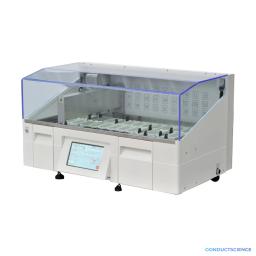
Slide Dryer(Hot Plate)
$1,399.00
Research data · Pathology
The tissue named most often is tumors, in 62% of the 8,230 papers from 2011 to 2025 whose Methods name a slide stainer and a tissue.
Humans lead the species, named in 61% of the 8,236 papers that name a slide stainer and a species.
Tissues and species in papers that name a slide stainer
Each bar is a share of the papers that name a tissue, or of those that name a species. A paper can name more than one of each.
Tissues, of 8,230 papers
Species, of 8,236 papers
| Tissue | Papers | Share |
|---|---|---|
| Tumors | 5,126 | 62% |
| Lymphoid organs | 771 | 9% |
| Brain and spinal cord | 770 | 9% |
| Reproductive organs | 739 | 9% |
| Lung | 605 | 7% |
| Gut | 581 | 7% |
| Liver | 538 | 7% |
| Kidney | 376 | 5% |
| Skin | 336 | 4% |
| Heart and vessels | 249 | 3% |
| Bone and cartilage | 237 | 3% |
| Pancreas | 212 | 3% |
| Muscle | 206 | 3% |
| Bone marrow | 109 | 1% |
| Eye | 109 | 1% |
| Embryos and larvae | 96 | 1% |
| Fat | 63 | 1% |
| Nerves and ganglia | 63 | 1% |
| Plant tissue | 47 | 1% |
| Teeth | 26 | under 1% |
| Species | Papers | Share |
|---|---|---|
| Human | 5,005 | 61% |
| Mouse | 2,387 | 29% |
| Rat | 360 | 4% |
| Other mammals | 164 | 2% |
| Dog | 114 | 1% |
| Rabbit | 110 | 1% |
| Pig | 89 | 1% |
| Monkey | 85 | 1% |
| Sheep and goats | 65 | 1% |
| Zebrafish | 44 | 1% |
| Cattle | 37 | under 1% |
| Birds | 32 | under 1% |
| Plants | 26 | under 1% |
| Other fish | 19 | under 1% |
| Flies | 6 | under 1% |
| Frogs and amphibians | 2 | under 1% |
11,665 papers from 2011 to 2025 name a slide stainer. In 2011 to 2015, 20.8 of every 10,000 research articles named one. In 2021 to 2025, 22.5 did.
Papers that name a slide stainer, per 10,000 research articles
Per 10,000 research articles with a Methods section in PubMed Central's open-access set, each counted once.
| Year | Papers that name a slide stainer | Research articles read | Per 10,000 |
|---|---|---|---|
| 2011 | 203 | 118,435 | 17.1 |
| 2012 | 303 | 144,042 | 21.0 |
| 2013 | 351 | 173,400 | 20.2 |
| 2014 | 408 | 193,750 | 21.1 |
| 2015 | 490 | 216,043 | 22.7 |
| 2016 | 598 | 239,533 | 25.0 |
| 2017 | 630 | 261,864 | 24.1 |
| 2018 | 642 | 284,305 | 22.6 |
| 2019 | 769 | 324,746 | 23.7 |
| 2020 | 930 | 416,410 | 22.3 |
| 2021 | 1,202 | 511,108 | 23.5 |
| 2022 | 1,306 | 578,059 | 22.6 |
| 2023 | 1,194 | 525,881 | 22.7 |
| 2024 | 1,269 | 554,710 | 22.9 |
| 2025 | 1,370 | 642,986 | 21.3 |
Of the 11,665 papers from 2011 to 2025 that name a slide stainer, 5,876 also name H&E staining. From 2021 to 2025, 543.4 of every 10,000 research articles named H&E.
Papers that name H&E staining, per 10,000 research articles
| Year | Papers that name H&E | Research articles read | Per 10,000 |
|---|---|---|---|
| 2011 | 5,699 | 118,435 | 481.2 |
| 2012 | 7,377 | 144,042 | 512.1 |
| 2013 | 9,076 | 173,400 | 523.4 |
| 2014 | 10,334 | 193,750 | 533.4 |
| 2015 | 11,547 | 216,043 | 534.5 |
| 2016 | 13,250 | 239,533 | 553.2 |
| 2017 | 15,150 | 261,864 | 578.5 |
| 2018 | 15,286 | 284,305 | 537.7 |
| 2019 | 17,543 | 324,746 | 540.2 |
| 2020 | 22,192 | 416,410 | 532.9 |
| 2021 | 27,174 | 511,108 | 531.7 |
| 2022 | 30,518 | 578,059 | 527.9 |
| 2023 | 27,693 | 525,881 | 526.6 |
| 2024 | 30,286 | 554,710 | 546.0 |
| 2025 | 37,183 | 642,986 | 578.3 |
Our guide to H&E staining of paraffin sections walks through the stain step by step.
The Oil Red O and Nissl pages show how often papers name those stains and how they cut the stained sections.
FDA puts slide stainers in Class I and exempts them from 510(k) premarket notification (21 CFR 864.3800, automated slide stainer).
FDA holds 1,453 reports about slide stainers received from 2003 to 2026. FDA's most common problem code for them, in 876 reports, is "Incorrect, Inadequate or Imprecise Result or Readings". A report can carry more than one code.
These counts reflect how often makers and users file reports, not how often instruments fail.
US federal labs paid a median of $30,391 for a slide stainer. Across 45 purchases in the fiscal years 2016 to 2026, the middle half of purchases ran from $13,400 to $97,504 a unit. The Department of Veterans Affairs made 67% of the purchases of slide stainers. Our listed prices for a slide stainer run from $5,690 to $22,000, up to each product’s most expensive option. Federal labs also bought 51 service contracts on slide stainers, at a median of $20,499 each.
$1,399.00

From $5,690.00
$22,000.00

$3,400.00

$1,200.00

$1,260.00
