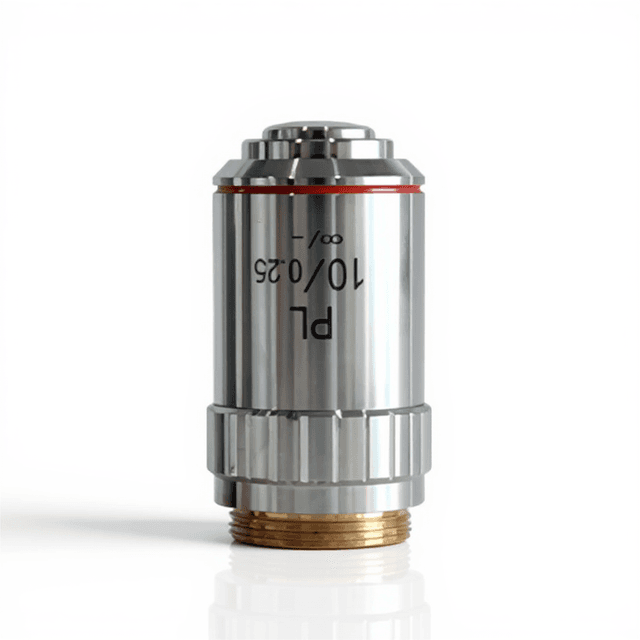
195mm Achromatic Biological Microscope Objective lens with RMS 20.2mm Interface with 4X, 10X, 40X, 100X
Four-piece achromatic microscope objective set (4X, 10X, 40X, 100X) with RMS threading for brightfield biological microscopy applications.
| Automation Level | manual |
| Product Type | Objective Lens |
| Application | Clinical Research, Life Science |
| Skill Level | Entry Level |
| Objective Type | Biological, Finite (195mm), Plan Achromatic |
| Brand | ConductScience |
This 195mm achromatic biological microscope objective lens set provides four magnification options (4X, 10X, 40X, 100X) with standard RMS 20.2mm threading for brightfield microscopy applications. The achromatic design corrects for chromatic aberration across the visible spectrum, delivering sharp contrast for routine biological specimen examination. Each objective features a numerical aperture of 0.10 and is optimized for 160mm tube length with 0.17mm cover glass thickness.
The spring-free construction ensures consistent focal positioning during specimen examination. These objectives integrate with standard biological microscopes using RMS threading, making them suitable for educational laboratories, clinical diagnostics, and research facilities requiring reliable brightfield imaging capabilities.
How It Works
Achromatic objectives utilize a two-lens design combining crown and flint glass elements to correct chromatic aberration. The crown glass element provides the primary magnification while the flint glass element compensates for the dispersion of different wavelengths, bringing red and blue light to the same focal point. This correction significantly reduces color fringing and improves image contrast compared to simple single-lens systems.
The RMS (Royal Microscopical Society) threading system ensures precise mechanical coupling with the microscope nosepiece, maintaining parfocal relationships between objectives. The 160mm tube length specification defines the optical path distance from the objective's back focal plane to the eyepiece focal plane, ensuring proper image formation and magnification calculations.
Each objective's numerical aperture of 0.10 determines the light-gathering capacity and resolution limits. Combined with the 0.17mm cover glass correction, these objectives optimize image quality for standard prepared slide specimens in biological applications.
Features & Benefits
Automation Level
- manual
Product Type
- Objective Lens
Application
- Clinical Research
- Life Science
Skill Level
- Entry Level
Objective Type
- Biological
- Finite (195mm)
- Plan Achromatic
Brand
- ConductScience
Research Domain
- Cell Biology
- Clinical Diagnostics
- Developmental Biology
- Food Science
- Materials Science
- Microbiology
Weight
- 1.9 lbs
Dimensions
- L: 4.9 in
- W: 6.6 in
- H: 6.6 in
Comparison Guide
| Feature | This Product | Typical Alternative | Advantage |
|---|---|---|---|
| Chromatic Correction | Achromatic design correcting for two wavelengths | Entry-level objectives often use simple lens designs with minimal correction | Reduces color fringing and improves contrast for accurate specimen visualization |
| Magnification Range | Complete 4-objective set (4X, 10X, 40X, 100X) | Individual objectives or incomplete sets with fewer magnifications | Provides comprehensive magnification coverage for survey to detailed examination in one purchase |
| Threading Standard | RMS 20.2mm threading | Proprietary threading systems limit microscope compatibility | Ensures broad compatibility with standard biological microscopes across manufacturers |
| Tube Length | 160mm tube length optimization | Infinity-corrected systems require additional tube lenses | Direct compatibility with finite tube length microscopes without additional optical components |
| Mechanical Design | Spring-free construction with 23.7mm length | Spring-loaded objectives with variable lengths | Provides consistent working distance and eliminates mechanical focal drift during observation |
This objective set offers standardized achromatic correction with comprehensive magnification coverage in a spring-free design optimized for 160mm tube length biological microscopes.
Practical Tips
Use a stage micrometer to verify magnification accuracy and calibrate measurement systems for each objective.
Why: Magnification can vary slightly between individual objectives and microscope systems.
Clean objectives only with appropriate lens cleaning solution and lint-free tissues, working from center outward.
Why: Improper cleaning can damage anti-reflection coatings and degrade optical performance.
Start examination with the lowest magnification objective and progress to higher magnifications sequentially.
Why: This approach minimizes risk of contact with specimens and allows systematic field location.
Ensure specimens are prepared with 0.17mm cover glass and avoid over-tightening objectives during installation.
Why: Proper cover glass thickness and mounting pressure maintain optical correction and prevent mechanical damage.
Verify parfocal alignment by focusing with one objective and checking focus retention when rotating to others.
Why: Poor parfocal alignment indicates mechanical issues that can affect measurement accuracy.
If images appear soft or show color fringing, verify tube length settings and cover glass thickness compliance.
Why: Optical aberrations often result from incorrect system configuration rather than objective defects.
Use appropriate illumination intensity to prevent specimen photodamage and avoid touching lens surfaces directly.
Why: High-intensity illumination can damage living specimens and skin oils can degrade optical coatings.
Setup Guide
What’s in the Box
- 4X achromatic objective
- 10X achromatic objective
- 40X achromatic objective
- 100X achromatic objective
- Protective caps for each objective (typical)
- User documentation (typical)
Warranty
ConductScience provides standard manufacturer warranty coverage for optical components with technical support for installation and compatibility questions.
Compliance
References
Background reading relevant to this product:
What is the working distance for each objective magnification?
Working distances are not specified in the product data - consult product datasheet for specific working distance measurements at each magnification.
Are these objectives suitable for oil immersion microscopy?
The 100X objective specifications do not indicate oil immersion capability - consult product datasheet to confirm if oil immersion correction is available.
What resolution can I expect with the 0.10 numerical aperture?
Theoretical resolution limit is approximately 2.75 micrometers using the Rayleigh criterion (λ/2NA) with 550nm illumination wavelength.
Can these objectives be used with fluorescence microscopy?
Achromatic objectives can transmit fluorescence wavelengths but are not optimized for fluorescence applications - consult specifications for transmission data across fluorescence excitation/emission bands.
How do I maintain parfocal alignment between objectives?
Objectives are designed for parfocal operation when properly installed - minor focus adjustments may be needed when switching between magnifications due to mechanical tolerances.
What cover glass thickness variation is acceptable?
Objectives are corrected for 0.17mm cover glass - significant deviations will introduce spherical aberration and degrade image quality.
Are these objectives compatible with digital imaging systems?
Standard RMS threading and 160mm tube length are compatible with most digital microscopy systems designed for biological applications.
Have a question about this product?
Accessories
Enhance your setup with compatible accessories
Frequently Bought Together
Upgrade Options
Related Products