Heating Stage Digital Dissecting Stereo Microscope Track Microscope Stand With Transmitted Light
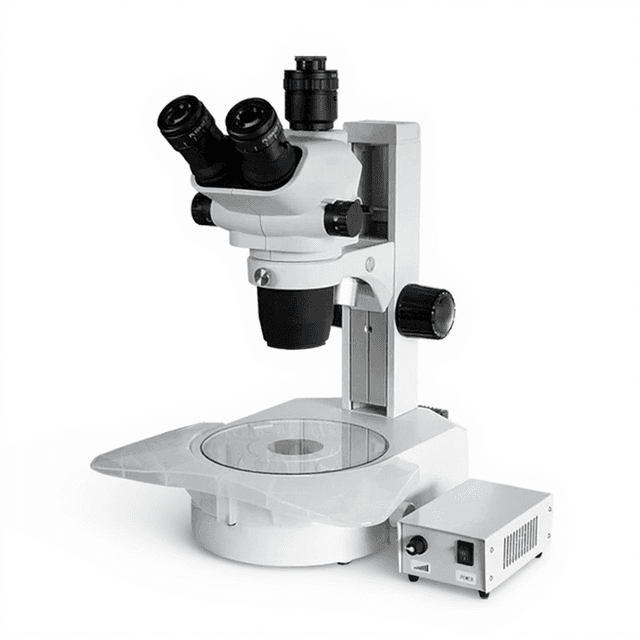
Trinocular stereo microscope with integrated heating stage for temperature-controlled specimen examination, featuring 6.7X-90X magnification, dual illumination, and 180mm glass work plate.

Louise Corscadden, PhD
Director of Science · ConductScience
Ask Louise about Heating Stage Digital Dissecting Stereo Microscope Track Microscope Stand With Transmitted Light fit, setup, configuration, or quote prep.
Already working with us? Sign in to connect this with My Scientist.
Key Specifications
Full details →- Model fit
- Configured during quote
- SKU family
- MCX-0034
- Shipping box
- 0.1 x 2.1 x 1.8 cm
- Ordering
- Online checkout and quote request available
- Category
- Microscopy
- Build notes
- Confirm accessories, station layout, and support needs before purchase
The Heating Stage Digital Dissecting Stereo Microscope represents a specialized optical instrument designed for temperature-controlled examination of specimens requiring precise thermal manipulation during observation. This trinocular system combines stereo visualization with integrated heating capabilities, enabling researchers to observe dynamic processes, phase transitions, and thermal responses in real-time. The system features a 6.7X to 90X magnification range through a 0.67X-4.5X objective with 1:6.7 zoom ratio, providing sufficient working distance (105mm) for specimen manipulation while maintaining optical clarity.
The integrated heating stage with 180mm diameter glass work plate allows for controlled thermal environments during microscopic examination, while dual illumination systems (transmitted LED and reflected halogen/LED) ensure optimal contrast and visibility across diverse specimen types. The trinocular head configuration enables simultaneous visual observation and digital documentation, supporting both qualitative assessment and quantitative image analysis workflows in research applications.
How It Works
The system operates on the principle of stereo microscopy, utilizing two separate optical paths positioned at a slight angle to create three-dimensional visualization of specimens. The 0.67X-4.5X zoom objective provides continuous magnification adjustment with a 1:6.7 ratio, while WF10X eyepieces deliver total magnifications from 6.7X to 90X. The 105mm working distance accommodates heating stage operations and specimen manipulation without objective interference.
Thermal control is achieved through the integrated heating stage beneath the 180mm diameter glass work plate. The specimen temperature can be precisely regulated while maintaining optical access from both transmitted and reflected illumination paths. The dual illumination system employs LED transmitted light and both LED/halogen reflected light sources with adjustable brightness, enabling optimal contrast through multiple viewing modes including oblique illumination and 360° rotating mirror configurations.
The trinocular head incorporates a built-in interlock mechanism ensuring proper optical alignment, while the adjustable interpupillary distance (52-76mm) accommodates various users. The vertical track system provides 300mm of height adjustment, allowing optimization of working distance and specimen positioning throughout the thermal examination process.
Features & Benefits
Automation Level
- manual
Product Type
- Microscope
Microscope Type
- Stereo / Dissecting
Application
- Assembly & Rework
- Sample Preparation
Skill Level
- Entry Level
Brand
- ConductScience
Research Domain
- Cell Biology
- Developmental Biology
- Histopathology
- Materials Science
- Microbiology
- Pharmaceutical QC
Shipping weight
- 6.5 lb
Shipping box
- L: 0.1 cm
- W: 2.1 cm
- H: 1.8 cm
| Feature | This Product | Typical Alternative | Advantage |
|---|---|---|---|
| Magnification Range | 6.7X to 90X with 1:6.7 zoom ratio | Entry-level models often provide fixed magnifications or limited zoom ranges | Continuous zoom adjustment allows seamless transition between overview and detailed examination without changing objectives |
| Working Distance | 105mm clearance | Standard stereo microscopes often have 65-85mm working distance | Extended working distance accommodates heating stage operations and temperature probe placement without optical interference |
| Thermal Integration | Built-in heating stage with 180mm glass work plate | Most stereo microscopes require separate heating accessories | Integrated design ensures optimal thermal-optical alignment and eliminates compatibility concerns between thermal and optical systems |
| Illumination System | Dual transmitted LED and reflected halogen/LED with brightness control | Many models offer single illumination type or limited brightness adjustment | Versatile lighting options enable optimal contrast for diverse specimen types and experimental conditions |
| Optical Configuration | Trinocular head with built-in interlock mechanism | Binocular configurations are common in this price range | Trinocular design enables simultaneous visual examination and digital documentation while maintaining consistent optical alignment |
| Contrast Enhancement | 360° rotating mirror with oblique illumination capability | Basic models typically have fixed mirror positions | Adjustable contrast enhancement reveals subtle specimen features and surface characteristics critical for detailed analysis |
This system distinguishes itself through integrated thermal control capabilities combined with comprehensive optical features including trinocular configuration, dual illumination systems, and extensive working distance. The built-in heating stage eliminates the complexity of adding separate thermal accessories while maintaining professional-grade optical performance.
Practical Tips
Verify temperature accuracy using an independent calibrated thermometer placed on the work plate before beginning thermal studies.
Why: Ensures accurate thermal control for reproducible experimental conditions and valid temperature-dependent results.
Clean optical surfaces weekly with appropriate lens cleaning solutions and check heating stage surface for residue or contamination.
Why: Maintains optical clarity and prevents thermal artifacts that could affect specimen observation and temperature distribution.
Allow heating stage to reach thermal equilibrium for at least 10 minutes before specimen placement to ensure stable temperature conditions.
Why: Prevents thermal shock to specimens and ensures consistent temperature throughout the examination period.
Use the lowest effective illumination intensity to minimize specimen heating from light sources during thermal studies.
Why: Reduces unwanted thermal input that could interfere with controlled heating stage temperature and specimen responses.
If focus drift occurs during heating, allow thermal expansion stabilization and refocus systematically at target temperature.
Why: Thermal expansion of components can cause focal shifts that need accommodation for sharp imaging throughout temperature protocols.
Document ambient laboratory temperature and humidity when recording thermal experiments for environmental context.
Why: Environmental conditions can affect heating stage performance and provide important metadata for experimental reproducibility.
Always verify heating stage temperature before direct contact and use appropriate tools for specimen manipulation on heated surfaces.
Why: Prevents burns and maintains experimental safety while working with elevated temperature conditions.
Inspect electrical connections and power adapter regularly for signs of wear or damage, especially in high-use thermal applications.
Why: Heating stage operations demand reliable electrical performance and safety to prevent equipment damage or experimental interruption.
Setup Guide
What’s in the Box
- Trinocular stereo microscope head with track stand
- Integrated heating stage assembly
- Pair of WF10X eyepieces with adjustable diopter
- 180mm diameter clear glass work plate
- Power adapter (100-240V AC)
- LED and halogen illumination systems
- 360° rotating mirror assembly
- User manual and optical cleaning kit (typical)
- Calibration certificate (typical)
Warranty
ConductScience provides a standard one-year manufacturer warranty covering optical and electronic components, with technical support available for setup, calibration, and troubleshooting assistance.
Compliance
References
Background reading relevant to this product:
What temperature range can the heating stage achieve and maintain?
Consult product datasheet for specific temperature range and stability specifications, as these parameters are critical for experimental planning and temperature-sensitive protocols.
Can the system accommodate standard microscope slides and coverslips?
The 180mm diameter glass work plate can accommodate standard slides, though direct contact with the heated surface should be considered for thermal uniformity and specimen integrity.
What camera systems are compatible with the trinocular port?
The trinocular port accepts standard C-mount cameras and microscope adapters, enabling integration with digital imaging systems for documentation and analysis.
How precise is the temperature control and what is the thermal stability?
Consult product datasheet for temperature accuracy, stability specifications, and response time characteristics essential for temperature-dependent experimental protocols.
Can the illumination be independently controlled for transmitted and reflected modes?
Yes, the dual illumination system provides independent brightness adjustment for both transmitted LED and reflected halogen/LED sources, allowing optimal contrast optimization.
What maintenance is required for the heating stage and optical components?
Regular cleaning of optical surfaces with appropriate solvents, periodic calibration verification of temperature control, and inspection of heating element integrity are recommended.
Is the system suitable for long-term time-lapse imaging under thermal control?
The stable mechanical design and temperature control capabilities support extended observation periods, though thermal drift monitoring and periodic refocusing may be necessary.
Have a question about this product?
Have a question? Just ask.
Send it over and we'll email you a personalized answer — no call, no scheduling.
Prefer to talk it through?
Accessories
Enhance your setup with compatible accessories
Frequently Bought Together
Upgrade Options
Related Products