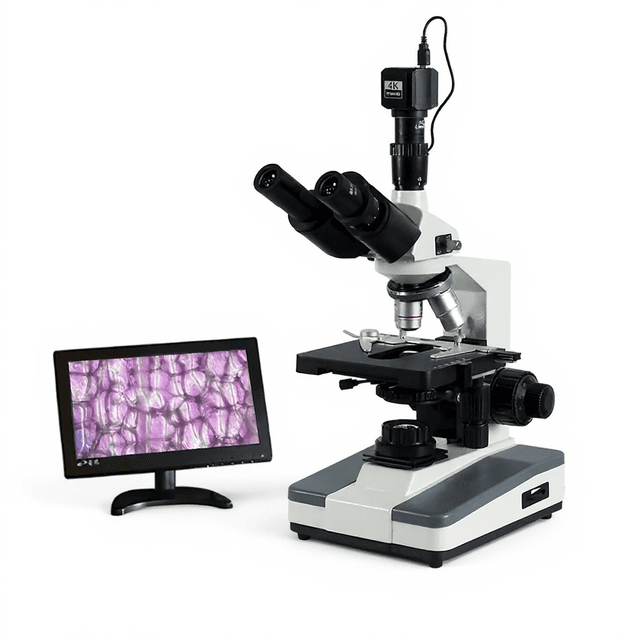
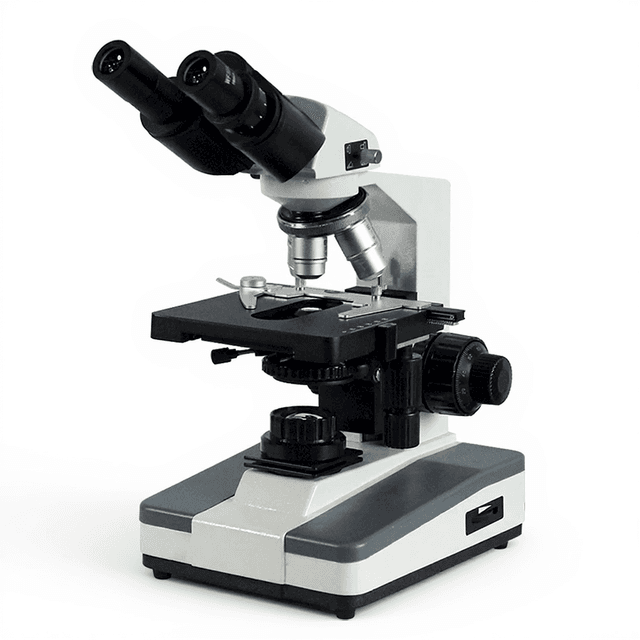
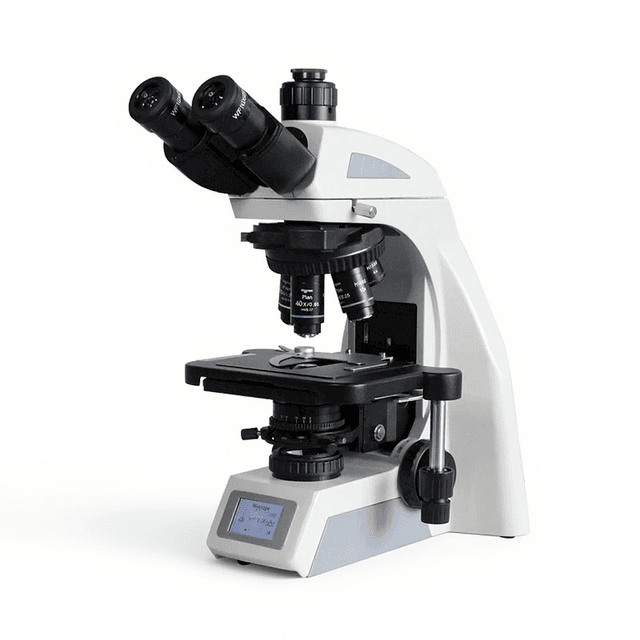
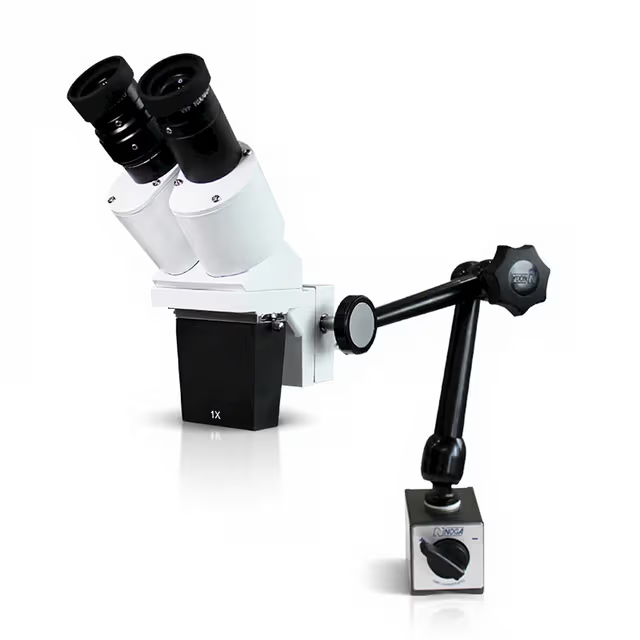
Trinocular Reflected & Transmitted Illumination Memory System Metallurgical Microscope with Coded Quintuple Nosepiece & Semi-apo Lens
Trinocular metallurgical microscope with coded quintuple nosepiece automation, brightness memory system, and dual reflected/transmitted illumination for materials characterization and microstructural analysis.

Louise Corscadden, PhD
Director of Science · ConductScience
Ask Louise about Trinocular Reflected & Transmitted Illumination Memory System Metallurgical Microscope with Coded Quintuple Nosepiece & Semi-apo Lens fit, setup, configuration, or quote prep.
Already working with us? Sign in to connect this with My Scientist.
Key Specifications
Full details →- Model fit
- Configured during quote
- SKU family
- MCX-0015
- Shipping box
- 4.9 x 6.6 x 6.6 cm
- Ordering
- Online checkout and quote request available
- Category
- Microscopy
- Build notes
- Confirm accessories, station layout, and support needs before purchase
The Trinocular Reflected & Transmitted Illumination Memory System Metallurgical Microscope represents a sophisticated analytical platform for materials characterization and microstructural analysis. This system combines reflected and transmitted illumination capabilities with automated measurement features through its coded quintuple nosepiece, which automatically adjusts calibration values in the accompanying image analysis software when switching between magnifications.
The microscope features infinity plan semi-apochromatic objectives providing magnification from 50X to 500X, a trinocular head with adjustable interpupillary distance (50-75mm), and high eyepoint SWH10X eyepieces with diopter adjustment. The brightness memory function maintains consistent illumination settings across different magnifications, while the 10W LED Köhler illumination system with field and aperture diaphragms ensures optimal contrast and resolution for metallographic specimens.
How It Works
The microscope operates through a dual-illumination system combining reflected and transmitted light pathways. Reflected illumination employs a 10W LED source configured in Köhler illumination geometry, where light passes through field and aperture diaphragms before reflecting off the specimen surface. This configuration provides even illumination and optimal contrast for opaque metallographic specimens. The transmitted illumination system uses an achromatic condenser (N.A. 0.9) with swing-out capability for transparent or translucent specimens.
The coded quintuple nosepiece contains identification sensors that communicate with the image analysis software, automatically updating measurement calibration factors when objectives are changed. This eliminates manual recalibration between magnifications and reduces measurement errors. The brightness memory function stores illumination intensity settings for each objective, maintaining consistent exposure conditions across different magnifications during extended observation sessions.
The infinity-corrected optical system uses plan semi-apochromatic objectives that form parallel light rays, allowing insertion of optical accessories without affecting image quality. The low-hand coaxial focus system provides coarse adjustment over 30mm range with fine focusing precision to 1μm, enabling precise focal plane positioning for accurate measurements and documentation.
Features & Benefits
Automation Level
- semi-automated
Product Type
- Microscope
Microscope Type
- General Purpose
Viewing Head
- Trinocular
Application
- General Laboratory
Illumination
- Reflected & Transmitted
Skill Level
- Professional / Research
Brand
- ConductScience
Research Domain
- Analytical Chemistry
- Materials Science
Shipping weight
- 1.9 lb
Shipping box
- L: 4.9 cm
- W: 6.6 cm
- H: 6.6 cm
| Feature | This Product | Typical Alternative | Advantage |
|---|---|---|---|
| Nosepiece Automation | Coded quintuple nosepiece with automatic software calibration | Manual nosepieces requiring operator calibration for each magnification change | Eliminates measurement errors from incorrect calibration settings and reduces analysis time in quantitative workflows. |
| Illumination Memory | Brightness memory function maintaining settings per objective | Manual illumination adjustment required for each magnification | Ensures consistent exposure conditions for reproducible documentation and photometric analysis across magnifications. |
| Objective Design | Infinity plan semi-apochromatic objectives with flat field correction | Finite-conjugate or achromatic objectives with limited field flatness | Provides accurate measurements across the entire field of view without edge distortion or chromatic aberration. |
| Focus Precision | Coaxial coarse/fine focus with 1μm minimum division | Separate coarse/fine controls with lower precision specifications | Enables precise focal plane positioning for accurate thickness measurements and improved depth-of-field control. |
| Stage Capacity | Double layer mechanical stage with 75 x 50mm movement range | Single-layer stages with limited specimen movement range | Accommodates systematic scanning of large specimens and precise positioning for multiple field analysis protocols. |
This microscope combines automation features (coded nosepiece, brightness memory) with high-quality infinity-corrected optics and versatile illumination capabilities. The system emphasizes measurement accuracy and workflow efficiency through automated calibration and consistent illumination control.
Practical Tips
Verify coded nosepiece calibration using a stage micrometer before critical measurements, ensuring software recognition matches actual objective magnification.
Why: Automatic calibration depends on proper sensor function and software communication integrity.
Clean objective front elements weekly with lens paper and appropriate solvents, avoiding contact with metallographic polishing compounds.
Why: Metallographic specimens can deposit polishing residue that degrades image contrast and measurement accuracy.
Set brightness memory at 70-80% maximum LED intensity to preserve lamp life while maintaining adequate illumination for documentation.
Why: Lower intensities extend LED lifespan and reduce thermal drift during extended observation sessions.
Use the 100:0 light splitting ratio for visual observation and switch to 50:50 only when digital imaging requires maximum camera sensitivity.
Why: Visual observation benefits from maximum light intensity, while cameras can typically operate effectively with reduced illumination.
Allow 15-20 minutes warm-up time for LED illumination stabilization before critical photometric measurements or color documentation.
Why: LED output intensity and color temperature can drift during initial heating phases, affecting measurement reproducibility.
If coded nosepiece calibration fails, clean electrical contacts on objectives and nosepiece body with isopropyl alcohol.
Why: Oxidation or contamination of electrical contacts can disrupt communication between nosepiece sensors and software.
Ensure mechanical stage locks are engaged when changing specimens to prevent accidental movement that could damage objectives or specimens.
Why: Unexpected stage movement during specimen exchange can cause collision between objectives and hard metallographic mounts.
Setup Guide
What’s in the Box
- Trinocular microscope body with coded quintuple nosepiece
- High eyepoint SWH10X eyepieces (pair)
- PL FLN 5X/0.15 infinity plan semi-apochromatic objective
- Double layer mechanical stage with glass insert
- 0.65X CCD adapter for digital imaging
- 10W LED illumination system with power supply
- Achromatic condenser (N.A. 0.9)
- Image analysis software with calibration database
- User manual and calibration certificate (typical)
- Dust cover and cleaning kit (typical)
Warranty
ConductScience provides a standard one-year manufacturer warranty covering defects in materials and workmanship, with technical support for software installation and operational guidance.
Compliance
References
Background reading relevant to this product:
How does the coded nosepiece integration work with image analysis software?
The coded nosepiece contains identification sensors that automatically communicate magnification information to the software, updating calibration factors and measurement scales without manual input when objectives are rotated.
What is the working distance and numerical aperture of the included objective?
The PL FLN 5X/0.15 objective provides 15mm working distance with 0.15 numerical aperture, suitable for thick metallographic specimens and accommodating stage movement without collision risk.
Can the brightness memory system accommodate different specimen types?
Yes, the brightness memory function stores individual illumination settings for each objective position, allowing optimization for specimens with varying reflectance properties while maintaining consistency across sessions.
What is the maximum specimen thickness that can be accommodated?
The transmitted and reflected body system can hold samples up to 4 inches thick, with the mechanical stage providing clearance for metallographic mounts and larger specimens.
How precise are measurements achievable with the focus system?
The coaxial focus system provides 1μm minimum division for fine focusing, enabling precise focal plane positioning for accurate thickness measurements and depth-of-field analysis.
What digital imaging capabilities are included?
The system includes a 0.65X CCD adapter that maintains parfocality with visual observation and optimizes the field of view for digital cameras while preserving measurement accuracy.
Have a question about this product?
Have a question? Just ask.
Send it over and we'll email you a personalized answer — no call, no scheduling.
Prefer to talk it through?
Frequently Bought Together
Related Products