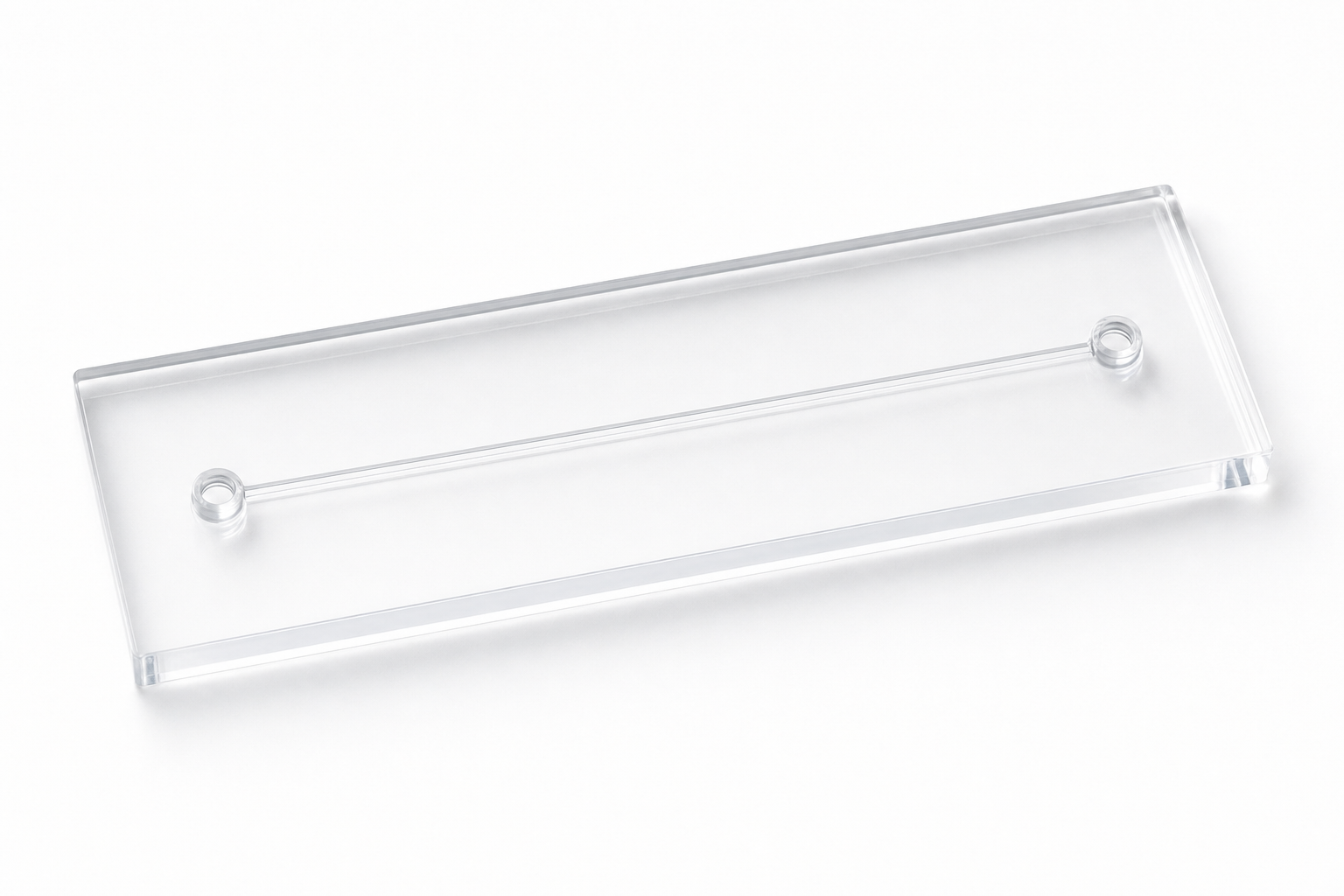
Basic Straight-Channel Microfluidic Chip (100 um)
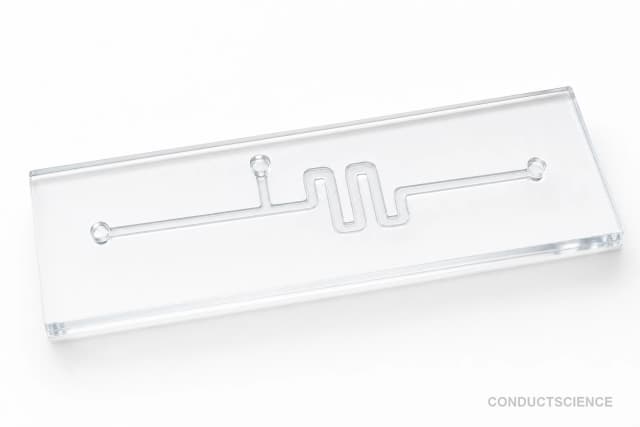
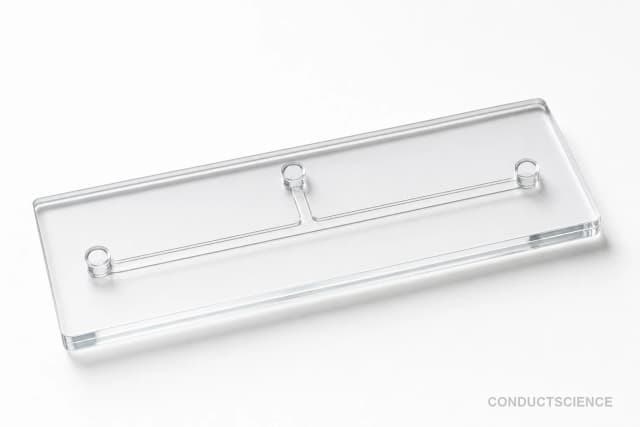
Single-channel microfluidic chip with 100 x 100 µm straight channel for teaching applications and flow visualization studies.
Reusable chip — designed for multiple experimental runs. Compatible with standard microfluidic tubing: steel pins (0.7 mm ID / 1.0 mm OD) and silicone tubing (0.8 mm ID / 1.9 mm OD). Available in bulk packs (5‑, 10‑, and 25‑unit) for lab-scale and consumable workflows.

Louise Corscadden, PhD
Director of Science · ConductScience
Ask Louise about Basic Straight-Channel Microfluidic Chip (100 um) fit, setup, configuration, or quote prep.
Already working with us? Sign in to connect this with My Scientist.
Key Specifications
Full details →- Model fit
- 2 selectable configurations
- SKU family
- WHM-0113
- Shipping box
- 181.8 x 136.3 x 90.9 cm
- Ordering
- Online checkout and quote request available
- Category
- Microfluidic Chips
- Build notes
- Confirm accessories, station layout, and support needs before purchase
The Basic Straight-Channel Microfluidic Chip (100 µm) provides a fundamental platform for microfluidic experimentation and education. Featuring a single straight channel with 100 x 100 µm cross-sectional dimensions, this chip enables direct observation of laminar flow behavior and basic fluid dynamics principles at the microscale. The straightforward design eliminates complex geometries, making it ideal for teaching applications and flow visualization studies.
Fabricated using standard microfluidic manufacturing techniques, this chip serves as an entry-level tool for researchers beginning microfluidic experimentation or educators demonstrating fundamental fluid mechanics concepts. The 100 µm channel dimensions fall within the typical range for many biological and analytical microfluidic applications, providing relevant scale experience for users transitioning to more complex devices.
Key Specs
| Material | PDMS |
|---|---|
| Geometry | 1 channel; single straight channel |
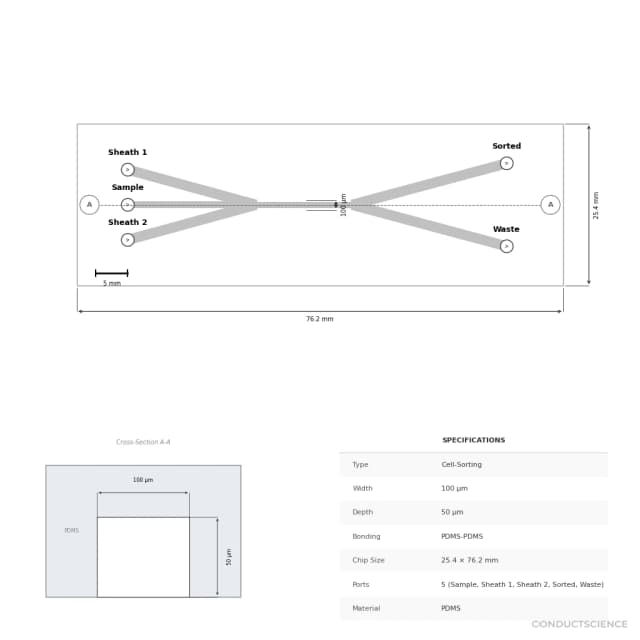
| Ports | 2 ports (Inlet, Outlet) |
| Chip footprint | 25.4 x 76.2 mm standard slide format |
| Channel width | 100 um |
| Channel depth | 50 um |
| Bonding | PDMS-PDMS, PDMS-glass |
| Packaging | Standard glass slide (25.4x76.2mm), stainless steel tubes (0.7x1.0x15mm), silicone tubing (0.8x1.9mm) |
| Source | suppliers/wenhao/docs/pdms-chips-catalog.json; 3.2.002.00.003, 3.2.002.00.004 |
This source-backed block is suitable for fixed-geometry image remediation.
How It Works
The chip operates on fundamental principles of microscale fluid dynamics, where viscous forces dominate over inertial forces due to the low Reynolds numbers characteristic of microfluidic systems. In the 100 µm straight channel, fluid flow exhibits purely laminar behavior, creating predictable parabolic velocity profiles with maximum flow velocity at the channel center and zero velocity at the walls due to the no-slip boundary condition.
Flow visualization is achieved by introducing contrast agents, dyes, or particles into the fluid stream, allowing direct observation of flow patterns under microscopic examination. The straight channel geometry eliminates complex mixing or separation effects, providing a controlled environment for studying basic transport phenomena including diffusion, convection, and pressure-driven flow. Channel dimensions of 100 x 100 µm provide sufficient optical access for standard microscopy while maintaining appropriate fluidic resistance for typical microfluidic pumping systems.
Features & Benefits
Shipping weight
- 3.3 lb
Shipping box
- L: 181.8 cm
- W: 136.3 cm
- H: 90.9 cm
| Feature | This Product | Typical Alternative | Advantage |
|---|---|---|---|
| Channel Geometry | Single straight channel, 100 x 100 µm | Multi-channel designs often feature 2-8 channels with varying geometries | Simplified design eliminates complex flow interactions, enabling clear observation of fundamental principles |
| Application Focus | Teaching and flow visualization | Many chips target specific analytical or separation applications | Educational focus makes this ideal for learning microfluidic concepts without application-specific complexity |
| Channel Dimensions | 100 x 100 µm square cross-section | Channel sizes vary widely from 10-500 µm depending on application | 100 µm dimension provides good balance of optical access and relevant scale for most microfluidic principles |
| Design Complexity | Basic straight-channel design | Advanced chips often incorporate mixers, valves, or separation structures | Straightforward geometry allows focus on core fluid dynamics without distracting design elements |
This chip offers an accessible entry point into microfluidics with its single-channel design optimized for teaching and flow visualization. The 100 µm dimensions and straight geometry provide fundamental microfluidic experience without the complexity of multi-functional devices.
| Model | SKU | Listed price | Status | Shipping box |
|---|---|---|---|---|
| 25-Pack | WHM-0113-25PK | Quote | Available | 181.8 x 136.3 x 90.9 cm |
| 10-Pack | WHM-0113-10PK | $1,490.00 | Available | 181.8 x 136.3 x 90.9 cm |
Practical Tips
Always filter fluids through 0.22 µm filters before introduction to prevent channel blockage.
Why: Particles larger than channel cross-section can cause irreversible clogs in microfluidic systems.
Flush channels immediately after use with appropriate cleaning solvents to prevent sample drying.
Why: Dried samples can create permanent blockages that are difficult to remove from microfluidic channels.
Allow flow to stabilize for several minutes before making measurements or observations.
Why: Transient effects during startup can mask steady-state flow behaviors you want to study.
If flow appears irregular, check for air bubbles and re-prime the system completely.
Why: Air bubbles significantly alter flow patterns and can cause pulsatile rather than steady flow.
Use appropriate chemical compatibility charts when selecting solvents for chip cleaning.
Why: Incompatible solvents may damage chip materials or create hazardous conditions.
Document flow rates and fluid properties for reproducible experimental conditions.
Why: Microfluidic behavior is highly sensitive to these parameters, making documentation essential for reproducibility.
Setup Guide
What’s in the Box
- Basic Straight-Channel Microfluidic Chip (100 µm)
- Protective packaging materials (typical)
- Basic documentation or handling instructions (typical)
Warranty
ConductScience provides standard manufacturer warranty coverage for defects in materials and workmanship. Technical support is available for setup and basic troubleshooting guidance.
Compliance
What flow rates are recommended for the 100 µm channel?
Flow rates depend on your pump system and fluid properties, but typical ranges are 1-100 µL/min for most educational demonstrations. Calculate Reynolds numbers to ensure laminar flow conditions.
Can this chip be reused after experiments?
Yes, with proper cleaning protocols. Flush thoroughly with appropriate solvents and check for residual contamination before reuse.
What microscopy magnifications work best for flow visualization?
10x to 40x objectives provide good balance of field of view and resolution for observing flow patterns in 100 µm channels.
Is this compatible with biological samples?
The chip can handle biological fluids, but surface biocompatibility should be verified for specific cell types or proteins used.
What pressure ratings should I consider?
Consult product datasheet for specific pressure limits. Most microfluidic chips handle pressures up to several bar, but verify for your application.
How do I prevent channel clogging?
Filter all fluids before introduction and avoid particles larger than 10-20 µm to prevent blockages in the 100 µm channel.
Have a question about this product?
Have a question? Just ask.
Send it over and we'll email you a personalized answer — no call, no scheduling.
Prefer to talk it through?