Y-Type Hybrid Mixing Microfluidic Chip
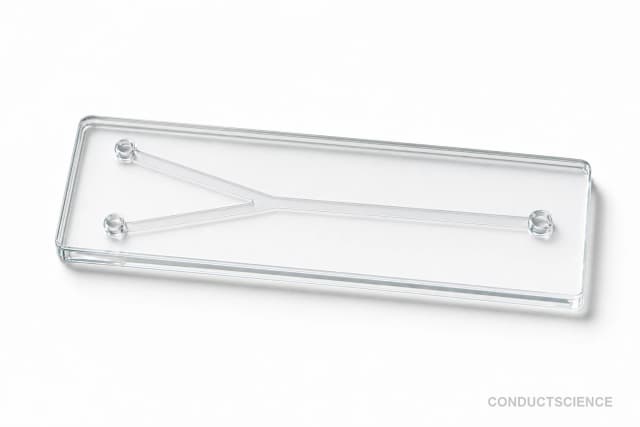
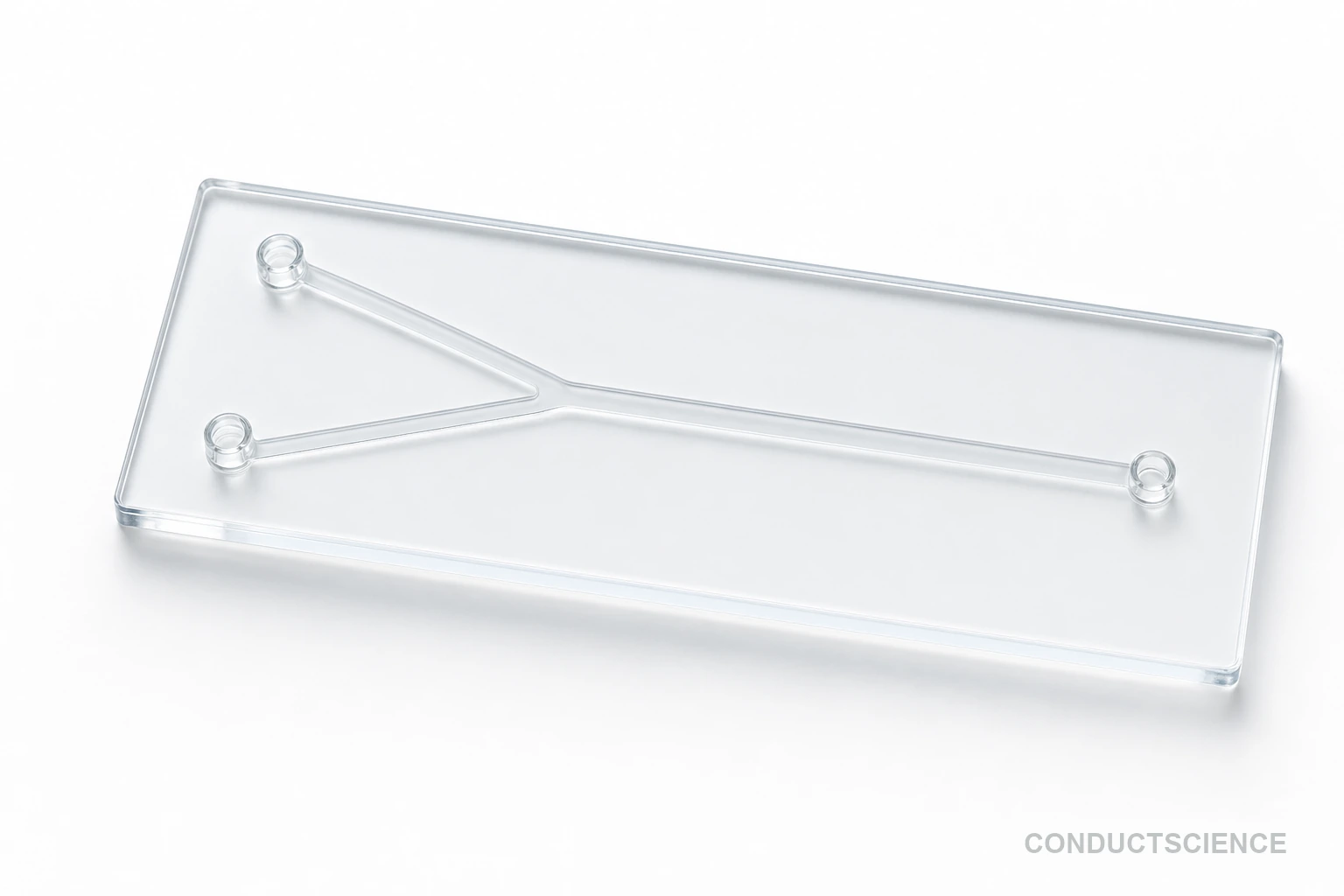
Glass microfluidic chip with embedded bead mixing elements for rapid turbulent mixing of two fluid streams in standard slide format.
Reusable chip — designed for multiple experimental runs. Compatible with standard microfluidic tubing: steel pins (0.7 mm ID / 1.0 mm OD) and silicone tubing (0.8 mm ID / 1.9 mm OD). Available in bulk packs (5‑, 10‑, and 25‑unit) for lab-scale and consumable workflows.

Louise Corscadden, PhD
Director of Science · ConductScience
Ask Louise about Y-Type Hybrid Mixing Microfluidic Chip fit, setup, configuration, or quote prep.
Already working with us? Sign in to connect this with My Scientist.
Key Specifications
Full details →- Model fit
- 3 selectable configurations
- SKU family
- WHM-0005
- Shipping box
- 76.0 x 25.0 x 2.0 cm
- Ordering
- Online checkout and quote request available
- Category
- Glass Chips
- Build notes
- Confirm accessories, station layout, and support needs before purchase
The Y-Type Hybrid Mixing Microfluidic Chip provides rapid, turbulent mixing of fluids through embedded bead structures within a standard microscope slide format. The glass microplate construction accommodates two-inlet confluence mixing with configurable channel spacing of either 4.5 mm or 9 mm to match experimental requirements. The chip's 25 × 76 mm dimensions conform to standard slide dimensions for compatibility with existing microscopy and imaging systems.
Turbulent mixing occurs through interaction with embedded microbeads positioned at the junction point, creating chaotic advection that enhances mass transfer between fluid streams. This design enables efficient reagent blending and sample preparation for downstream analysis applications requiring homogeneous solutions.
Key Specs
| Material | PDMS |
|---|---|
| Geometry | Y-shaped junction, 3 ports |
| Ports | 3 ports (Inlet 1, Inlet 2, Outlet) |
| Chip footprint | 25.4 x 76.2 mm standard slide format |
| Channel width | 50 um, 100 um, 150 um, 200 um |
| Channel depth | 50 um |
| Bonding | PDMS-PDMS, PDMS-glass |
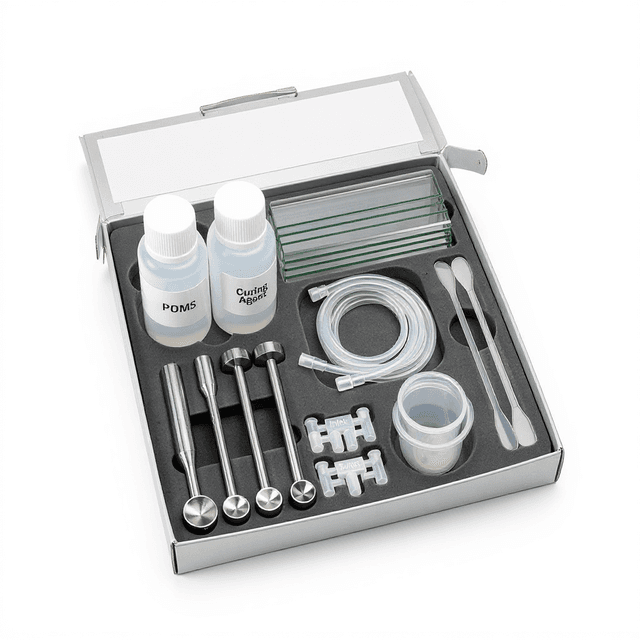
| Packaging | Standard glass slide (25.4x76.2mm), stainless steel tubes (0.7x1.0x15mm), silicone tubing (0.8x1.9mm) |
| Source | suppliers/wenhao/docs/pdms-chips-catalog.json; 3.2.002.00.017, 3.2.002.00.018, 3.2.002.00.019, 3.2.002.00.020, 3.2.002.00.021, 3.2.002.00.022, 3.2.002.00.023, 3.2.002.00.024 |
This source-backed block lists available source configurations; confirm selected width/bonding when quoting.
How It Works
The Y-Type Hybrid Mixing chip operates through chaotic advection generated by embedded microbeads at the confluence junction. Two inlet channels converge at a Y-shaped intersection where fluid streams encounter strategically positioned glass microbeads. These beads create flow obstructions that induce turbulent mixing through repeated stretching and folding of fluid interfaces.
The turbulent flow regime enhances mass transfer by increasing the interfacial area between mixing streams and reducing diffusion path lengths. Unlike passive laminar mixers that rely solely on molecular diffusion, the embedded bead structure actively promotes convective mixing for faster homogenization. The glass construction provides chemical inertness and optical transparency for real-time monitoring of mixing processes.
Features & Benefits
Shipping weight
- 0.03 lb
Shipping box
- L: 76.0 cm
- W: 25.0 cm
- H: 2.0 cm
| Feature | This Product | Typical Alternative | Advantage |
|---|---|---|---|
| Channel Pattern | Y-junction (Y型) — 3 ports, two inlets merge into single outlet | Smooth angular merge for combining two streams with minimal turbulence | |
| Channel Depth | 50 μm (fixed) | Standard across all configurations in this product line | |
| Channel Width Options | 50, 100, 150, or 200 μm (8 configurations total) | Width determines mixing length required for complete diffusion | |
| Bonding Options | PDMS-to-PDMS or PDMS-to-glass | Glass bonding recommended for imaging gradient formation downstream | |
| Manufacturer Part Numbers | 3.2.002.00.017 through 3.2.002.00.024 (Model: WHBZ-YC) | Odd numbers = PDMS-PDMS; even numbers = PDMS-glass | |
| Chip Dimensions | 25 × 15 × 3 mm chip on 25.4 × 76.2 mm glass slide | Standard microscope slide format | |
| Included Accessories | Stainless steel tubes (0.7 × 1.0 × 15 mm), silicone tubing (0.8 × 1.9 mm) | 3 connection points: 2 inlets + 1 outlet |
Y-junction PDMS chip for two-stream combining, concentration gradient generation, and passive mixing. The Y-angle merge creates smoother flow intersection than T-junctions. 8 configurations: 4 widths × 2 bonding types.
| Model | SKU | Listed price | Status | Shipping box |
|---|---|---|---|---|
| 25-Pack | WHM-0005-200-um-pdms-glass-25-pack | Quote | Available | 76.0 x 25.0 x 2.0 cm |
| 10-Pack | WHM-0005-200-um-pdms-glass-10-pack | Quote | Available | 76.0 x 25.0 x 2.0 cm |
| 5-Pack | WHM-0005-200-um-pdms-glass-5-pack | Quote | Available | 76.0 x 25.0 x 2.0 cm |
| 25-Pack | WHM-0005-200-um-pdms-pdms-25-pack | Quote | Available | 76.0 x 25.0 x 2.0 cm |
| 10-Pack | WHM-0005-200-um-pdms-pdms-10-pack | Quote | Available | 76.0 x 25.0 x 2.0 cm |
| 5-Pack | WHM-0005-200-um-pdms-pdms-5-pack | Quote | Available | 76.0 x 25.0 x 2.0 cm |
| 25-Pack | WHM-0005-150-um-pdms-glass-25-pack | Quote | Available | 76.0 x 25.0 x 2.0 cm |
| 10-Pack | WHM-0005-150-um-pdms-glass-10-pack | Quote | Available | 76.0 x 25.0 x 2.0 cm |
| 5-Pack | WHM-0005-150-um-pdms-glass-5-pack | Quote | Available | 76.0 x 25.0 x 2.0 cm |
| 25-Pack | WHM-0005-150-um-pdms-pdms-25-pack | Quote | Available | 76.0 x 25.0 x 2.0 cm |
| 10-Pack | WHM-0005-150-um-pdms-pdms-10-pack | Quote | Available | 76.0 x 25.0 x 2.0 cm |
| 5-Pack | WHM-0005-150-um-pdms-pdms-5-pack | Quote | Available | 76.0 x 25.0 x 2.0 cm |
| 25-Pack | WHM-0005-100-um-pdms-glass-25-pack | Quote | Available | 76.0 x 25.0 x 2.0 cm |
| 10-Pack | WHM-0005-100-um-pdms-glass-10-pack | Quote | Available | 76.0 x 25.0 x 2.0 cm |
| 5-Pack | WHM-0005-100-um-pdms-glass-5-pack | Quote | Available | 76.0 x 25.0 x 2.0 cm |
| 25-Pack | WHM-0005-100-um-pdms-pdms-25-pack | Quote | Available | 76.0 x 25.0 x 2.0 cm |
| 10-Pack | WHM-0005-100-um-pdms-pdms-10-pack | Quote | Available | 76.0 x 25.0 x 2.0 cm |
| 5-Pack | WHM-0005-100-um-pdms-pdms-5-pack | Quote | Available | 76.0 x 25.0 x 2.0 cm |
| 25-Pack | WHM-0005-50-um-pdms-glass-25-pack | Quote | Available | 76.0 x 25.0 x 2.0 cm |
| 10-Pack | WHM-0005-50-um-pdms-glass-10-pack | Quote | Available | 76.0 x 25.0 x 2.0 cm |
| 5-Pack | WHM-0005-50-um-pdms-glass-5-pack | Quote | Available | 76.0 x 25.0 x 2.0 cm |
| 25-Pack | WHM-0005-50-um-pdms-pdms-25-pack | Quote | Available | 76.0 x 25.0 x 2.0 cm |
| 10-Pack | WHM-0005-50-um-pdms-pdms-10-pack | $1,490.00 | Available | 76.0 x 25.0 x 2.0 cm |
| 5-Pack | WHM-0005-50-um-pdms-pdms-5-pack | Quote | Available | 76.0 x 25.0 x 2.0 cm |
Practical Tips
Prime both inlet channels separately before connecting to verify flow path integrity and remove air bubbles.
Why: Air bubbles can disrupt mixing patterns and affect reproducibility.
Use colored dye solutions to visually optimize flow rates and mixing ratios before introducing valuable samples.
Why: Visual verification ensures optimal mixing conditions and prevents sample waste.
Clean channels immediately after use to prevent sample carryover and maintain flow characteristics.
Why: Residual materials can alter mixing dynamics and contaminate subsequent experiments.
Handle the glass chip carefully and inspect for cracks before each use, especially around connection points.
Why: Damaged glass can fail under pressure and pose safety hazards.
Allow sufficient equilibration time when changing flow rates to reach steady-state mixing conditions.
Why: Transient flow conditions can affect mixing uniformity and experimental reproducibility.
If mixing appears incomplete, verify that both inlet flow rates are balanced and check for partial blockages.
Why: Unbalanced flows or blockages can create dead zones that reduce mixing efficiency.
Setup Guide
What’s in the Box
- Y-Type Hybrid Mixing Microfluidic Chip
- Product specifications sheet (typical)
- Handling instructions (typical)
Warranty
ConductScience provides standard manufacturer warranty coverage with technical support for microfluidic chip products.
Compliance
What flow rate ranges are recommended for optimal mixing performance?
Flow rates depend on fluid viscosity and desired mixing ratio. Consult product datasheet for specific recommendations based on your application requirements.
Can the chip handle high-pressure applications or only gravity-fed flows?
Pressure limits depend on the glass construction and channel dimensions. Verify maximum operating pressure specifications before connecting to high-pressure pumps.
How do I clean the chip between different sample types?
Flush thoroughly with compatible solvents, starting with the sample solvent followed by cleaning agents appropriate for your contamination concerns.
What is the dead volume and mixing time for this chip design?
Dead volume and mixing time vary with flow rates and fluid properties. Consult technical specifications for volumetric calculations.
Is the chip reusable or designed for single-use applications?
Glass construction typically allows multiple uses with proper cleaning protocols, though lifetime depends on sample compatibility and handling.
Can I monitor mixing progress in real-time using this chip?
Yes, the glass construction and slide format enable optical monitoring through standard microscopy or imaging systems.
Have a question about this product?
Have a question? Just ask.
Send it over and we'll email you a personalized answer — no call, no scheduling.
Prefer to talk it through?
Upgrade Options