Standard PDMS Microfluidic Chip
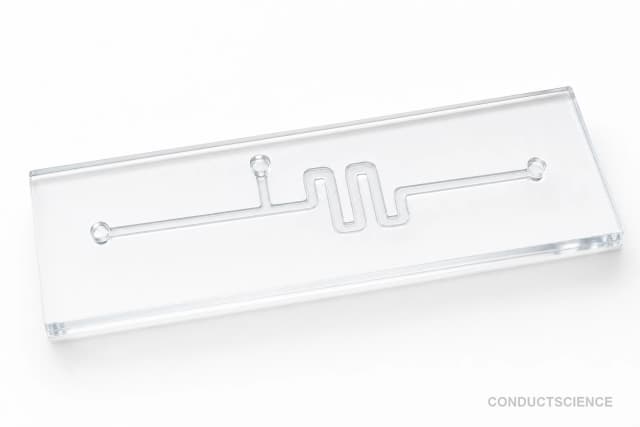
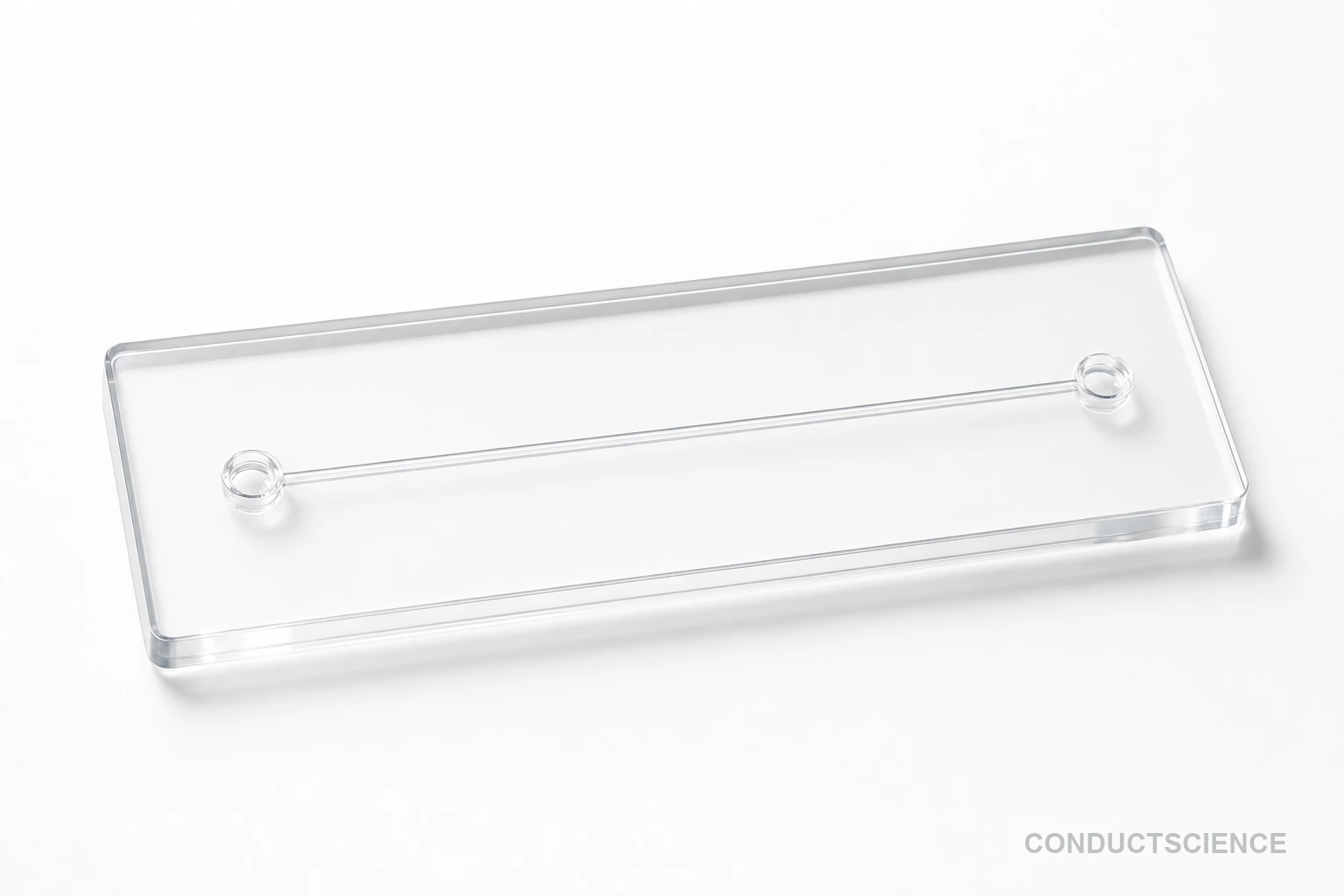
Precision PDMS microfluidic chip with 50 μm channel depth, multiple width options (50–300 μm), and configurable geometries for controlled microscale fluid manipulation experiments.
Reusable chip — designed for multiple experimental runs. Compatible with standard microfluidic tubing: steel pins (0.7 mm ID / 1.0 mm OD) and silicone tubing (0.8 mm ID / 1.9 mm OD). Available in bulk packs (5‑, 10‑, and 25‑unit) for lab-scale and consumable workflows. Request a Quote

Louise Corscadden, PhD
Director of Science · ConductScience
Ask Louise about Standard PDMS Microfluidic Chip fit, setup, configuration, or quote prep.
Already working with us? Sign in to connect this with My Scientist.
Key Specifications
Full details →- Model fit
- 2 selectable configurations
- SKU family
- WHM-0009
- Shipping box
- 25.0 x 15.0 x 3.0 cm
- Ordering
- Online checkout and quote request available
- Category
- Lab Equipment
- Build notes
- Confirm accessories, station layout, and support needs before purchase
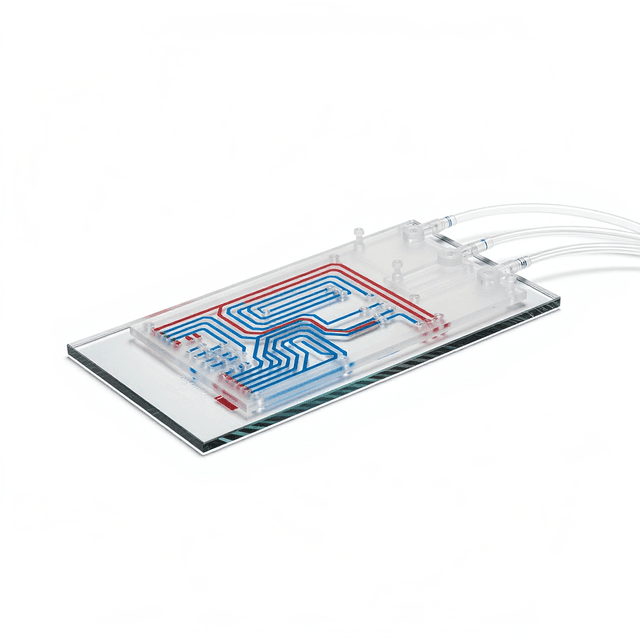
The Standard PDMS Microfluidic Chip provides researchers with a versatile platform for controlled fluid manipulation at the microscale. This polydimethylsiloxane (PDMS) device features precision-molded channels with 50 μm depth and selectable widths from 50 to 300 μm, supporting various experimental geometries including single, cross, T-shaped, Y, focusing, and S-hybrid configurations.
The chip accommodates both PDMS-to-PDMS and PDMS-to-glass bonding protocols, with glass substrate options of 0.17, 0.55, or 1.0 mm thickness to match specific optical and mechanical requirements. The standardized 25 × 15 × 3 mm form factor ensures compatibility with common microscopy stages and fluidic connectors while maintaining reproducible flow characteristics across experiments.
Key Specs
| Material | PDMS |
|---|---|
| Geometry | 1 channel; single straight channel |
| Ports | 2 ports (Inlet, Outlet) |
| Chip footprint | 25.4 x 76.2 mm standard slide format |
| Channel width | 50 um, 100 um, 150 um, 200 um |
| Channel depth | 50 um |
| Bonding | PDMS-PDMS, PDMS-glass |
| Packaging | Standard glass slide (25.4x76.2mm), stainless steel tubes (0.7x1.0x15mm), silicone tubing (0.8x1.9mm) |
| Source | suppliers/wenhao/docs/pdms-chips-catalog.json; 3.2.002.00.001, 3.2.002.00.002, 3.2.002.00.003, 3.2.002.00.004, 3.2.002.00.005, 3.2.002.00.006, 3.2.002.00.007, 3.2.002.00.008 |
This source-backed block lists available source configurations; confirm selected width/bonding when quoting.
How It Works
Microfluidic chips exploit the unique physics of fluid flow at microscales, where viscous forces dominate inertial forces (low Reynolds number regime). The PDMS channels create laminar flow conditions where mixing occurs primarily through molecular diffusion rather than turbulent convection. Channel geometry determines flow patterns: T-junctions create stable co-flow interfaces, Y-configurations enable flow focusing, and cross-geometries allow four-way fluid interaction.
The PDMS material provides optical transparency for real-time microscopic observation while maintaining chemical compatibility with most aqueous solutions and many organic solvents. Channel dimensions control flow resistance according to the Hagen-Poiseuille equation, with the 50 μm depth providing balance between flow control and imaging resolution. Surface properties can be modified through plasma treatment or chemical functionalization to achieve specific wetting characteristics or biomolecular binding.
Bonding methods determine device durability and chemical resistance. PDMS-to-PDMS bonding creates reversible seals suitable for prototype testing, while PDMS-to-glass bonding provides permanent, high-pressure resistant assemblies for extended experiments. Glass thickness selection affects optical properties and mechanical stability under pressure-driven flow conditions.
Features & Benefits
Shipping weight
- 0.02 lb
Shipping box
- L: 25.0 cm
- W: 15.0 cm
- H: 3.0 cm
| Feature | This Product | Typical Alternative | Advantage |
|---|---|---|---|
| Channel Pattern | Straight channel (一型) — single channel, 2 ports (inlet/outlet) | Simplest geometry; ideal baseline for laminar flow and diffusion studies | |
| Channel Depth | 50 μm (fixed) | Standard across all configurations in this product line | |
| Channel Width Options | 50, 100, 150, or 200 μm (8 configurations total) | Specify width when ordering; each width available in both bonding types | |
| Bonding Options | PDMS-to-PDMS or PDMS-to-glass | Glass bonding recommended — PDMS is elastic, glass slide provides structural support | |
| Manufacturer Part Numbers | 3.2.002.00.001 through 3.2.002.00.008 (Model: WHBZ-ZC) | Odd numbers = PDMS-PDMS; even numbers = PDMS-glass | |
| Chip Dimensions | 25 × 15 × 3 mm chip on 25.4 × 76.2 mm glass slide | Standard microscope slide format; compatible with common stages | |
| Included Accessories | Stainless steel tubes (0.7 × 1.0 × 15 mm), silicone tubing (0.8 × 1.9 mm) | Ready to connect to standard syringe pumps out of the box |
Straight channel PDMS chip for laminar transport, diffusion studies, and shear calibration. 8 configurations: 4 widths × 2 bonding types. Reusable, optically transparent, and compatible with standard microfluidic tubing.
| Model | SKU | Listed price | Status | Shipping box |
|---|---|---|---|---|
| 25-Pack | WHM-0019-200-um-pdms-glass-25-pack | Quote | Available | 25.0 x 15.0 x 3.0 cm |
| 10-Pack | WHM-0019-200-um-pdms-glass-10-pack | Quote | Available | 25.0 x 15.0 x 3.0 cm |
| 25-Pack | WHM-0019-200-um-pdms-pdms-25-pack | Quote | Available | 25.0 x 15.0 x 3.0 cm |
| 10-Pack | WHM-0019-200-um-pdms-pdms-10-pack | Quote | Available | 25.0 x 15.0 x 3.0 cm |
| 25-Pack | WHM-0019-150-um-pdms-glass-25-pack | Quote | Available | 25.0 x 15.0 x 3.0 cm |
| 10-Pack | WHM-0019-150-um-pdms-glass-10-pack | Quote | Available | 25.0 x 15.0 x 3.0 cm |
| 25-Pack | WHM-0019-150-um-pdms-pdms-25-pack | Quote | Available | 25.0 x 15.0 x 3.0 cm |
| 10-Pack | WHM-0019-150-um-pdms-pdms-10-pack | Quote | Available | 25.0 x 15.0 x 3.0 cm |
| 25-Pack | WHM-0019-100-um-pdms-glass-25-pack | Quote | Available | 25.0 x 15.0 x 3.0 cm |
| 10-Pack | WHM-0019-100-um-pdms-glass-10-pack | Quote | Available | 25.0 x 15.0 x 3.0 cm |
| 25-Pack | WHM-0019-100-um-pdms-pdms-25-pack | Quote | Available | 25.0 x 15.0 x 3.0 cm |
| 10-Pack | WHM-0019-100-um-pdms-pdms-10-pack | Quote | Available | 25.0 x 15.0 x 3.0 cm |
| 25-Pack | WHM-0019-50-um-pdms-glass-25-pack | Quote | Available | 25.0 x 15.0 x 3.0 cm |
| 10-Pack | WHM-0019-50-um-pdms-glass-10-pack | Quote | Available | 25.0 x 15.0 x 3.0 cm |
| 25-Pack | WHM-0019-50-um-pdms-pdms-25-pack | Quote | Available | 25.0 x 15.0 x 3.0 cm |
| 10-Pack | WHM-0019-50-um-pdms-pdms-10-pack | $1,490.00 | Available | 25.0 x 15.0 x 3.0 cm |
Practical Tips
Pre-wet channels with surfactant solution to prevent air bubble formation during fluid introduction.
Why: Air bubbles disrupt laminar flow patterns and interfere with mixing or separation processes.
Flush channels with deionized water immediately after each experiment to prevent sample residue buildup.
Why: Protein or particle deposits can alter channel geometry and affect subsequent flow characteristics.
Verify channel dimensions by microscopy before first use and periodically during extended studies.
Why: Channel swelling or deformation can occur with certain solvents, affecting flow calculations.
Use proper ventilation when working with organic solvents as PDMS can absorb and release vapors.
Why: Absorbed solvents may affect device performance and create safety hazards in enclosed spaces.
Allow 10-15 minutes equilibration time after changing flow rates before data collection.
Why: Flow stabilization ensures consistent experimental conditions and reproducible measurements.
If channels appear collapsed, reduce inlet pressure and check for over-tightened connections.
Why: Excessive pressure can compress flexible PDMS channels, altering flow patterns.
Store unused chips in clean, dry conditions away from dust and direct sunlight.
Why: Contamination and UV exposure can affect surface properties and bonding quality.
Setup Guide
What’s in the Box
- Standard PDMS microfluidic chip (selected configuration)
- Glass substrate (if PDMS-to-glass bonding selected)
- User manual with bonding protocols
- Quality control certificate (typical)
Warranty
ConductScience provides a 30-day quality guarantee covering manufacturing defects in channel geometry and bonding integrity. Technical support includes bonding protocols and surface modification guidance.
Compliance
References
Background reading relevant to this product:
What flow rates can these channels accommodate without deformation?
Flow rates depend on channel geometry and bonding strength. PDMS-to-glass bonded chips typically handle pressures up to 3-5 psi, corresponding to flow rates of 1-100 μL/min depending on channel resistance. Consult product datasheet for specific pressure ratings.
Are these chips compatible with organic solvents?
PDMS shows good compatibility with aqueous solutions and short-chain alcohols but may swell in aromatic solvents or long-chain hydrocarbons. Test compatibility with specific solvents before extended exposure.
How do I prevent channel clogging with biological samples?
Pre-filter samples through 20-30 μm filters, use appropriate flow rates to prevent particle settling, and implement washing protocols between samples. Consider surface functionalization to reduce protein adsorption.
What microscopy techniques work best with these chips?
Brightfield, phase contrast, and fluorescence microscopy are all compatible. Select glass thickness based on objective working distance: 0.17 mm for high-NA objectives, 1.0 mm for greater mechanical stability.
Can channels be reused after biological experiments?
PDMS-to-PDMS bonded chips can be disassembled, cleaned, and rebonded. PDMS-to-glass bonded devices are permanent but can be cleaned with appropriate solvents and detergents for reuse.
How accurate are the channel dimensions?
Channel dimensions typically maintain ±5 μm tolerance on width and ±2 μm on depth. Verify actual dimensions by microscopy for precision applications requiring exact flow characteristics.
What surface modifications are possible?
PDMS surfaces can be modified through oxygen plasma treatment, silanization, or protein coating to achieve hydrophilic, hydrophobic, or biomolecular binding properties as needed for specific applications.
Have a question about this product?
Have a question? Just ask.
Send it over and we'll email you a personalized answer — no call, no scheduling.
Prefer to talk it through?