PDMS S-Channel Mixing Chip
Passive microfluidic mixing device with serpentine S-channel geometry in biocompatible PDMS for efficient reagent blending and fluid mixing applications.
Reusable chip — designed for multiple experimental runs. Compatible with standard microfluidic tubing: steel pins (0.7 mm ID / 1.0 mm OD) and silicone tubing (0.8 mm ID / 1.9 mm OD). Available in bulk packs (5‑, 10‑, and 25‑unit) for lab-scale and consumable workflows.

Louise Corscadden, PhD
Director of Science · ConductScience
Ask Louise about PDMS S-Channel Mixing Chip fit, setup, configuration, or quote prep.
Already working with us? Sign in to connect this with My Scientist.
Key Specifications
Full details →- Model fit
- 2 selectable configurations
- SKU family
- WHM-0010
- Shipping box
- 25.0 x 15.0 x 3.0 cm
- Ordering
- Online checkout and quote request available
- Category
- Lab Equipment
- Build notes
- Confirm accessories, station layout, and support needs before purchase
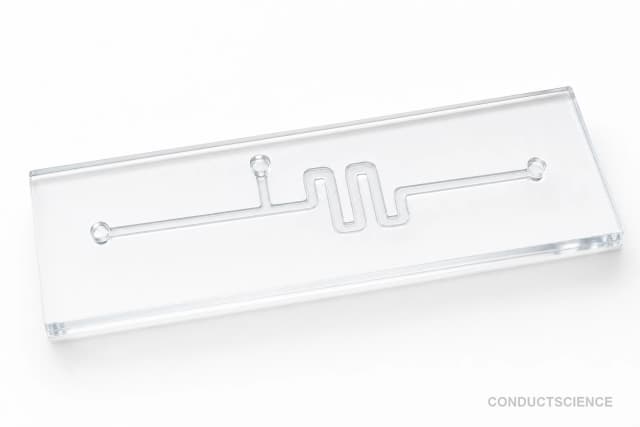
The PDMS S-Channel Mixing Chip is a passive microfluidic device engineered for efficient reagent blending and fluid mixing applications. Fabricated from polydimethylsiloxane (PDMS), this chip features a serpentine S-channel geometry with square cross-section channels that promote chaotic advection and enhanced mixing through repeated directional changes and flow recirculation.
The serpentine channel design creates Dean flow patterns and secondary vortices that significantly improve mixing efficiency compared to straight-channel devices. The biocompatible PDMS material provides optical transparency for real-time observation and is chemically inert to most aqueous solutions and organic solvents commonly used in laboratory applications. This chip serves as a fundamental component in microfluidic systems requiring controlled fluid mixing without active pumping or external mixing mechanisms.
Key Specs
| Material | PDMS |
|---|---|
| Geometry | S-shaped serpentine mixing channel |
| Chip footprint | 25.4 x 76.2 mm standard slide format |
| Channel width | 100 um, 300 um |
| Channel depth | 50 um |
| Bonding | PDMS-PDMS, PDMS-glass |
| Packaging | Standard glass slide (25.4x76.2mm), stainless steel tubes (0.7x1.0x15mm), silicone tubing (0.8x1.9mm) |
| Source | suppliers/wenhao/docs/pdms-chips-catalog.json; 3.2.002.00.041, 3.2.002.00.042, 3.2.002.00.043, 3.2.002.00.044 |
This source-backed block lists available source configurations; confirm selected width/bonding when quoting.
How It Works
The S-channel mixing chip operates through passive chaotic advection principles. As fluids enter the serpentine channel, the curved geometry induces Dean flow - a secondary circulation pattern perpendicular to the main flow direction. This creates helical flow structures that stretch and fold fluid interfaces, dramatically increasing the contact area between different solutions.
The square cross-section channels enhance mixing through sharp corner effects that generate additional vortices and flow instabilities. Multiple S-curves in the serpentine path ensure repeated flow direction changes, preventing the formation of stable stratified layers and promoting rapid homogenization. The mixing efficiency increases with channel length and decreases with flow rate, allowing researchers to optimize mixing performance for specific applications.
The PDMS material provides excellent optical properties for visualization while maintaining chemical compatibility with most biological and analytical solutions. The flexible polymer allows for easy integration with other microfluidic components and enables reversible bonding to glass or other substrates.
Features & Benefits
Shipping weight
- 0.02 lb
Shipping box
- L: 25.0 cm
- W: 15.0 cm
- H: 3.0 cm
| Feature | This Product | Typical Alternative | Advantage |
|---|---|---|---|
| Channel Pattern | S-shaped serpentine mixing channel — 2 ports (inlet/outlet) | Long serpentine path induces chaotic advection for efficient passive mixing | |
| Channel Depth | 50 μm (fixed) | Standard across all configurations in this product line | |
| Channel Width Options | 100 or 300 μm (4 configurations total) | 100 μm for fine mixing; 300 μm for viscous fluids and higher throughput | |
| Bonding Options | PDMS-to-PDMS or PDMS-to-glass | Glass bonding recommended for structural support under higher back-pressure | |
| Manufacturer Part Numbers | 3.2.002.00.041 through 3.2.002.00.044 | Odd numbers = PDMS-PDMS; even numbers = PDMS-glass | |
| Chip Dimensions | 25 × 15 × 3 mm chip on 25.4 × 76.2 mm glass slide | Standard microscope slide format | |
| Included Accessories | Stainless steel tubes (0.7 × 1.0 × 15 mm), silicone tubing (0.8 × 1.9 mm) | Ready to connect to standard syringe pumps out of the box |
S-channel serpentine PDMS chip for passive mixing and extended residence time. Only 2 width options (100 and 300 μm) unlike other geometries. Best for reagent blending, reaction assays, and applications needing thorough mixing without active actuators.
| Model | SKU | Listed price | Status | Shipping box |
|---|---|---|---|---|
| 25-Pack | WHM-0010-300-um-pdms-glass-25-pack | Quote | Available | 25.0 x 15.0 x 3.0 cm |
| 10-Pack | WHM-0010-300-um-pdms-glass-10-pack | Quote | Available | 25.0 x 15.0 x 3.0 cm |
| 25-Pack | WHM-0010-300-um-pdms-pdms-25-pack | Quote | Available | 25.0 x 15.0 x 3.0 cm |
| 10-Pack | WHM-0010-300-um-pdms-pdms-10-pack | Quote | Available | 25.0 x 15.0 x 3.0 cm |
| 25-Pack | WHM-0010-100-um-pdms-glass-25-pack | Quote | Available | 25.0 x 15.0 x 3.0 cm |
| 10-Pack | WHM-0010-100-um-pdms-glass-10-pack | Quote | Available | 25.0 x 15.0 x 3.0 cm |
| 25-Pack | WHM-0010-100-um-pdms-pdms-25-pack | Quote | Available | 25.0 x 15.0 x 3.0 cm |
| 10-Pack | WHM-0010-100-um-pdms-pdms-10-pack | $1,490.00 | Available | 25.0 x 15.0 x 3.0 cm |
Practical Tips
Characterize mixing efficiency using fluorescent tracers at different flow rate ratios to establish optimal operating parameters for your specific application.
Why: Mixing performance varies significantly with flow conditions and requires empirical optimization for each fluid combination.
Clean channels immediately after use to prevent protein adsorption or chemical residue buildup that can alter flow patterns.
Why: Residue accumulation changes channel surface properties and can create flow disturbances that reduce mixing efficiency.
Use degassed solutions and maintain steady flow rates to prevent air bubble formation that disrupts mixing patterns.
Why: Air bubbles create flow instabilities and dead zones that significantly impair mixing performance and reproducibility.
If mixing appears incomplete, reduce flow rates to increase residence time or check for channel blockages that may alter flow patterns.
Why: Insufficient residence time or flow obstructions prevent proper development of chaotic advection patterns essential for mixing.
Document flow rates, pressure drops, and mixing times for each experiment to ensure reproducible conditions between runs.
Why: Microfluidic mixing is highly sensitive to flow parameters and requires precise documentation for reliable experimental replication.
Verify chemical compatibility with PDMS before introducing new solvents, as some chemicals can cause swelling or degradation.
Why: Chemical incompatibility can damage the device and potentially contaminate samples or create safety hazards.
Store chips in clean, dry containers away from dust and particulates to maintain channel cleanliness.
Why: Contamination of channels requires extensive cleaning and can introduce variables that affect mixing performance.
Use microscopy to verify complete mixing before sample collection, as visual mixing may not indicate molecular-level homogenization.
Why: Apparent visual mixing does not guarantee complete molecular homogenization, which may be critical for quantitative analyses.
Setup Guide
What’s in the Box
- PDMS S-Channel Mixing Chip
- User manual with operating procedures
- Material compatibility chart (typical)
- Storage container (typical)
Warranty
ConductScience provides a 1-year manufacturer warranty covering material defects and fabrication quality, with technical support for application development and troubleshooting.
Compliance
What flow rate range provides optimal mixing efficiency?
Optimal mixing typically occurs at flow rates between 1-100 μL/min, with lower rates providing more residence time for complete homogenization. Specific optimization depends on fluid viscosity and desired mixing quality.
Can this chip handle organic solvents or only aqueous solutions?
PDMS is compatible with most aqueous solutions and many organic solvents, but swelling may occur with non-polar solvents like hexane or toluene. Consult material compatibility charts for specific solvent interactions.
How do I prevent air bubble formation during operation?
Prime channels slowly with degassed buffers, maintain steady flow rates, and ensure all connections are bubble-free before introducing samples. Surface treatment with oxygen plasma can improve wetting if bubbles persist.
What microscope objectives work best for mixing visualization?
10x to 20x objectives provide good field of view for observing mixing patterns, while 40x objectives allow detailed analysis of interface boundaries and mixing quality.
Can multiple chips be connected in series for enhanced mixing?
Yes, chips can be connected in series using appropriate tubing and connectors, though pressure drop and dead volume between devices should be considered in the design.
How do I clean the chip between different experiments?
Flush channels with appropriate cleaning solutions (water, ethanol, or surfactants) followed by buffer rinse. Sonication may help remove stubborn residues, but avoid excessive power that could damage PDMS.
What is the typical channel lifetime with continuous use?
PDMS channels can withstand hundreds of hours of operation with compatible fluids. Lifetime depends on chemical exposure, flow rates, and mechanical stress from pressure cycling.
Have a question about this product?
Have a question? Just ask.
Send it over and we'll email you a personalized answer — no call, no scheduling.
Prefer to talk it through?