PDMS Fluid Mixing Microfluidic Chip
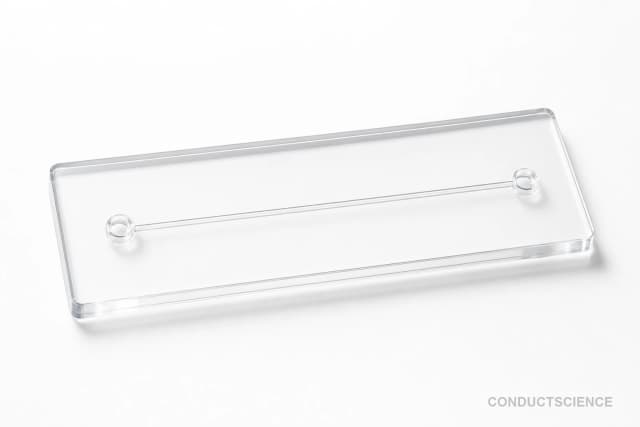
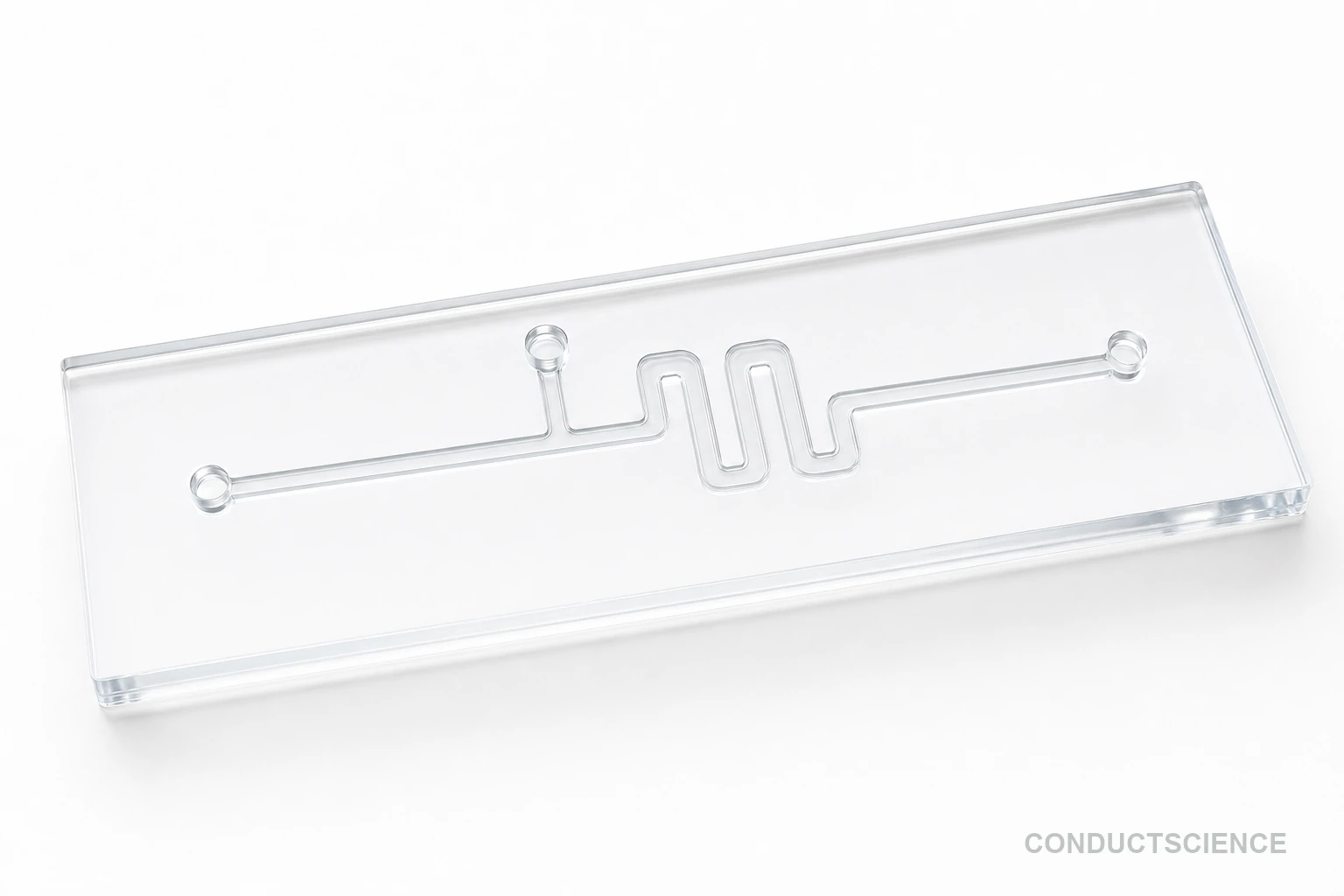
PDMS microfluidic chip with 500 μm square channels designed for fluid mixing applications and viscous fluid handling with optical transparency for real-time monitoring.
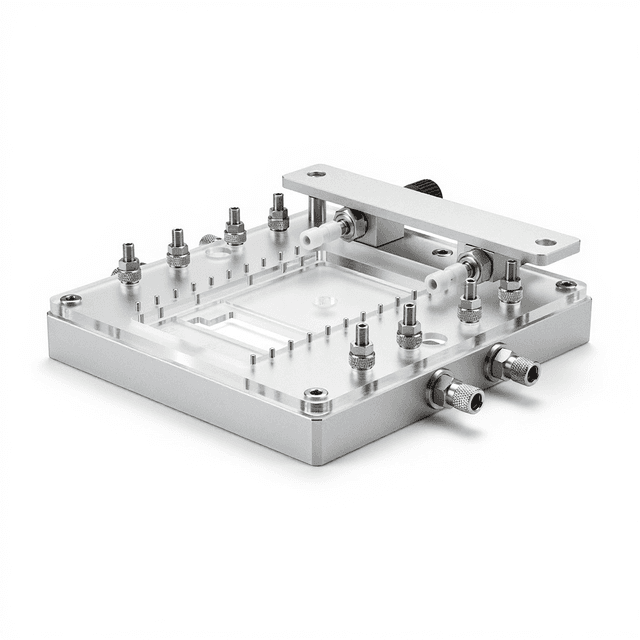
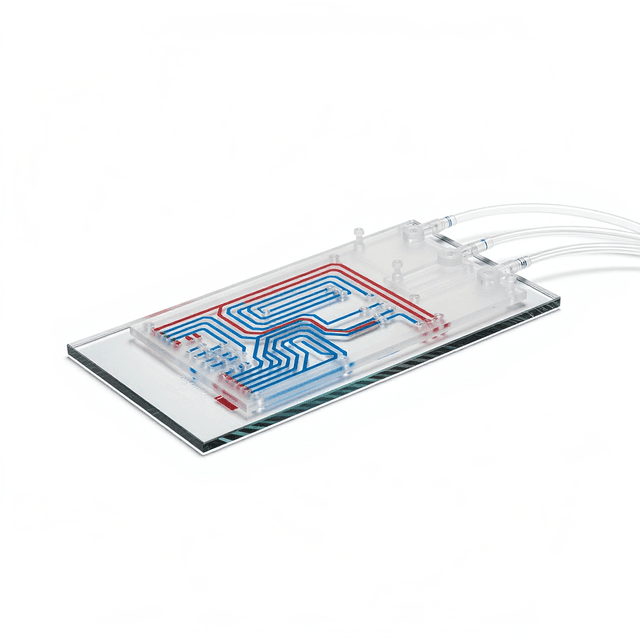
Reusable chip — designed for multiple experimental runs. Compatible with standard microfluidic tubing: steel pins (0.7 mm ID / 1.0 mm OD) and silicone tubing (0.8 mm ID / 1.9 mm OD). Available in bulk packs (5‑, 10‑, and 25‑unit) for lab-scale and consumable workflows.

Louise Corscadden, PhD
Director of Science · ConductScience
Ask Louise about PDMS Fluid Mixing Microfluidic Chip fit, setup, configuration, or quote prep.
Already working with us? Sign in to connect this with My Scientist.
Key Specifications
Full details →- Model fit
- 2 selectable configurations
- SKU family
- WHM-0011
- Shipping box
- 25.0 x 15.0 x 3.0 cm
- Ordering
- Online checkout and quote request available
- Category
- Lab Equipment
- Build notes
- Confirm accessories, station layout, and support needs before purchase
The PDMS Fluid Mixing Microfluidic Chip is a polydimethylsiloxane (PDMS) microfluidic device designed for controlled fluid mixing and viscous fluid handling applications. This chip features uniform 500 μm × 500 μm microchannels fabricated in optically clear PDMS, enabling real-time visualization of fluid behavior and mixing dynamics. The device provides a controlled microenvironment for studying fluid mechanics, chemical reactions, and biological processes at the microscale.
The chip's square channel geometry and biocompatible PDMS material make it suitable for applications requiring precise fluid control, from chemical synthesis to cell culture studies. The transparent substrate allows for optical monitoring and analysis of mixing processes, particle tracking, and reaction kinetics using standard microscopy techniques.
Key Specs
| Material | PDMS |
|---|---|
| Geometry | T-shaped junction with serpentine mixing section, 3 ports |
| Ports | 3 ports (Inlet 1, Inlet 2, Outlet) |
| Chip footprint | 25.4 x 76.2 mm standard slide format |
| Channel width | 50 um, 100 um, 150 um, 200 um |
| Channel depth | 50 um |
| Bonding | PDMS-PDMS, PDMS-glass |
| Packaging | Standard glass slide (25.4x76.2mm), stainless steel tubes (0.7x1.0x15mm), silicone tubing (0.8x1.9mm) |
| Source | suppliers/wenhao/docs/pdms-chips-catalog.json; 3.2.002.00.025, 3.2.002.00.026, 3.2.002.00.027, 3.2.002.00.028, 3.2.002.00.029, 3.2.002.00.030, 3.2.002.00.031, 3.2.002.00.032 |
This source-backed block lists available source configurations; confirm selected width/bonding when quoting.
How It Works
The PDMS microfluidic chip operates on principles of laminar flow mixing at low Reynolds numbers. Fluids introduced into the 500 μm square channels maintain laminar flow characteristics, with mixing occurring primarily through molecular diffusion across fluid interfaces. The channel dimensions are optimized to balance mixing efficiency with flow resistance, allowing controlled residence times for complete mixing.
The PDMS material provides optical transparency across the visible spectrum, enabling direct observation of mixing processes using brightfield, fluorescence, or phase contrast microscopy. The biocompatible and chemically inert properties of PDMS make it suitable for biological applications while maintaining structural integrity under moderate pressures and flow rates.
Features & Benefits
Shipping weight
- 0.02 lb
Shipping box
- L: 25.0 cm
- W: 15.0 cm
- H: 3.0 cm
| Feature | This Product | Typical Alternative | Advantage |
|---|---|---|---|
| Channel Pattern | T-junction (T型) with downstream serpentine mixing section — 3 ports | Perpendicular intersection for droplet pinch-off, serpentine extends residence time | |
| Channel Depth | 50 μm (fixed) | Standard across all configurations in this product line | |
| Channel Width Options | 50, 100, 150, or 200 μm (8 configurations total) | Width controls droplet size and generation frequency | |
| Bonding Options | PDMS-to-PDMS or PDMS-to-glass | Glass bonding recommended for structural support during pressure-driven flow | |
| Manufacturer Part Numbers | 3.2.002.00.025 through 3.2.002.00.032 (Model: WHBZ-TC) | Odd numbers = PDMS-PDMS; even numbers = PDMS-glass | |
| Chip Dimensions | 25 × 15 × 3 mm chip on 25.4 × 76.2 mm glass slide | Standard microscope slide format | |
| Included Accessories | Stainless steel tubes (0.7 × 1.0 × 15 mm), silicone tubing (0.8 × 1.9 mm) | 3 connection points: 2 inlets + 1 outlet |
T-junction PDMS chip with integrated serpentine mixing section for droplet generation and two-phase segmented flow. The serpentine downstream section provides additional mixing and extended residence time. 8 configurations: 4 widths × 2 bonding types.
| Model | SKU | Listed price | Status | Shipping box |
|---|---|---|---|---|
| 25-Pack | WHM-0011-200-um-pdms-glass-25-pack | Quote | Available | 25.0 x 15.0 x 3.0 cm |
| 10-Pack | WHM-0011-200-um-pdms-glass-10-pack | Quote | Available | 25.0 x 15.0 x 3.0 cm |
| 25-Pack | WHM-0011-200-um-pdms-pdms-25-pack | Quote | Available | 25.0 x 15.0 x 3.0 cm |
| 10-Pack | WHM-0011-200-um-pdms-pdms-10-pack | Quote | Available | 25.0 x 15.0 x 3.0 cm |
| 25-Pack | WHM-0011-150-um-pdms-glass-25-pack | Quote | Available | 25.0 x 15.0 x 3.0 cm |
| 10-Pack | WHM-0011-150-um-pdms-glass-10-pack | Quote | Available | 25.0 x 15.0 x 3.0 cm |
| 25-Pack | WHM-0011-150-um-pdms-pdms-25-pack | Quote | Available | 25.0 x 15.0 x 3.0 cm |
| 10-Pack | WHM-0011-150-um-pdms-pdms-10-pack | Quote | Available | 25.0 x 15.0 x 3.0 cm |
| 25-Pack | WHM-0011-100-um-pdms-glass-25-pack | Quote | Available | 25.0 x 15.0 x 3.0 cm |
| 10-Pack | WHM-0011-100-um-pdms-glass-10-pack | Quote | Available | 25.0 x 15.0 x 3.0 cm |
| 25-Pack | WHM-0011-100-um-pdms-pdms-25-pack | Quote | Available | 25.0 x 15.0 x 3.0 cm |
| 10-Pack | WHM-0011-100-um-pdms-pdms-10-pack | Quote | Available | 25.0 x 15.0 x 3.0 cm |
| 25-Pack | WHM-0011-50-um-pdms-glass-25-pack | Quote | Available | 25.0 x 15.0 x 3.0 cm |
| 10-Pack | WHM-0011-50-um-pdms-glass-10-pack | Quote | Available | 25.0 x 15.0 x 3.0 cm |
| 25-Pack | WHM-0011-50-um-pdms-pdms-25-pack | Quote | Available | 25.0 x 15.0 x 3.0 cm |
| 10-Pack | WHM-0011-50-um-pdms-pdms-10-pack | $1,490.00 | Available | 25.0 x 15.0 x 3.0 cm |
Practical Tips
Degas all fluids before use to minimize bubble formation in channels.
Why: Air bubbles can disrupt flow patterns and interfere with optical measurements.
Clean channels immediately after use with appropriate solvents or buffer solutions.
Why: Prevents protein adsorption or particle accumulation that could affect subsequent experiments.
Establish flow rate calibration curves for each pump and tubing setup.
Why: Ensures reproducible flow conditions and accurate fluid delivery rates.
Allow sufficient equilibration time for steady-state flow before data collection.
Why: Transient flow effects can confound mixing measurements and particle tracking analysis.
Use fluorescent dyes or particles to visualize flow patterns and identify flow irregularities.
Why: Visual confirmation helps identify blockages, leaks, or uneven flow distribution.
Verify chemical compatibility of PDMS with all solutions before use.
Why: Some organic solvents can cause PDMS swelling or degradation, compromising device integrity.
Setup Guide
What’s in the Box
- PDMS microfluidic chip
- User manual with specifications
- Storage case (typical)
Warranty
ConductScience provides a 1-year manufacturer warranty covering material defects and fabrication quality. Technical support is available for application guidance and troubleshooting.
Compliance
References
Background reading relevant to this product:
What pressure range can the PDMS chip withstand?
Consult product datasheet for specific pressure ratings. PDMS devices typically operate at pressures up to several atmospheres, but exact limits depend on channel geometry and bonding method.
Is the chip reusable for multiple experiments?
PDMS chips can be cleaned and reused for compatible applications. Cleaning protocols depend on the fluids used and may include solvent flushing, sonication, or plasma treatment to restore surface properties.
What microscopy techniques are compatible?
The optical transparency of PDMS supports brightfield, fluorescence, phase contrast, and differential interference contrast microscopy. UV applications may require consideration of PDMS autofluorescence.
How do I prevent bubble formation in channels?
Prime channels slowly with degassed fluids, use consistent flow rates, and consider surface treatment to improve wetting properties. Bubble traps in tubing connections can also help.
What flow rates are optimal for mixing?
Optimal flow rates depend on fluid properties and desired mixing time. Start with low flow rates to establish laminar conditions, then increase systematically while monitoring mixing efficiency optically.
Can organic solvents be used with PDMS?
PDMS can swell in organic solvents like toluene and chloroform. Test compatibility with specific solvents and consider alternative materials for aggressive chemical applications.
How do I connect tubing to the chip?
Use appropriate tubing connectors or punch holes for tight-fitting tubing. Ensure leak-free connections with biocompatible adhesives or mechanical fittings as needed.
Have a question about this product?
Have a question? Just ask.
Send it over and we'll email you a personalized answer — no call, no scheduling.
Prefer to talk it through?
Upgrade Options