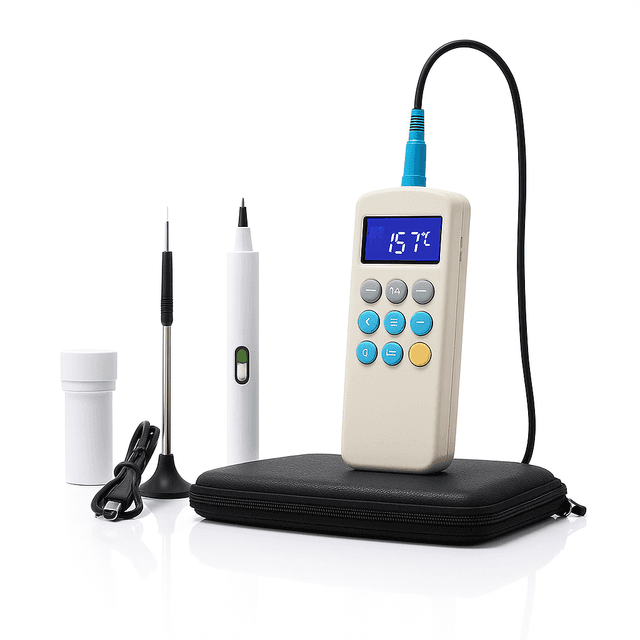
Conductivity Probe
Precision platinum electrode conductivity probe with 0.1 cm⁻¹ cell constant, optimized for pure water analysis and laboratory water quality measurements with anti-polarization platinum-black surface treatment.

Louise Corscadden, PhD
Director of Science · ConductScience
Ask Louise about Conductivity Probe fit, setup, configuration, or quote prep.
Already working with us? Sign in to connect this with My Scientist.
Key Specifications
Full details →- Model fit
- Configured during quote
- SKU family
- CS-LH-ELC008
- Shipping box
- 20.0 x 10.0 x 5.0 cm
- Ordering
- Online checkout and quote request available
- Category
- Portable Analyzers
- Build notes
- Confirm accessories, station layout, and support needs before purchase
The DJS-0.1 Conductivity Probe represents a specialized platinum electrode system designed for precise electrical conductivity measurements in laboratory water quality applications. This bipolar electrode configuration features platinum plates sintered onto parallel glass substrates with optimized electrode spacing and surface area to achieve a cell constant of 0.1 cm⁻¹, making it particularly suited for pure and ultra-pure water analysis where low conductivity values require enhanced sensitivity.
The probe employs a platinum-black electrode surface treatment that effectively minimizes polarization effects in high-conductivity solutions, ensuring stable readings across a broad measurement range. The glass-body construction provides chemical inertness and dimensional stability, while the precision-manufactured electrode geometry delivers consistent cell constant values essential for accurate conductivity determinations in research and analytical applications.
How It Works
Electrical conductivity measurement relies on the principle that dissolved ionic species in aqueous solutions facilitate current flow between electrodes under an applied electrical potential. The DJS-0.1 probe utilizes a bipolar electrode configuration where two platinum surfaces are positioned at a fixed distance within a glass cell body. When an alternating voltage is applied across the electrodes, current flows through the solution proportionally to the concentration and mobility of dissolved ions.
The platinum-black coating increases the effective electrode surface area through microscopic roughening, reducing polarization impedance that can interfere with accurate measurements at higher conductivity levels. The cell constant (K = 0.1 cm⁻¹) represents the ratio of electrode spacing to electrode area, allowing direct calculation of specific conductance from measured conductance values. This geometric factor remains stable due to the precision-manufactured glass substrate that maintains electrode positioning under varying temperature and solution conditions.
Temperature compensation is critical since ionic mobility varies with temperature, typically following a 2-3% change per degree Celsius. The glass construction provides thermal equilibration with the sample while maintaining dimensional stability of the electrode geometry essential for measurement repeatability.
Features & Benefits
Automation Level
- manual
Brand
- ConductScience
Research Domain
- Analytical Chemistry
- Environmental Monitoring
- Food Science
- Industrial Hygiene
- Materials Science
- Pharmaceutical QC
Shipping weight
- 0.26 lb
Shipping box
- L: 20.0 cm
- W: 10.0 cm
- H: 5.0 cm
| Feature | This Product | Typical Alternative | Advantage |
|---|---|---|---|
| Cell Constant | 0.1 cm⁻¹ optimized for pure water analysis | Standard electrodes often use 1.0 cm⁻¹ cell constants | Enhanced sensitivity enables accurate measurement of low-conductivity pure water samples where higher cell constants lack sufficient resolution. |
| Electrode Material | Platinum-black coated electrodes with anti-polarization properties | Basic models use plain platinum or stainless steel electrodes | Reduces measurement drift and extends usable conductivity range while maintaining stable readings across varying solution conditions. |
| Construction Material | Glass body construction for chemical inertness | Entry-level probes often feature plastic housing | Provides superior chemical compatibility and dimensional stability essential for precise analytical measurements and long-term reliability. |
| Electrode Configuration | Precision bipolar electrode design with optimized geometry | Simple probe designs may lack optimized electrode spacing | Ensures consistent cell constant and reduces stray capacitance effects that can compromise measurement accuracy in pure water applications. |
This conductivity probe offers specialized design features including 0.1 cm⁻¹ cell constant, platinum-black anti-polarization coating, and precision glass construction that optimize performance for pure water analysis and analytical chemistry applications requiring enhanced sensitivity and chemical compatibility.
Practical Tips
Use conductivity standards that bracket your expected measurement range and verify calibration with multiple standard concentrations to ensure linearity across your working range.
Why: Ensures measurement accuracy across the full range of sample conductivities you expect to encounter.
Clean platinum electrodes gently with soft brush and mild detergent, avoiding abrasive materials that could damage the platinum-black coating.
Why: Preserves the anti-polarization surface treatment that is critical for stable measurements in higher conductivity solutions.
Allow adequate equilibration time (5-10 minutes) when moving between solutions of significantly different conductivity or temperature.
Why: Ensures thermal and chemical equilibrium for accurate readings, particularly important in pure water applications.
If readings drift or appear unstable, check for air bubbles on electrode surfaces and verify the electrode is fully immersed in solution.
Why: Air contact or partial immersion creates measurement artifacts that compromise accuracy and repeatability.
Record solution temperature alongside conductivity measurements and apply appropriate temperature compensation factors for your specific solution type.
Why: Temperature significantly affects ionic mobility and conductivity, requiring correction for accurate and comparable results.
Handle the glass electrode body carefully to avoid mechanical shock that could crack the electrode housing or disturb electrode geometry.
Why: Maintains the precision electrode spacing and cell constant that are essential for accurate conductivity measurements.
Setup Guide
What’s in the Box
- DJS-0.1 conductivity probe with glass electrode body
- Connection cable with appropriate connector (typical)
- User manual and specifications (typical)
- Calibration certificate (typical)
Warranty
ConductScience provides standard manufacturer warranty coverage for defects in materials and workmanship. Technical support is available for calibration procedures and measurement troubleshooting.
Compliance
References
Background reading relevant to this product:
What is the optimal measurement range for the 0.1 cm⁻¹ cell constant?
The 0.1 cell constant is optimized for pure and ultra-pure water applications with low conductivity values. Consult the product datasheet for specific measurement ranges and accuracy specifications.
How does the platinum-black coating affect electrode maintenance?
The platinum-black surface increases effective area and reduces polarization but may require gentle cleaning procedures to maintain coating integrity. Avoid abrasive cleaning methods that could damage the surface treatment.
What temperature compensation factors should be applied?
Conductivity typically increases 2-3% per degree Celsius. Use certified temperature compensation coefficients specific to your solution type, or employ automatic temperature compensation if available on your meter.
How frequently should calibration verification be performed?
Calibration frequency depends on measurement precision requirements and solution types. For critical applications, verify calibration daily using certified standard solutions bracketing your measurement range.
What connector types are available for different meter systems?
The probe is available with various connector configurations to match different conductivity meters. Verify connector compatibility with your specific instrument model before ordering.
Can this electrode measure high-conductivity solutions?
While optimized for pure water, the platinum-black coating enables measurement of higher conductivity solutions. However, accuracy may be reduced outside the optimal range - consult specifications for your application.
What storage conditions maintain electrode performance?
Store the electrode immersed in deionized water or appropriate storage solution. Avoid allowing the platinum surfaces to dry completely, which can affect response characteristics.
Have a question about this product?
Have a question? Just ask.
Send it over and we'll email you a personalized answer — no call, no scheduling.
Prefer to talk it through?
Accessories
Enhance your setup with compatible accessories
Frequently Bought Together