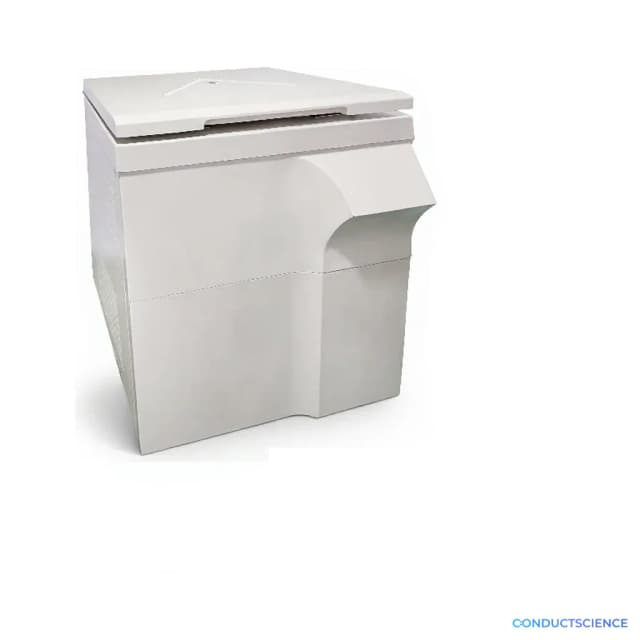
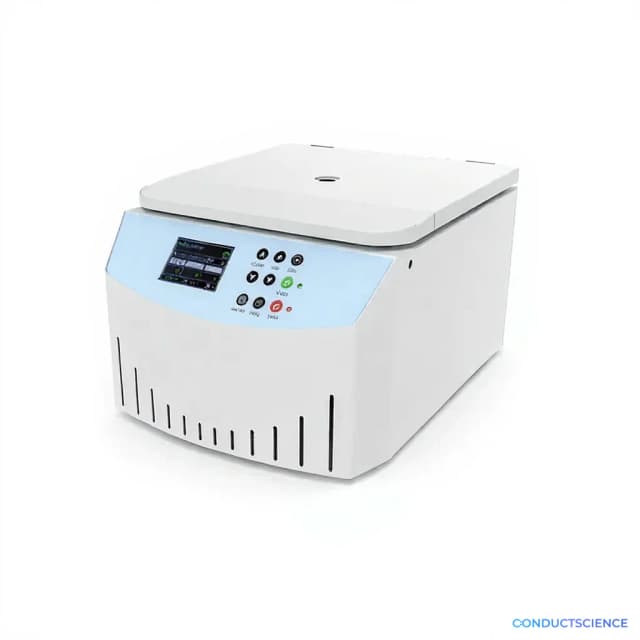
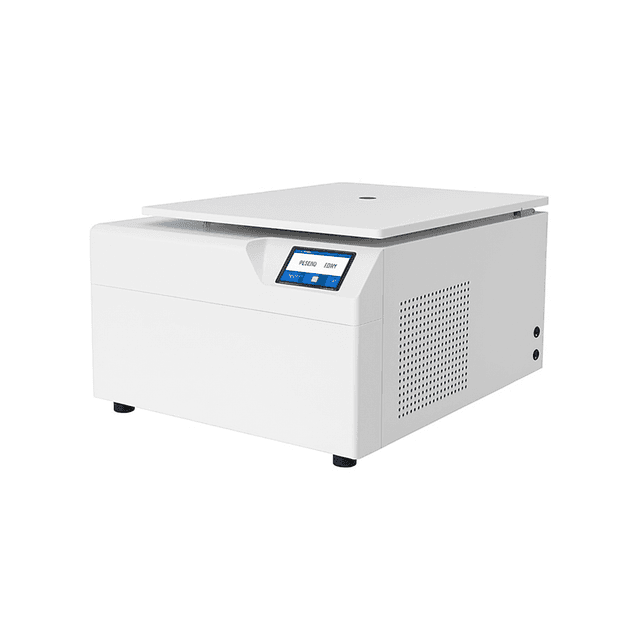
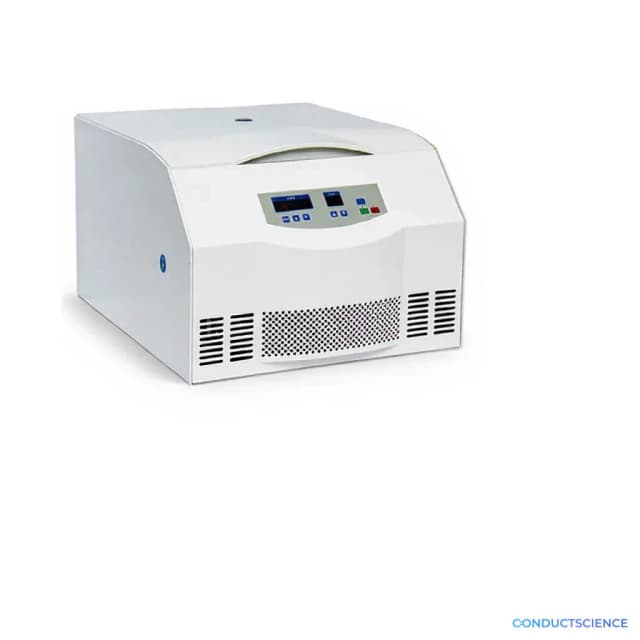
Cytology Centrifuge
Benchtop cytology centrifuge accommodating 12 cards with speeds up to 3000 rpm and centrifugal forces to 1026×g for cellular specimen preparation and analysis.

Louise Corscadden, PhD
Director of Science · ConductScience
Ask Louise about Cytology Centrifuge fit, setup, configuration, or quote prep.
Already working with us? Sign in to connect this with My Scientist.
Key Specifications
Full details →- Model fit
- Configured during quote
- SKU family
- BIO-0334
- Shipping box
- 27.8 x 34.0 x 43.0 cm
- Ordering
- Online checkout and quote request available
- Category
- Centrifuges
- Build notes
- Confirm accessories, station layout, and support needs before purchase
The ConductScience Cytology Centrifuge is a benchtop laboratory centrifuge designed for cytological specimen preparation and cellular analysis applications. This unit accommodates up to 12 cytology cards with a maximum speed of 3000 rpm, generating centrifugal forces up to 1026×g for effective sedimentation of cellular material onto microscope slides or analysis surfaces.
The centrifuge features precise speed control with ±10 rpm accuracy and programmable timing from 1 second to 99 minutes, enabling standardized processing protocols for various cytological specimens. The compact design with low noise operation (≤60dB) makes it suitable for use in clinical laboratories, research facilities, and pathology departments where consistent, reproducible specimen preparation is required.
How It Works
The cytology centrifuge operates on the principle of centrifugal sedimentation, where rotational motion creates centrifugal force that drives cellular material through a liquid medium toward a collection surface. When cytology cards containing specimen chambers are loaded into the rotor, the centrifugal force generated at speeds up to 3000 rpm (1026×g) overcomes the buoyancy and drag forces acting on suspended cells, causing them to migrate radially outward and deposit onto the slide or analysis surface.
The sedimentation velocity depends on cell size, density, and the viscosity of the surrounding medium according to Stokes' law. Larger, denser cells sediment faster than smaller cells, allowing for some degree of size-based separation during the centrifugation process. The programmable timing control allows optimization of centrifugation duration to achieve complete sedimentation without cell damage or over-concentration effects.
The precise speed control (±10 rpm) ensures reproducible centrifugal force application across samples, critical for standardized cytological preparations. The gradual acceleration and deceleration profiles minimize cell disruption while maintaining morphological integrity of the deposited cellular material for subsequent microscopic examination.
Features & Benefits
Automation Level
- semi-automated
Max. Capacity
- 12 cards
Max speed
- 3,000 rpm
Timing Range
- 1s~99min
Speed Precision
- ±10rpm
Noise
- ≤60dB
Consumption
- 150W
External Size(L*W*H)
- 340*430*278mm
Package Size(L*W*H)
- 476*566*436mm
NO.
- Rotors Type
Brand
- ConductScience
Research Domain
- Cancer Research
- Cell Biology
- Clinical Diagnostics
- Developmental Biology
- Histopathology
- Microbiology
Power/Voltage
- AC220V, 50/60Hz or 110V, 50/60Hz
Weight
- 24kg
Capacity
- Max. Speed
Max force
- 1,026 ×g
Shipping weight
- 20.0 lb
Shipping box
- L: 27.8 cm
- W: 34.0 cm
- H: 43.0 cm
| Feature | This Product | Typical Alternative | Advantage |
|---|---|---|---|
| Sample Capacity | 12 cytology cards | Entry-level models often offer 6-8 card capacity | Higher capacity reduces the number of centrifugation runs required for batch specimen processing. |
| Maximum Speed | 3000 rpm (1026×g) | Basic cytology centrifuges typically offer 2000-2500 rpm | Higher centrifugal force enables more efficient cellular sedimentation and concentration. |
| Speed Precision | ±10 rpm accuracy | Standard models may have ±20-50 rpm variation | Improved precision ensures reproducible centrifugal forces for consistent specimen preparation results. |
| Timing Range | 1 second to 99 minutes programmable | Many units offer limited timing options or manual control | Precise timing control allows optimization for different specimen types and concentration requirements. |
| Noise Level | ≤60dB operation | Older models often operate at 70-80dB | Quieter operation is suitable for use in clinical environments without disrupting adjacent activities. |
| Power Consumption | 150W energy usage | Comparable units vary widely in power requirements | Efficient power usage reduces operational costs and heat generation in laboratory environments. |
This cytology centrifuge provides 12-card capacity with precise speed control up to 3000 rpm and programmable timing, offering efficient specimen processing for routine cytological applications. The combination of moderate speed capability, precise control, and quiet operation makes it suitable for clinical and research laboratory environments.
Practical Tips
Verify speed accuracy monthly using a digital tachometer or calibrated speed measurement device during routine maintenance.
Why: Speed accuracy directly affects centrifugal force application and specimen preparation consistency.
Clean and inspect the rotor for wear, cracks, or corrosion after every 100 uses or monthly, whichever occurs first.
Why: Rotor integrity is critical for safe operation and prevents catastrophic failure during high-speed operation.
Always balance cytology cards by positioning them symmetrically in the rotor, using water-filled balance cards if necessary.
Why: Proper balancing prevents excessive vibration, reduces wear, and ensures uniform centrifugal force distribution.
If excessive vibration occurs, stop immediately and check for proper card seating, balanced loading, and rotor installation.
Why: Unbalanced operation can damage the centrifuge mechanism and compromise specimen preparation quality.
Record centrifugation parameters (speed, time, temperature) for each specimen type to establish standardized protocols.
Why: Consistent parameters improve reproducibility and enable method validation for diagnostic applications.
Never open the lid while the rotor is spinning, and wait for complete deceleration before accessing specimens.
Why: Moving rotors present serious injury hazards and opening during operation can damage the safety interlock system.
Pre-cool the centrifuge for temperature-sensitive specimens by running empty at desired speed for 2-3 minutes before loading samples.
Why: Temperature control prevents heat-induced cellular damage and maintains specimen morphology during processing.
Keep spare rotor seals and gaskets available and replace them at first sign of wear or contamination.
Why: Proper sealing prevents specimen contamination and maintains optimal centrifugation conditions.
Setup Guide
What’s in the Box
- Cytology centrifuge main unit
- 12-position cytology card rotor (typical)
- Power cord
- User manual and operation guide (typical)
- Rotor balancing accessories (typical)
Warranty
ConductScience provides a standard one-year manufacturer warranty covering defects in materials and workmanship, with technical support available for operational questions and maintenance guidance.
Compliance
What types of cytology cards are compatible with this centrifuge?
The centrifuge accommodates up to 12 standard cytology cards. Consult product datasheet for specific card dimensions and compatibility requirements with your cytology preparation system.
How do I determine optimal centrifugation parameters for different specimen types?
Start with manufacturer protocols for your specific specimen type, typically 1000-2000 rpm for 5-10 minutes. Adjust speed and time based on cell concentration and morphology requirements while staying within the 3000 rpm maximum.
Can the rotor be removed for cleaning and maintenance?
Yes, the rotor is designed for removal to facilitate thorough cleaning and decontamination between different specimen types. Follow manufacturer instructions for proper installation and balancing procedures.
What maintenance schedule is recommended for optimal performance?
Regular cleaning after each use, monthly inspection of rotor balance and wear, and annual professional calibration of speed and timing systems are recommended to maintain accuracy and safety.
How does the speed precision affect cytological preparation consistency?
The ±10 rpm precision ensures consistent centrifugal force application, which is critical for reproducible cell sedimentation patterns and uniform specimen distribution on slides across multiple preparations.
Is the centrifuge suitable for processing infectious specimens?
The unit can process specimens following appropriate biosafety protocols. Ensure proper containment procedures, use sealed cytology cards when appropriate, and follow institutional guidelines for infectious material handling.
What happens if the rotor becomes unbalanced during operation?
Unbalanced loading will cause excessive vibration and noise. The unit should be stopped immediately, and specimens redistributed for balanced loading before resuming operation to prevent damage and ensure safety.
How does this compare to manual sedimentation methods?
Centrifugal force provides faster, more complete cell concentration compared to gravity sedimentation, with programmable timing for standardized protocols and reduced hands-on time for laboratory personnel.
Have a question about this product?
Have a question? Just ask.
Send it over and we'll email you a personalized answer — no call, no scheduling.
Prefer to talk it through?