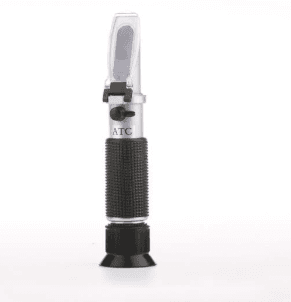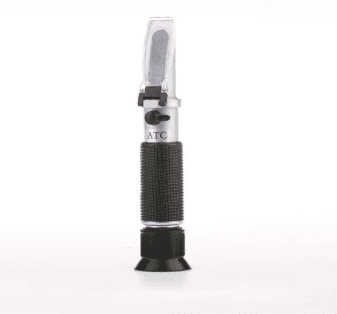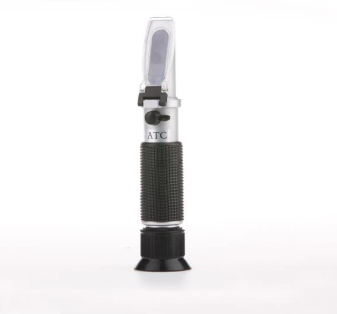
Honey Refractometer
Handheld optical refractometer for measuring Brix concentration across low to high ranges in food products, beverages, and industrial fluids.

Louise Corscadden, PhD
Director of Science · ConductScience
Ask Louise about Honey Refractometer fit, setup, configuration, or quote prep.
Already working with us? Sign in to connect this with My Scientist.
Key Specifications
Full details →- Model fit
- Configured during quote
- SKU family
- CS-LH-F92
- Shipping box
- 20.0 x 10.0 x 5.0 cm
- Ordering
- Online checkout and quote request available
- Category
- Refractometers
- Build notes
- Confirm accessories, station layout, and support needs before purchase
The Honey Refractometer (Model LH-F92) is a handheld optical instrument designed for measuring Brix concentration across low, middle, and high ranges. This refractometer utilizes the principle of light refraction to determine sugar content in various liquid samples, making it suitable for food science applications, quality control testing, and industrial fluid analysis.
The instrument accommodates a wide range of sample types, from low-concentration beverages and fruit juices to high-sugar content materials like honey and concentrated syrups. The optical measurement system provides rapid determination of soluble solid content without sample dilution or complex preparation protocols, supporting both laboratory and field-based testing scenarios.
How It Works
Refractometry operates on Snell's law of light refraction, measuring the bending of light as it passes from one medium to another with different refractive indices. When light transitions from the sample solution to the refractometer's optical system, the angle of refraction correlates directly with the concentration of dissolved solids in the sample.
The instrument contains a prism system and optical scale that converts the critical angle of total internal reflection into a readable Brix value. As sugar concentration increases, the refractive index of the solution increases proportionally, causing measurable changes in the light path. The optical system compensates for ambient temperature effects and provides direct readout of percent Brix concentration.
Sample preparation requires only a few drops of liquid placed on the daylight plate. The measurement occurs instantly when light passes through the sample, eliminating the need for lengthy analytical procedures or chemical reagents.
Features & Benefits
Model
- LH-F92
Scope of use
- Model No.
Honey
- LH-F92
Automation Level
- manual
Brand
- ConductScience
Research Domain
- Analytical Chemistry
- Environmental Monitoring
- Food Science
- Industrial Hygiene
- Microbiology
- Pharmaceutical QC
Shipping weight
- 0.26 lb
Shipping box
- L: 20.0 cm
- W: 10.0 cm
- H: 5.0 cm
| Feature | This Product | Typical Alternative | Advantage |
|---|---|---|---|
| Measurement Range Coverage | Low, middle, and high Brix ranges in single instrument | Entry-level models often cover limited ranges requiring multiple instruments | Eliminates need for multiple refractometers when testing diverse sample types in the same laboratory. |
| Power Requirements | Optical system requires no electrical power | Digital models require battery power or AC adapters | Enables field measurements and eliminates concerns about battery life or power availability. |
| Sample Volume | Requires only 2-3 drops for measurement | Some instruments require larger sample volumes | Conserves valuable samples and reduces waste during quality control testing. |
| Calibration Method | Simple water-based zero adjustment | Digital models may require complex calibration procedures | Simplifies routine calibration and reduces training requirements for laboratory personnel. |
| Environmental Durability | Mechanical optical system with temperature compensation | Electronic components may be sensitive to temperature and humidity | Maintains measurement capability in challenging field conditions and varying environmental conditions. |
The LH-F92 combines wide-range measurement capability with mechanical reliability, making it suitable for laboratories requiring consistent Brix measurements across diverse sample types. The optical design eliminates electronic dependencies while maintaining measurement accuracy through integrated temperature compensation.
Practical Tips
Use only distilled or deionized water for zero calibration, and allow water to reach ambient temperature before calibration.
Why: Temperature differences and dissolved minerals in tap water can introduce calibration errors.
Clean the daylight plate immediately after measuring sticky or high-sugar samples to prevent residue buildup.
Why: Dried sugar residues can scratch optical surfaces and affect subsequent measurement accuracy.
Point the refractometer toward a consistent light source and avoid direct sunlight for readings.
Why: Variable lighting conditions can make it difficult to identify the precise boundary line position.
Take multiple readings of the same sample and average the results for critical measurements.
Why: Reduces random errors from slight variations in sample placement or boundary line reading.
If the boundary line appears fuzzy or indistinct, ensure complete sample coverage and remove any air bubbles.
Why: Incomplete sample coverage or air gaps create optical discontinuities that interfere with accurate readings.
Avoid using organic solvents or harsh chemicals for cleaning optical surfaces.
Why: Chemical solvents can damage optical coatings and affect the instrument's measurement accuracy.
Record ambient temperature along with Brix readings for samples measured outside normal laboratory conditions.
Why: Temperature documentation helps identify potential measurement drift and supports data quality assurance.
Setup Guide
What’s in the Box
- Honey Refractometer LH-F92 main unit
- Protective carrying case (typical)
- Calibration adjustment tool (typical)
- Cleaning cloth (typical)
- User manual and calibration instructions (typical)
Warranty
ConductScience provides a standard one-year manufacturer warranty covering defects in materials and workmanship, with technical support available for calibration and operational questions.
Compliance
What is the measurement accuracy and precision of the LH-F92 refractometer?
Consult product datasheet for specific accuracy specifications. Typical handheld refractometers provide measurements within ±0.2-0.5% Brix, depending on sample type and environmental conditions.
How often should the refractometer be calibrated?
Calibrate before each measurement session using distilled water as the zero reference. Daily calibration is recommended for routine use, with additional checks when changing sample types or environmental conditions.
What types of samples can interfere with accurate measurements?
Samples containing suspended particles, air bubbles, or volatile compounds may affect readings. Filter turbid samples and allow carbonated beverages to degas before measurement.
Can the refractometer measure non-sugar dissolved solids?
The instrument reads total dissolved solids as Brix equivalent. For non-sugar solutions, conversion factors may be needed to relate Brix readings to actual concentration.
What is the minimum sample volume required for measurement?
Requires 2-3 drops of liquid sample to cover the daylight plate completely. Ensure uniform coverage without air gaps for accurate readings.
How does temperature affect measurement accuracy?
The instrument includes temperature compensation for typical laboratory conditions. Large temperature differences between sample and ambient may require equilibration time.
What maintenance is required for long-term accuracy?
Clean optical surfaces with distilled water after each use, store in protective case, and verify calibration regularly. Avoid exposure to extreme temperatures or mechanical shock.
Have a question about this product?
Have a question? Just ask.
Send it over and we'll email you a personalized answer — no call, no scheduling.
Prefer to talk it through?