Laboratory Hammer Mill for Grain Samples
The mill grinds wheat and other grain into whole meal for gluten, alpha-amylase and starch pasting tests and for near-infrared analysis.

Louise Corscadden, PhD
Director of Science · ConductScience
Ask Louise about Laboratory Hammer Mill for Grain Samples fit, setup, configuration, or quote prep.
Already working with us? Sign in to connect this with My Scientist.
Key Specifications
Full details →- Mill Type
- Hammer mill with cyclone collection
- Hammer Speed
- 16,800 rpm
- Motor Power
- 750 W
- Grinding Chamber Diameter
- 110 mm
- Screen Aperture
- 0.5, 0.8 or 1.5 mm
- Power Supply
- 220 V ±10 V AC, 50 Hz
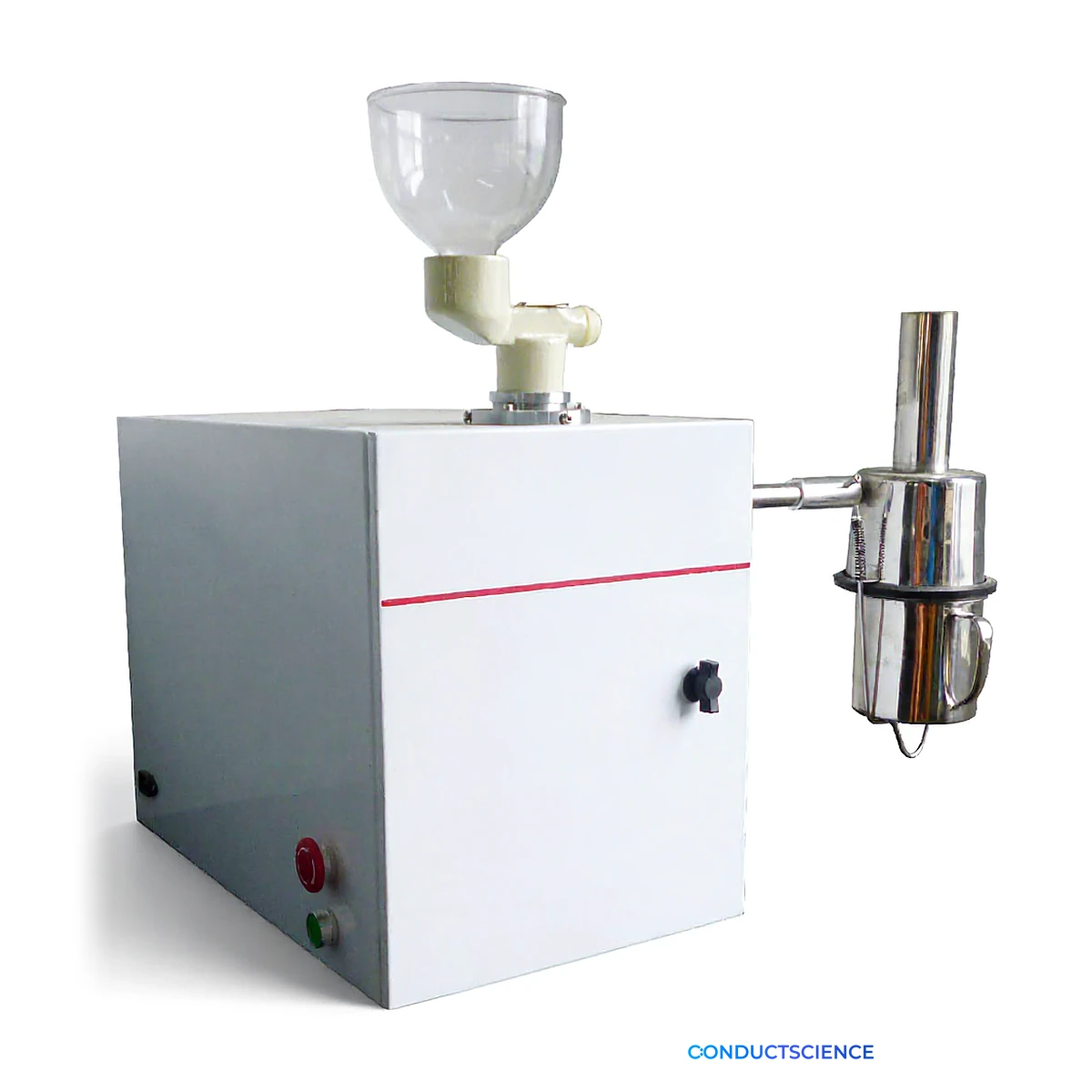
Grain feeds from a clear hopper into the grinding chamber, where the hammer breaks the kernels until the particles pass through the screen plate. An air stream carries the meal to a cyclone beside the cabinet. The cyclone separates the meal from the air and drops it into a stainless steel collection cup. A smaller screen aperture gives finer meal.
An automatic feeder can be mounted directly on the mill to meter high-moisture samples and shelled corn into the chamber at a steady rate.
Sound-insulating material lines the cabinet. The mill also has a built-in protection switch and a thermal cutoff in the motor, which shuts the mill down if the motor overheats.
Pair the mill with our grain alpha-amylase activity tester and wet gluten tester for wheat quality work, or with the near-infrared grain analyzer for composition. Use a grain divider to sample the lot before grinding, and laboratory test sieves to check particle size after.
Mill Type
- Hammer mill with cyclone collection
Hammer Speed
- 16,800 rpm
Motor Power
- 750 W
Grinding Chamber Diameter
- 110 mm
Screen Aperture
- 0.5, 0.8 or 1.5 mm
Power Supply
- 220 V ±10 V AC, 50 Hz
Dimensions
- 530 × 530 × 650 mm
Net Weight
- 51 kg
Setup Guide
Will the mill run on 120 V, 60 Hz power?
No. It is built for 220 V ±10 V AC at 50 Hz. If your lab runs on 60 Hz, request a quote before you order so we can confirm the power options for your lab.
When should I choose a hammer mill over a knife mill or ball mill?
Choose a hammer mill for dry grain that needs a set fineness for whole-meal tests. Knife mills suit soft, fibrous or oily material, and ball mills grind inside a closed jar to a very fine powder.
How do I prevent carryover between samples?
Empty the collection cup after each sample, then grind a small portion of the next sample and discard it to clear residue from the previous one.
Have a question about this product?
Have a question? Just ask.
Send it over and we'll email you a personalized answer, with no call or scheduling.
Prefer to talk it through?

Frequently Bought Together