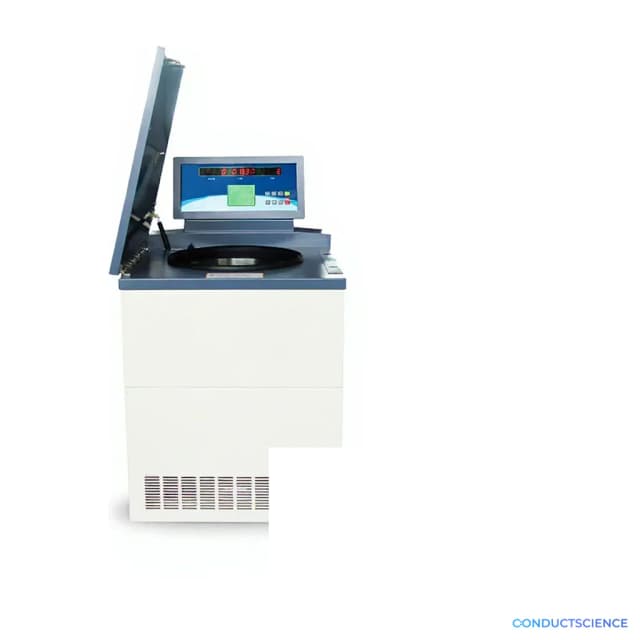
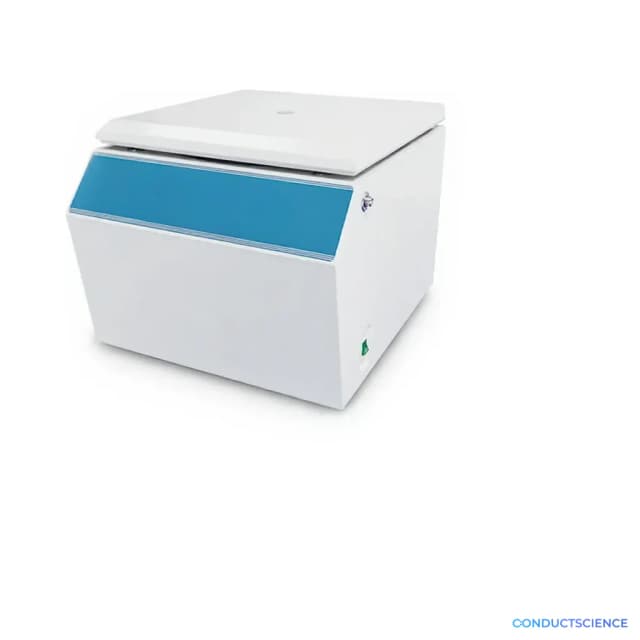
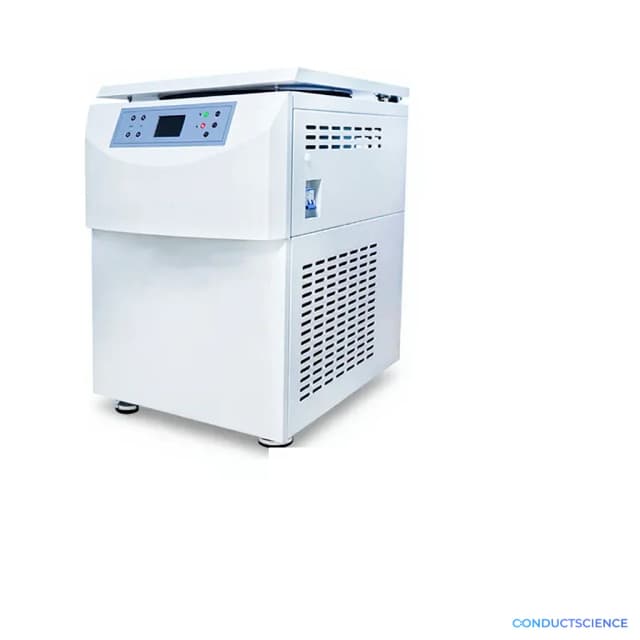
Low Speed Large Capacity Refrigerated Centrifuge
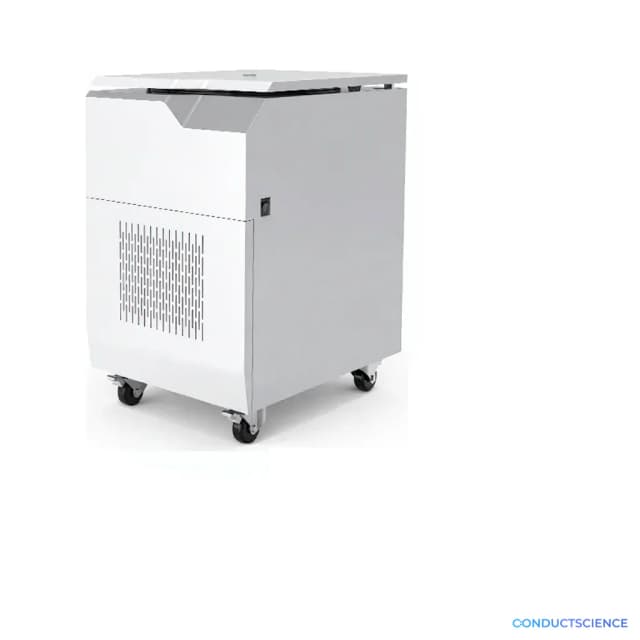
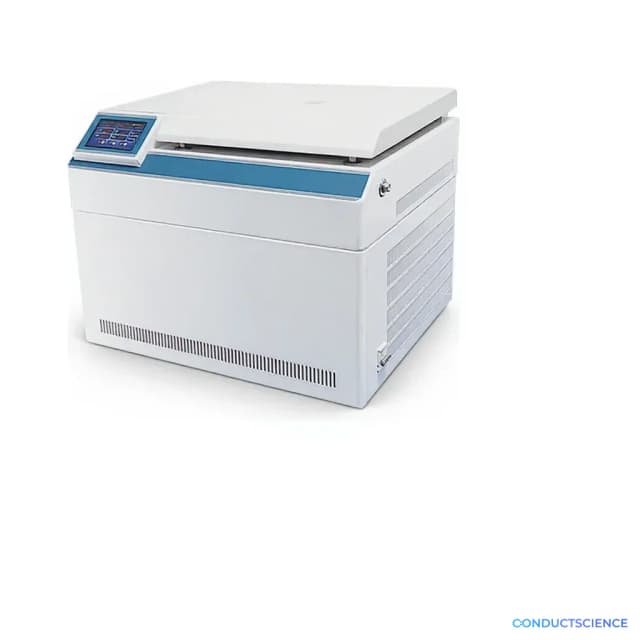
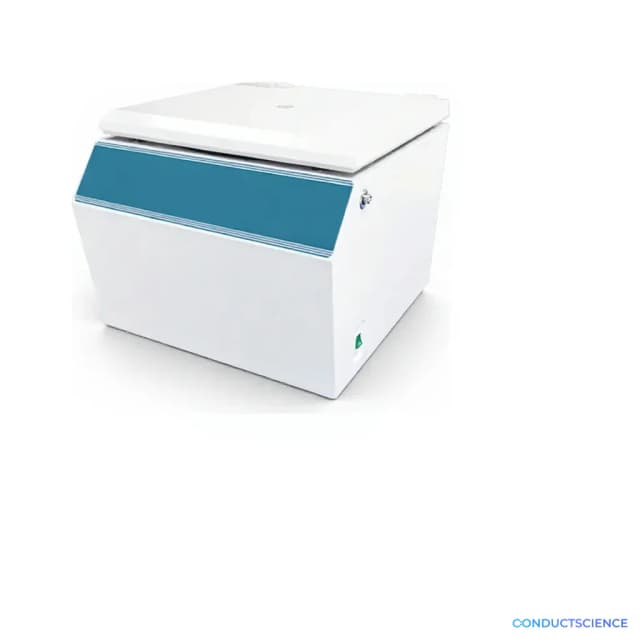
Large capacity refrigerated centrifuge with 4×750 ml rotor capacity, operating at speeds up to 5,500 rpm with temperature control from -20°C to 40°C for high-volume sample processing.
| Automation Level | semi-automated |
| BKC-TL5RL | BKC-VL6RLII |
| Max. Capacity | 4*750ml |
| Max. Speed | 5500rpm |
| Max. RCF | 4390xg |
| Speed Precision | ±30rpm |

The Low Speed Large Capacity Refrigerated Centrifuge (BIO-0272) is a benchtop instrument designed for temperature-controlled separation applications requiring large sample volumes. This refrigerated centrifuge operates at speeds up to 5,500 rpm with a maximum relative centrifugal force of 4,390×g, accommodating four 750 ml rotors simultaneously. The integrated refrigeration system maintains precise temperature control from -20°C to 40°C with ±1°C accuracy.
The instrument features digital controls with timing capability up to 99 hours 59 minutes 59 seconds and speed precision of ±30 rpm. Low noise operation (≤60 dB) and compact footprint (720×743×410 mm) make it suitable for routine laboratory use. The system operates on standard laboratory power (AC 220V±22V, 50/60Hz) with optional 110V configuration available.
How It Works
Centrifugal separation operates on the principle that particles of different densities migrate at different rates when subjected to centrifugal force. As the rotor spins, samples experience acceleration proportional to the rotational speed and radius, creating a relative centrifugal force (RCF) measured in multiples of gravitational force (×g). Denser components migrate toward the rotor periphery while lighter components remain closer to the rotation axis.
The refrigeration system maintains sample temperature through a closed-loop cooling circuit that removes heat generated during rotor acceleration and friction. Temperature sensors monitor the chamber environment, with active cooling preventing thermal degradation of temperature-sensitive biological samples. The microprocessor control system coordinates motor speed, temperature regulation, and timing functions to maintain precise separation conditions throughout the run cycle.
Features & Benefits
Automation Level
- semi-automated
BKC-TL5RL
- BKC-VL6RLII
Max. Capacity
- 4*750ml
Max. Speed
- 5500rpm
Max. RCF
- 4390xg
Speed Precision
- ±30rpm
Temp. Range
- -20~40°C
Temp. Accuracy
- ±1°C
Timing Range
- 0~99h59min59s
Noise
- ≤60dB
Consumption
- 1.2KW
External Size(W*D*H)mm
- 720*743*410
Packing Size(W*D*H)mm
- 810*825*570
Net Weight(kg)
- 110
Brand
- ConductScience
Research Domain
- Analytical Chemistry
- Cell Biology
- Clinical Diagnostics
- Environmental Monitoring
- Food Science
- Microbiology
- Pharmaceutical QC
Power/Voltage
- AC220±22V, 50/60Hz(Standard); AC110V, 60Hz(Optional)
Weight
- 242.51 kg
Dimensions
- L: 29.25 mm
- W: 28.35 mm
- H: 16.14 mm
Comparison Guide
| Feature | This Product | Typical Alternative | Advantage |
|---|---|---|---|
| Rotor Capacity | 4×750 ml (3 L total) | Compact models typically offer 100-250 ml total capacity | Reduces processing time by handling larger sample volumes in single runs. |
| Temperature Range | -20°C to 40°C with ±1°C accuracy | Basic models often lack refrigeration or offer limited cooling | Preserves temperature-sensitive samples during extended separations. |
| Maximum Speed | 5,500 rpm (4,390×g) | Entry-level units often limited to 3,000-4,000 rpm | Provides higher centrifugal force for efficient separation of dense particles. |
| Timing Range | 0-99h59min59s | Basic models typically offer 0-99 minutes maximum | Accommodates overnight and extended separation protocols. |
| Noise Level | ≤60 dB operation | Standard models often operate at 65-70 dB | Enables extended runs without disrupting adjacent laboratory work. |
This refrigerated centrifuge combines large sample capacity with precise temperature control and extended timing capability. The 3-liter total capacity and sub-freezing operation distinguish it from basic benchtop models, while the compact footprint suits routine laboratory use.
Practical Tips
Verify temperature accuracy monthly using calibrated thermometer placed in sample tubes filled with water.
Why: Temperature accuracy affects sample integrity and separation reproducibility.
Clean condenser coils monthly with compressed air to maintain refrigeration efficiency.
Why: Dust accumulation reduces cooling capacity and increases power consumption.
Pre-cool rotors and adapters to operating temperature before loading temperature-sensitive samples.
Why: Minimizes thermal shock and maintains sample temperature throughout the run.
Always balance samples to within 0.1g across opposing positions to prevent rotor damage.
Why: Unbalanced loads create dangerous vibrations that can damage the centrifuge and create safety hazards.
Allow 15-minute equilibration after reaching setpoint before starting time-critical separations.
Why: Temperature stability ensures consistent separation conditions throughout the sample volume.
If excessive vibration occurs, stop immediately and check sample balance and rotor installation.
Why: Continued operation with imbalance can cause permanent damage to drive mechanisms.
Use only rotors and accessories specified for this model to ensure proper fit and safety.
Why: Incompatible rotors may not engage safety interlocks or may exceed design specifications.
Setup Guide
What’s in the Box
- Low speed refrigerated centrifuge main unit
- 4×750 ml swing-out rotor set (typical)
- Power cord
- User manual and operation guide
- Safety key and rotor wrench (typical)
- Calibration certificate (typical)
Warranty
ConductScience provides a one-year manufacturer warranty covering defects in materials and workmanship. Technical support includes installation guidance, operation training, and troubleshooting assistance.
Compliance
What is the temperature equilibration time for the refrigeration system?
Allow 4-6 hours for the chamber to reach -20°C from ambient temperature. Temperature stability is achieved within 30 minutes of reaching setpoint.
Can the centrifuge accommodate different rotor types beyond the 750 ml capacity?
Consult product datasheet for compatible rotor options. The instrument is designed for the specified 4×750 ml configuration with appropriate safety interlocks.
What maintenance is required for the refrigeration system?
Monthly cleaning of condenser coils and annual refrigerant system inspection by qualified service technician. Monitor temperature accuracy quarterly.
How do I ensure proper sample balance for safe operation?
Balance opposing samples to within 0.1g using analytical balance. Partially filled tubes should be balanced with water-filled tubes of identical weight.
What safety features prevent operation with unbalanced loads?
The instrument includes vibration detection and automatic shutdown for excessive imbalance. Safety interlocks prevent operation with improperly installed rotors.
Can the centrifuge be used for density gradient separations?
Yes, the variable speed control and temperature regulation support density gradient protocols. Extended timing capability accommodates gradient formation and separation phases.
Have a question about this product?
Replacement Parts & Consumables