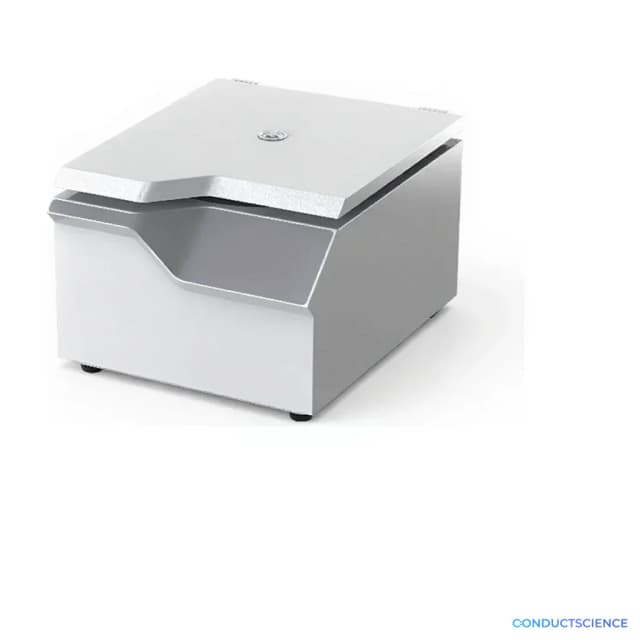
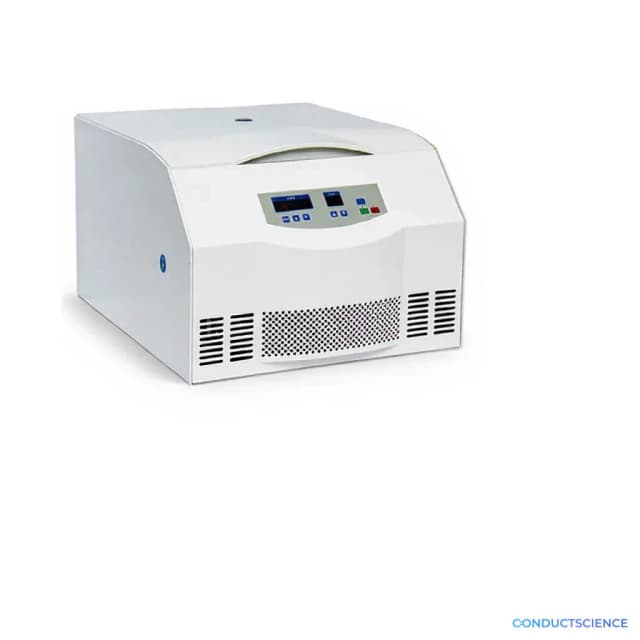
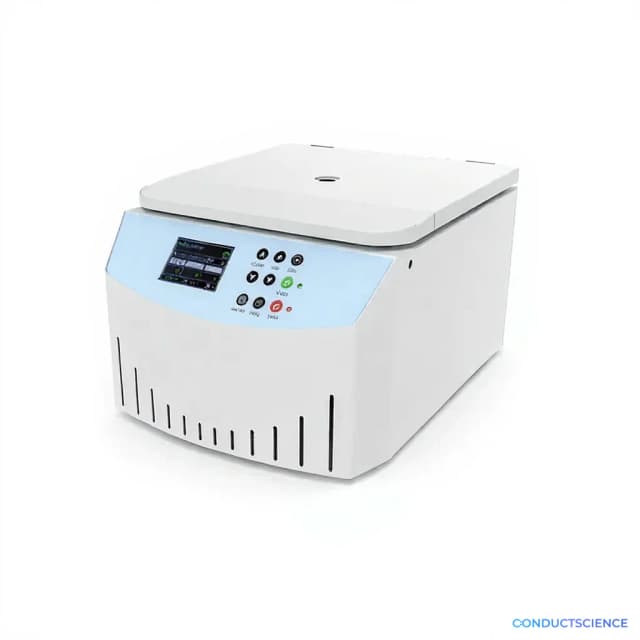
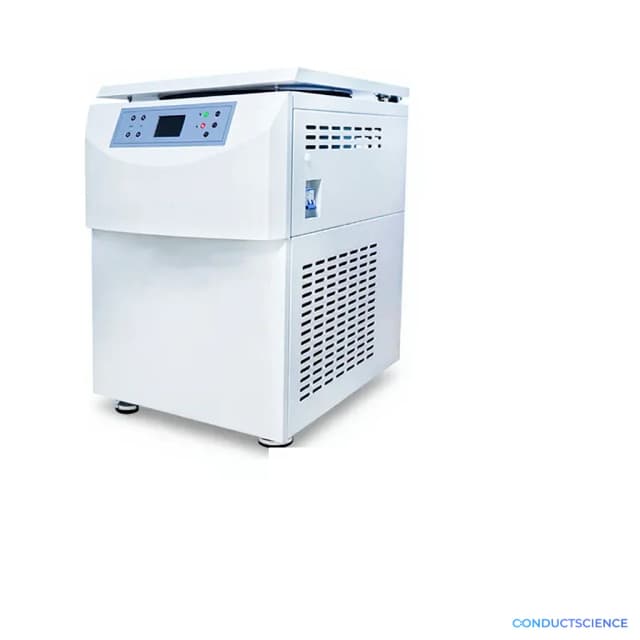
High Speed Refrigerated Centrifuge
High-capacity refrigerated centrifuge operating up to 21,000 rpm with temperature control from -20°C to 40°C, accommodating 4×750ml samples for temperature-sensitive separation protocols.

Louise Corscadden, PhD
Director of Science · ConductScience
Ask Louise about High Speed Refrigerated Centrifuge fit, setup, configuration, or quote prep.
Already working with us? Sign in to connect this with My Scientist.
Key Specifications
Full details →- Model fit
- 1 selectable configurations
- SKU family
- BIO-0945
- Shipping box
- 29527.56 x 157.48 x 38.0 cm
- Ordering
- Online checkout and quote request available
- Category
- Centrifuges
- Build notes
- Confirm accessories, station layout, and support needs before purchase
The High Speed Refrigerated Centrifuge is a high-capacity laboratory instrument designed for temperature-controlled separation applications requiring substantial rotor volumes and precise speed control. This benchtop unit operates at speeds up to 21,000 rpm with maximum relative centrifugal force of 47,580×g, accommodating up to 4×750ml sample volumes per run. The integrated refrigeration system maintains sample temperatures from -20°C to 40°C with ±2°C accuracy, essential for preserving temperature-sensitive biological materials during extended centrifugation protocols.
The centrifuge features digital speed control with ±30 rpm precision and programmable timing from 1 minute to 23 hours 59 minutes. Sound dampening reduces operational noise to ≤65dB, suitable for standard laboratory environments. The substantial 252 kg net weight provides operational stability during high-speed runs, while the compact 825×625×910mm footprint fits standard benchtop configurations.
How It Works
Centrifugal separation exploits differences in particle density, size, and shape by subjecting samples to controlled gravitational forces. The centrifuge rotor accelerates samples in a circular path, generating centrifugal force proportional to the square of angular velocity and radius from the rotation axis. Denser particles migrate outward faster than lighter components, enabling separation based on sedimentation coefficients.
The integrated refrigeration system circulates coolant through the rotor chamber, maintaining precise temperature control during operation. This prevents thermal denaturation of proteins, maintains enzyme activity, and preserves sample integrity during extended protocols. Variable speed control allows optimization of separation conditions for different sample types, from gentle pelleting of fragile cells to high-force clarification of dense suspensions.
Digital timing and speed controls enable reproducible protocols with precise control over separation parameters. The microprocessor monitors rotor speed, temperature, and elapsed time, automatically terminating runs when programmed conditions are met while maintaining safe deceleration profiles.
Features & Benefits
Shipping weight
- 555.56 lb
Shipping box
- L: 29527.56 cm
- W: 157.48 cm
- H: 38.0 cm
| Feature | This Product | Typical Alternative | Advantage |
|---|---|---|---|
| Maximum Speed | 21,000 rpm | Entry-level refrigerated centrifuges typically operate up to 15,000-18,000 rpm | Higher speeds enable more efficient separation of dense particles and reduce processing time for demanding applications. |
| Sample Capacity | 4×750ml maximum capacity | Benchtop models often accommodate smaller volumes with 4×250ml or 6×50ml configurations | Large volume capacity reduces number of processing runs required for bulk sample preparations. |
| Temperature Range | -20°C to 40°C with ±2°C accuracy | Basic refrigerated units typically offer 2°C to 40°C range with lower precision | Extended low-temperature capability preserves sample integrity for applications requiring sub-zero processing conditions. |
| Speed Precision | ±30 rpm accuracy | Standard centrifuges often provide ±50-100 rpm precision | Improved speed control ensures reproducible separation conditions critical for quantitative protocols and method validation. |
| Maximum RCF | 47,580×g | Compact refrigerated models typically generate 25,000-35,000×g maximum force | Higher centrifugal force capability enables separation of smaller particles and denser materials that require increased gravitational force. |
| Operational Noise | ≤65dB noise level | High-speed centrifuges often operate at 70-80dB without sound enclosures | Reduced noise levels improve laboratory working environment and allow operation without additional sound isolation measures. |
This centrifuge combines high-speed capability with substantial sample capacity and precise temperature control in a benchtop configuration. The 21,000 rpm speed and 4×750ml capacity provide processing capability typically found in larger floor-standing models, while maintaining compatibility with standard laboratory bench installations.
Practical Tips
Verify temperature accuracy quarterly using calibrated thermometer placed in sample chamber during typical operating conditions.
Why: Temperature drift affects sample integrity and separation reproducibility in temperature-sensitive applications.
Inspect rotor threads and sealing surfaces monthly for wear or damage, particularly after high-speed runs with dense samples.
Why: Rotor integrity is critical for operational safety and consistent separation performance at maximum speeds.
Pre-cool the rotor chamber to target temperature before loading samples for temperature-sensitive applications.
Why: Thermal equilibration prevents temperature fluctuations that can affect sample stability during centrifugation startup.
Balance sample tubes to within 0.1g when operating above 15,000 rpm to minimize rotor stress and vibration.
Why: Proper balancing reduces mechanical wear and ensures smooth operation at high centrifugal forces.
Allow rotor to come to complete stop before opening chamber lid, even during routine operation checks.
Why: Residual rotor motion can cause injury and sample spillage, particularly with large-capacity rotors.
Monitor refrigeration system performance by checking chamber temperature recovery time after door opening.
Why: Slow temperature recovery indicates refrigeration system maintenance requirements or ambient overload conditions.
Document speed and temperature conditions for each run to ensure protocol reproducibility across different operators.
Why: Consistent separation conditions are essential for quantitative applications and method validation requirements.
Setup Guide
What’s in the Box
- High Speed Refrigerated Centrifuge main unit
- Power cable and external transformer (if AC110V model)
- User manual and operation procedures
- Rotor installation tools (typical)
- Safety documentation and compliance certificates (typical)
- Initial calibration certificate (typical)
Warranty
ConductScience provides standard one-year manufacturer warranty covering parts and labor for defects in materials and workmanship. Technical support includes installation guidance, operational training, and troubleshooting assistance throughout the warranty period.
Compliance
What rotor types are compatible with this centrifuge model?
Rotor compatibility depends on the specific model designation and maximum speed rating. Consult product datasheet for complete rotor compatibility chart including fixed-angle, swinging-bucket, and specialty rotors with appropriate capacity ratings.
How is temperature monitored during operation?
The integrated refrigeration system maintains chamber temperature with ±2°C accuracy across the -20°C to 40°C range. Digital temperature display provides real-time monitoring, though specific sensor location and calibration procedures should be confirmed with product documentation.
What sample tube formats fit the maximum 4×750ml capacity?
The 750ml capacity specification refers to maximum volume per rotor position. Actual tube compatibility depends on rotor selection and may accommodate various formats including centrifuge bottles, conical tubes, and specialty containers within the volume limit.
How long does the unit require to reach set temperature?
Temperature equilibration time varies with ambient conditions and target temperature. Allow adequate pre-cooling time before sample loading, particularly for low-temperature applications. Consult product datasheet for specific thermal performance specifications.
What maintenance schedule is recommended for optimal performance?
Regular maintenance includes rotor inspection, refrigeration system service, and speed calibration verification. Specific intervals and procedures depend on usage frequency and laboratory environment conditions detailed in the user manual.
Can the unit operate without refrigeration for room temperature applications?
The refrigeration system can be disabled for room temperature operation, though the unit will maintain ambient temperature control within the specified accuracy range. Consult operational manual for temperature control settings and energy consumption considerations.
Have a question about this product?
Have a question? Just ask.
Send it over and we'll email you a personalized answer — no call, no scheduling.
Prefer to talk it through?
Accessories
Enhance your setup with compatible accessories
Replacement Parts & Consumables

Frequently Bought Together
Upgrade Options