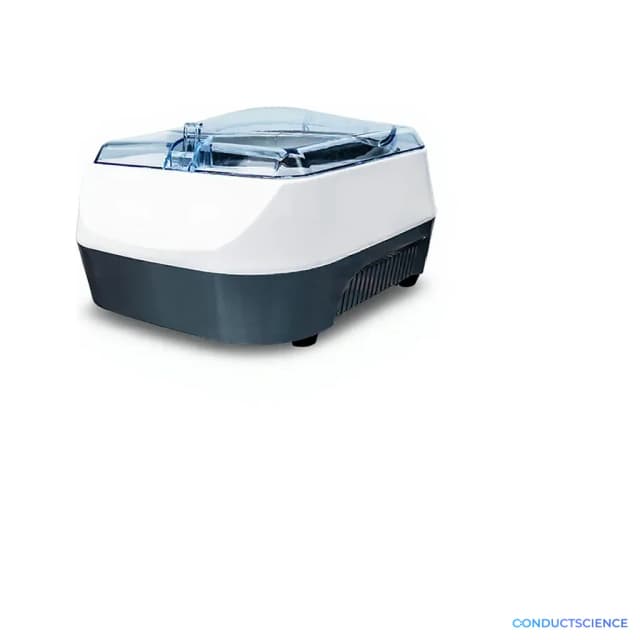
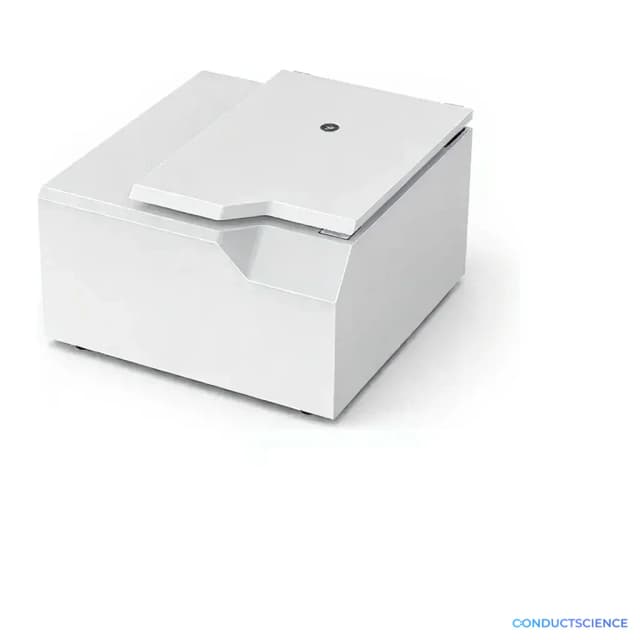
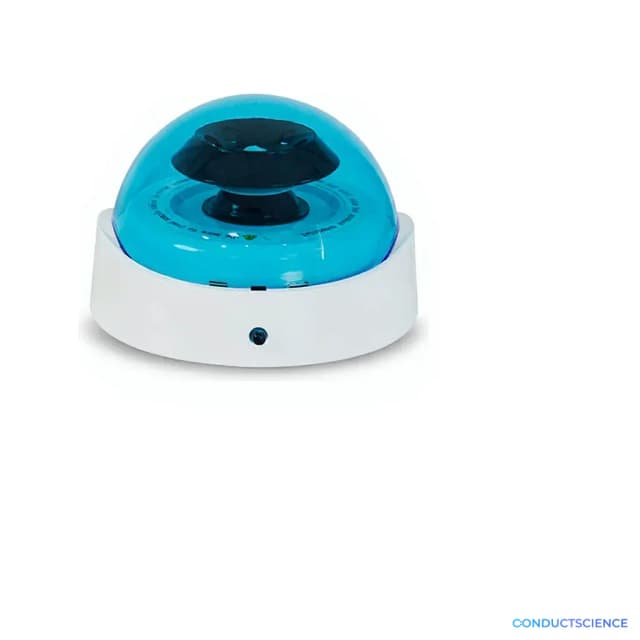
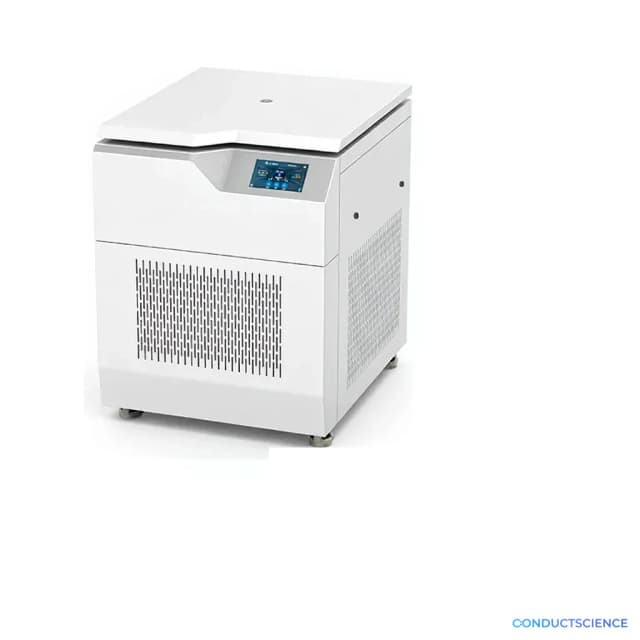
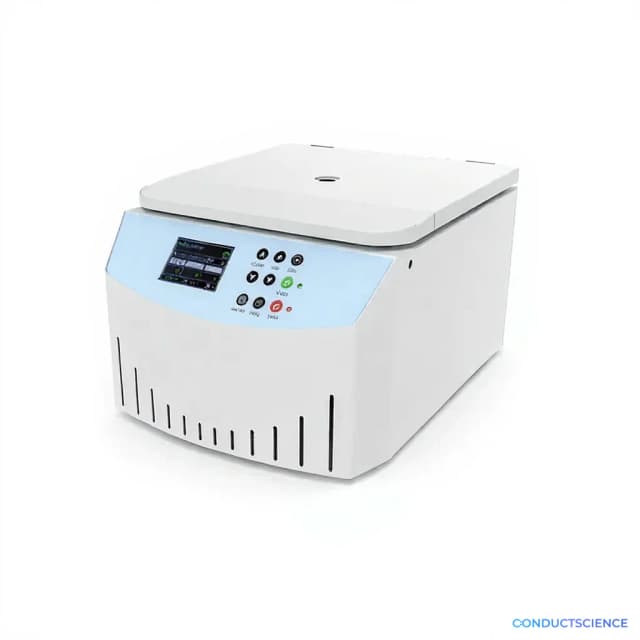
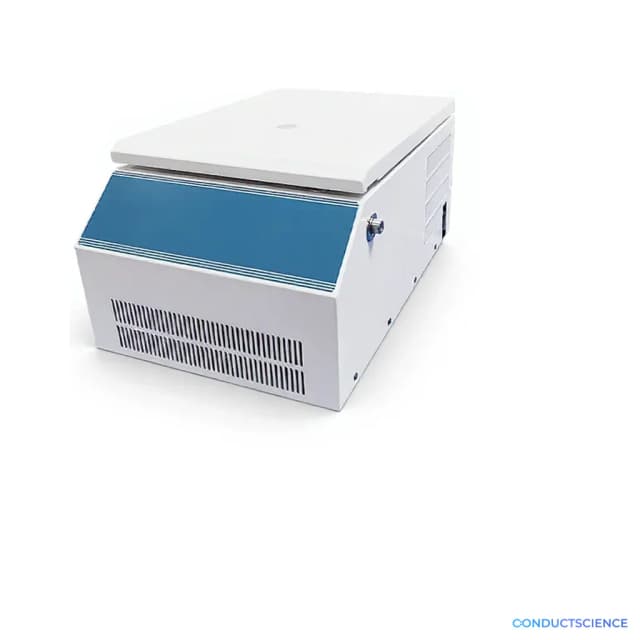
Mini High Speed Centrifuge D2012 plus
Compact benchtop centrifuge operating at 15,000 rpm maximum speed with 15,100 x g maximum RCF, accommodating twelve 2mL tubes for rapid sample processing in research laboratories.

Louise Corscadden, PhD
Director of Science · ConductScience
Ask Louise about Mini High Speed Centrifuge D2012 plus fit, setup, configuration, or quote prep.
Already working with us? Sign in to connect this with My Scientist.
Key Specifications
Full details →- Model fit
- Configured during quote
- SKU family
- BIO-0262
- Shipping box
- 14.0 x 25.5 x 24.5 cm
- Ordering
- Online checkout and quote request available
- Category
- Centrifuges
- Build notes
- High strength plastic
The Mini High Speed Centrifuge D2012 plus is a compact benchtop centrifuge designed for rapid sample processing in research and clinical laboratories. Operating at speeds up to 15,000 rpm with maximum centrifugal force of 15,100 x g, this brushless DC motor-driven system accommodates twelve 2mL tubes in a high-strength plastic rotor. The unit features precise speed control (±20 rpm accuracy) and programmable run times from 30 seconds to 99 minutes or continuous operation.
With rapid acceleration and deceleration times (11 seconds up, 9 seconds down), the D2012 plus enables efficient sample preparation workflows while maintaining low noise operation below 54 dB. The compact footprint (255 × 245 × 140 mm) and universal power compatibility (AC 100-240V, 50/60 Hz) make it suitable for diverse laboratory environments requiring reliable, high-speed centrifugal separation.
How It Works
Centrifugal separation operates on the principle that particles of different densities and sizes sediment at different rates when subjected to centrifugal force. The D2012 plus generates centrifugal acceleration up to 15,100 times gravitational force, creating a strong radial field that drives denser particles toward the tube bottom while lighter components remain in the supernatant.
The brushless DC motor provides precise rotational control with ±20 rpm accuracy, ensuring consistent separation conditions. Sample tubes are held in a fixed-angle rotor configuration, optimizing the sedimentation path and reducing separation time compared to swing-out rotors. The high-strength plastic rotor construction provides chemical resistance while maintaining structural integrity at maximum operating speeds.
Programmable run times and rapid acceleration/deceleration cycles (11s/9s) enable efficient batch processing. The motor's electronic control system maintains stable operation across the full speed range while monitoring for imbalance conditions to ensure safe operation.
Features & Benefits
Automation Level
- semi-automated
Max speed
- 15,000 rpm
Speed Accuracy
- ±20rpm
Rotor Capacity
- 2mL*12
Run Time
- 30sec-99min/Continuous
Acceleration/Braking Time
- 11s↑/9s↓
Driving Motor
- Brushless DC motor
Weight
- 6.54kg
Noise Level
- ≤54dB
Dimension(D*W*H)
- 255*245*140mm
Package Size(D*W*H)
- 455345*250mm
Rotor Material
- High strength plastic
Brand
- ConductScience
Research Domain
- Analytical Chemistry
- Cell Biology
- Clinical Diagnostics
- Materials Science
- Microbiology
- Pharmaceutical QC
Power/Voltage
- Single-phase,AC100V-240V;50Hz/6OHz,3A;100W
Max force
- 15,100 ×g
Shipping weight
- 6.54 lb
Shipping box
- L: 14.0 cm
- W: 25.5 cm
- H: 24.5 cm
| Feature | This Product | Typical Alternative | Advantage |
|---|---|---|---|
| Maximum Speed | 15,000 rpm with 15,100 x g RCF | Entry-level models often limited to 10,000-12,000 rpm | Higher centrifugal force enables more efficient separation of dense particles and cellular components. |
| Speed Accuracy | ±20 rpm precision control | Basic models may have ±50-100 rpm variation | Precise speed control ensures reproducible separation conditions across experimental replicates. |
| Sample Capacity | 12 × 2mL tube positions | Smaller units often accommodate 6-8 tubes | Higher throughput reduces processing time for multi-sample protocols and batch experiments. |
| Motor Technology | Brushless DC motor system | Traditional brushed motors require periodic maintenance | Maintenance-free operation reduces downtime and service costs over the instrument lifecycle. |
| Noise Level | ≤54 dB operation | Standard centrifuges typically operate at 60-70 dB | Quieter operation improves laboratory working conditions during extended runs. |
| Cycle Time | 11s acceleration, 9s deceleration | Slower models require 20-30 seconds for speed changes | Rapid acceleration/deceleration reduces total cycle time for improved laboratory productivity. |
The D2012 plus combines high-speed performance with compact design, offering 15,000 rpm operation and 12-sample capacity in a benchtop format. The brushless motor technology and precise speed control provide reliable operation with minimal maintenance requirements for routine laboratory centrifugation applications.
Practical Tips
Verify speed accuracy periodically using a tachometer or strobe light at various speed settings across the operational range.
Why: Speed verification ensures separation conditions remain consistent and reproducible over time.
Clean the rotor and chamber regularly with mild detergent and inspect for wear or chemical damage to plastic components.
Why: Regular cleaning prevents sample cross-contamination and extends rotor service life.
Always balance samples by weight rather than volume, placing tubes opposite each other in the 12-position rotor for optimal balance.
Why: Proper balancing prevents excessive vibration that could damage the motor bearings or affect separation quality.
Allow complete deceleration before opening the lid and never attempt to stop the rotor manually during operation.
Why: The high rotational energy at 15,000 rpm poses injury risk and sudden stopping can damage the motor system.
If excessive vibration occurs during operation, immediately stop the run and check for proper tube balancing and rotor installation.
Why: Unbalanced loads can cause mechanical damage to the drive system and compromise separation results.
Document run parameters including speed, time, and sample characteristics to ensure protocol reproducibility across experiments.
Why: Consistent documentation enables troubleshooting of separation issues and protocol optimization.
Pre-cool samples and tubes if working with temperature-sensitive materials to minimize heat generation during high-speed operation.
Why: High-speed centrifugation generates heat that could denature proteins or affect sample stability.
Monitor the brushless motor for unusual sounds or vibrations that could indicate bearing wear or rotor imbalance.
Why: Early detection of mechanical issues prevents catastrophic failure and extends instrument service life.
Setup Guide
What’s in the Box
- Mini High Speed Centrifuge D2012 plus main unit
- High-strength plastic rotor for 2mL tubes
- Power cord with universal voltage compatibility
- User manual and operating instructions
- Tube adapters and accessories (typical)
- Warranty documentation and service contacts (typical)
Warranty
ConductScience provides a standard one-year manufacturer warranty covering parts and labor with comprehensive technical support. Extended service plans and calibration services are available through authorized service centers.
Compliance
What is the maximum relative centrifugal force and how does speed accuracy affect separation reproducibility?
The D2012 plus generates maximum RCF of 15,100 x g at 15,000 rpm with ±20 rpm speed accuracy, ensuring consistent separation conditions for reproducible pelleting and clarification across multiple runs.
Can the rotor accommodate different tube sizes and what is the maximum sample capacity?
The high-strength plastic rotor is designed specifically for twelve 2mL tubes. For other tube sizes, consult product datasheet for compatible rotor options and adapter availability.
What are the typical run times for common applications like cell pelleting and protein precipitation?
Run times are programmable from 30 seconds to 99 minutes depending on application requirements. Typical protocols range from 2-5 minutes for cell pelleting to 10-15 minutes for protein precipitation, with specific times determined by sample characteristics.
How does the acceleration/deceleration profile affect sample resuspension and pellet integrity?
The 11-second acceleration and 9-second deceleration times provide controlled speed changes that minimize sample disturbance while maintaining pellet integrity for most standard applications.
What maintenance requirements are needed for the brushless DC motor system?
The brushless DC motor design requires minimal maintenance beyond routine cleaning and periodic inspection. No brush replacement or motor service is typically needed during normal operational life.
Is the unit suitable for temperature-sensitive samples and what cooling options are available?
The D2012 plus operates at ambient temperature. For temperature-sensitive samples requiring cooling, consult product datasheet for refrigerated centrifuge options in the product line.
How does the 54 dB noise level compare to other benchtop centrifuges?
The ≤54 dB operation is comparable to quiet conversation levels, making it suitable for open laboratory environments where noise control is important for worker comfort.
What safety features prevent operation with unbalanced loads?
The electronic control system monitors for imbalance conditions during operation. Consult product datasheet for specific imbalance detection thresholds and automatic shutdown parameters.
Have a question about this product?
Have a question? Just ask.
Send it over and we'll email you a personalized answer — no call, no scheduling.
Prefer to talk it through?
Accessories
Enhance your setup with compatible accessories
Frequently Bought Together
Upgrade Options