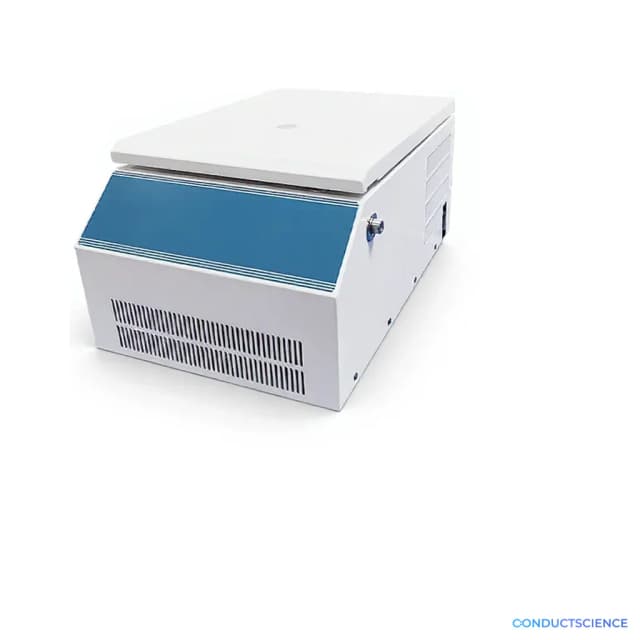
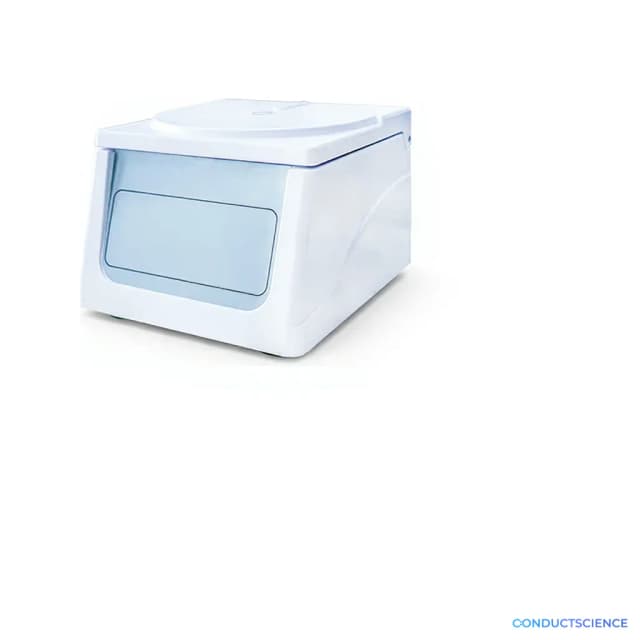
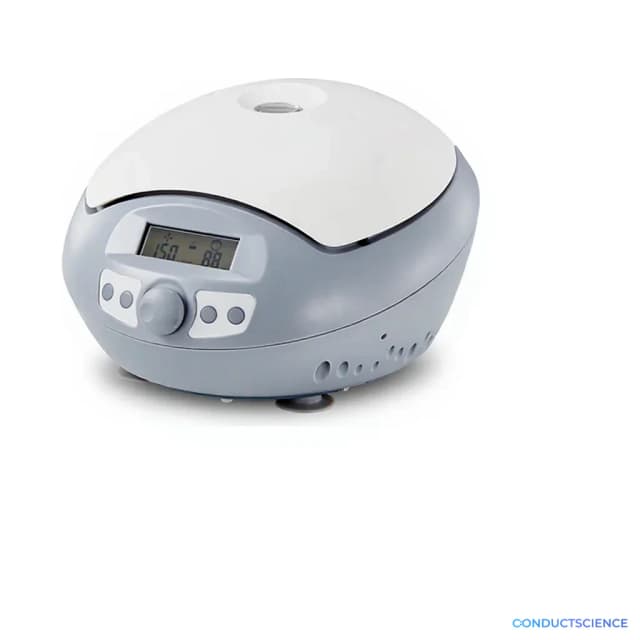
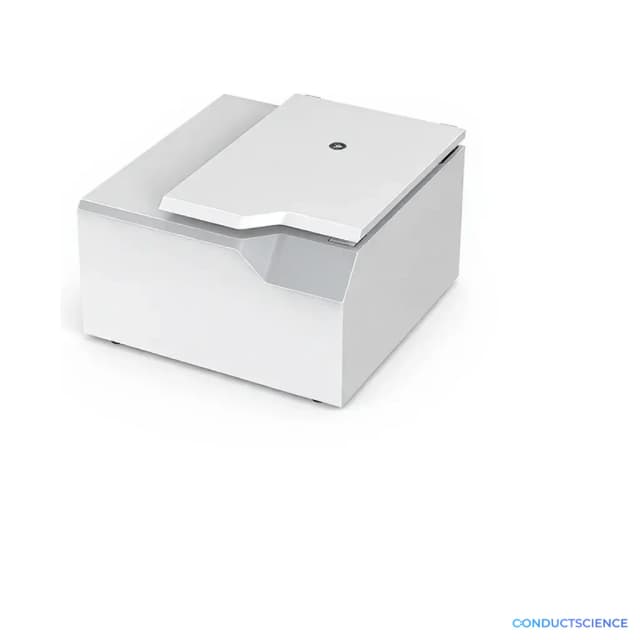
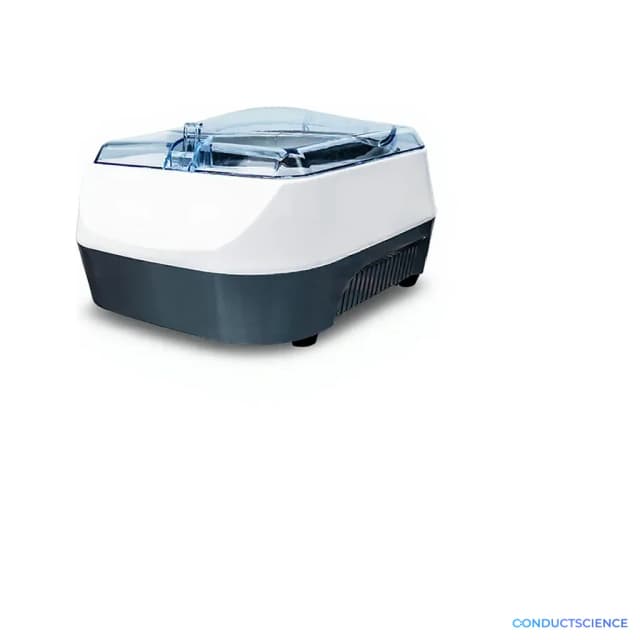
Table Top High Speed Centrifuge
Compact high-speed centrifuge capable of 18,800 rpm and 26,870×g, accommodating 12 tubes up to 10 ml capacity with precision timing control and low-noise operation.

Louise Corscadden, PhD
Director of Science · ConductScience
Ask Louise about Table Top High Speed Centrifuge fit, setup, configuration, or quote prep.
Already working with us? Sign in to connect this with My Scientist.
Key Specifications
Full details →- Model fit
- Configured during quote
- SKU family
- BIO-0295
- Shipping box
- 16.77 x 13.39 x 12.68 cm
- Ordering
- Online checkout and quote request available
- Category
- Centrifuges
- Build notes
- Confirm accessories, station layout, and support needs before purchase
The Table Top High Speed Centrifuge is a compact laboratory centrifuge designed for rapid separation of small-volume samples in research and analytical applications. With a maximum speed of 18,800 rpm and maximum relative centrifugal force of 26,870×g, this instrument provides high-performance separation capabilities for tubes up to 10 ml capacity. The unit accommodates up to 12 tubes simultaneously, enabling efficient batch processing of samples.
Engineered for precision operation, the centrifuge maintains speed accuracy within ±10 rpm and operates with low noise levels at ≤58 dB. The flexible timing system allows operation from 1 second to 99 hours 59 minutes 59 seconds, with jog function capability for short-duration spins. The compact desktop design (426×322×340 mm) makes it suitable for laboratories with limited bench space while maintaining the performance characteristics required for demanding separation protocols.
How It Works
Centrifugal separation operates on the principle of differential sedimentation under high gravitational forces. When samples are subjected to high-speed rotation, particles experience centrifugal force proportional to their mass, density, and distance from the rotation axis. Denser particles migrate toward the bottom of the tube while less dense components remain in the supernatant, enabling physical separation based on these density differences.
The centrifuge rotor spins samples at controlled speeds up to 18,800 rpm, generating centrifugal forces up to 26,870 times Earth's gravity. This acceleration overcomes Brownian motion and thermal effects that normally keep small particles in suspension, forcing rapid sedimentation according to Stokes' law. The separation efficiency depends on particle size, density differential, viscosity of the medium, and applied centrifugal force.
Precision speed control (±10 rpm accuracy) ensures reproducible separation conditions, while programmable timing allows optimization of separation protocols for different sample types. The low-noise design (≤58 dB) minimizes vibration that could disturb the separation process or affect nearby sensitive equipment.
Features & Benefits
Automation Level
- manual
Max Capacity
- 12*10ml
Max RCF
- 26870×g
Speed Precision
- ±10rpm
Timing Range
- 1s~99h59min59s/jog
Noise
- ≤58dB
External Size(W*D*H)mm
- 426*322*340
Package Size(W*D*H)mm
- 530*520*520
Net Weight(kg)
- 27
Gross Weight(kg)
- 28
Rotor No.
- Max. Capacity
Max. Speed(rpm)
- Max. RCF(×g)
H0.512
- 12*0.5ml
18800
- 26870
Brand
- ConductScience
Research Domain
- Analytical Chemistry
- Cell Biology
- Clinical Diagnostics
- Materials Science
- Microbiology
- Pharmaceutical QC
Speed/RPM
- 18800rpm
Shipping weight
- 59.52 lb
Shipping box
- L: 16.77 cm
- W: 13.39 cm
- H: 12.68 cm
| Feature | This Product | Typical Alternative | Advantage |
|---|---|---|---|
| Maximum Speed | 18,800 rpm | Entry-level benchtop models often operate at 12,000-15,000 rpm | Higher speed capability enables more efficient separation of dense particles and reduces processing time for challenging samples. |
| Maximum RCF | 26,870×g | Compact centrifuges typically provide 15,000-20,000×g | Higher centrifugal force improves separation efficiency for applications requiring maximum sedimentation power. |
| Sample Capacity | 12 tubes up to 10 ml | Basic models often accommodate 6-8 tubes with smaller volume limits | Larger capacity enables batch processing of more samples, improving laboratory throughput and workflow efficiency. |
| Speed Precision | ±10 rpm accuracy | Standard models may have ±50-100 rpm variation | Higher precision ensures reproducible separation conditions critical for quantitative analytical protocols. |
| Timing Range | 1s to 99h59min59s with jog function | Basic timers often limited to minutes or hours without jog capability | Flexible timing accommodates both quick spins and extended separation protocols with precise control options. |
| Noise Level | ≤58 dB operation | High-speed centrifuges may operate at 60-70 dB | Quieter operation reduces laboratory noise pollution and allows placement near sensitive analytical instruments. |
This centrifuge combines high-speed performance (18,800 rpm, 26,870×g) with precise control and compact design. The 12-tube capacity and flexible timing system provide efficient batch processing capabilities, while low noise operation and space-efficient footprint make it suitable for diverse laboratory environments.
Practical Tips
Verify speed accuracy monthly using a tachometer or built-in diagnostics, particularly after transport or significant temperature changes.
Why: Speed accuracy directly affects centrifugal force calculations and separation reproducibility.
Clean rotor and chamber after each use with mild detergent, paying special attention to tube contact surfaces and drainage areas.
Why: Sample residue can cause corrosion and imbalance issues that affect performance and safety.
Always balance samples by placing tubes of equal weight in opposite positions, using water-filled tubes as counterweights when necessary.
Why: Proper balance prevents excessive vibration, extends bearing life, and ensures safe high-speed operation.
Never open the lid while the rotor is spinning and allow complete stop before opening, even during brief jog operations.
Why: Moving rotors pose serious injury risk and sudden lid opening can cause dangerous rotor destabilization.
Record actual centrifugation parameters (speed, time, temperature) for each run to ensure protocol reproducibility.
Why: Small variations in centrifugation conditions can significantly affect separation efficiency and experimental outcomes.
If excessive vibration occurs, immediately stop operation and check sample balance, tube integrity, and rotor installation.
Why: Vibration indicates potential safety hazard and can damage internal components if operation continues.
Pre-cool samples and rotor to 4°C for temperature-sensitive applications, allowing equilibration time before high-speed operation.
Why: Temperature control prevents sample degradation and reduces thermal effects on separation efficiency.
Inspect rotor for cracks, corrosion, or wear every few months, particularly around tube contact points and mounting areas.
Why: Rotor integrity is critical for safe high-speed operation and early detection prevents catastrophic failure.
Setup Guide
What’s in the Box
- Table top high speed centrifuge main unit
- Fixed angle rotor for 12 tubes (typical)
- Power cord (typical)
- User manual and operating instructions (typical)
- Tool kit for maintenance (typical)
Warranty
ConductScience provides a standard one-year manufacturer warranty covering defects in materials and workmanship. Technical support is available for installation guidance, operational questions, and troubleshooting assistance.
Compliance
What is the minimum sample volume required for effective separation?
Minimum volume depends on tube geometry and sample characteristics. Most protocols require at least 0.5-1.0 ml for adequate separation, though the rotor accommodates tubes up to 10 ml capacity.
How do I determine the optimal centrifugation speed for my samples?
Start with manufacturer recommendations for your sample type, typically 10,000-15,000 rpm for cellular debris removal or protein precipitation. Adjust based on pellet formation and supernatant clarity.
What maintenance schedule should I follow?
Perform daily cleaning of rotor and chamber, weekly inspection of gaskets and seals, and monthly verification of speed accuracy. Annual professional calibration is recommended for critical applications.
Can I use different tube types with this centrifuge?
The rotor is designed for specific tube dimensions up to 10 ml. Consult the rotor compatibility chart to ensure proper tube fit and maximum safe speed for different tube materials.
How does this compare to larger floor-model centrifuges?
This benchtop model provides similar g-force capability (26,870×g) as many floor models but with smaller sample capacity. It offers better space efficiency for laboratories processing moderate sample volumes.
What safety features are included?
Safety features typically include lid lock during operation, imbalance detection, overspeed protection, and automatic braking. Consult product datasheet for complete safety specifications.
How long does it take to reach maximum speed?
Acceleration time to maximum speed depends on rotor mass and sample load. Typical acceleration is 30-60 seconds to reach 18,800 rpm, with corresponding deceleration times for safe operation.
Have a question about this product?
Have a question? Just ask.
Send it over and we'll email you a personalized answer — no call, no scheduling.
Prefer to talk it through?
Accessories
Enhance your setup with compatible accessories
Frequently Bought Together