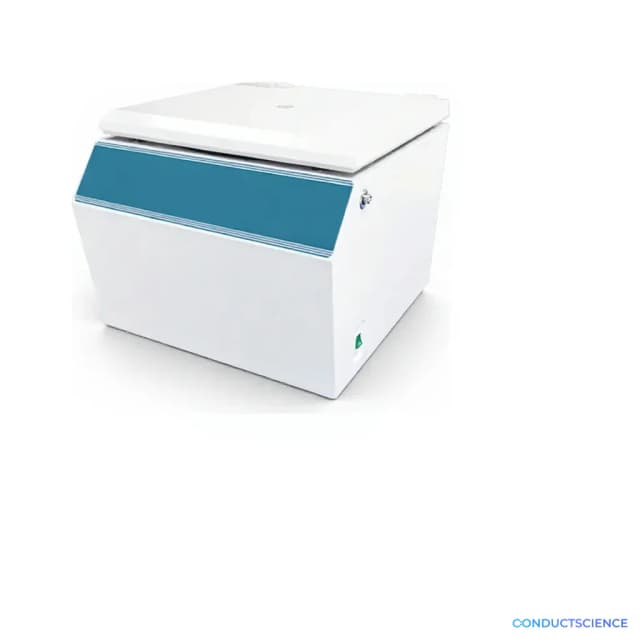
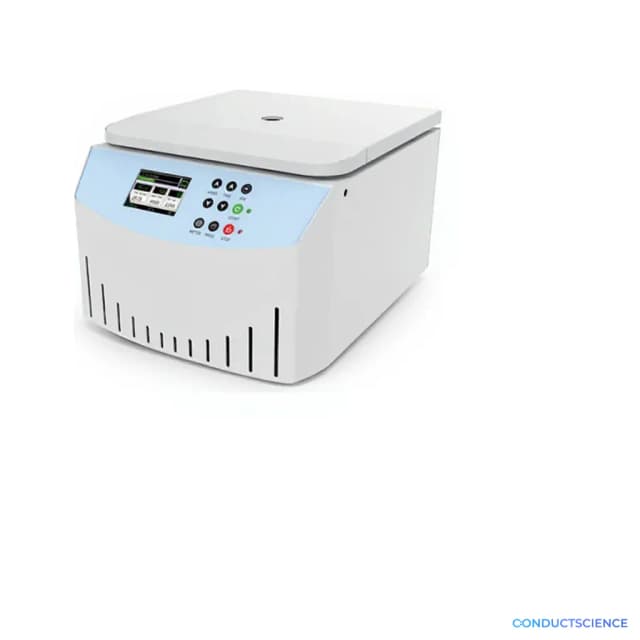
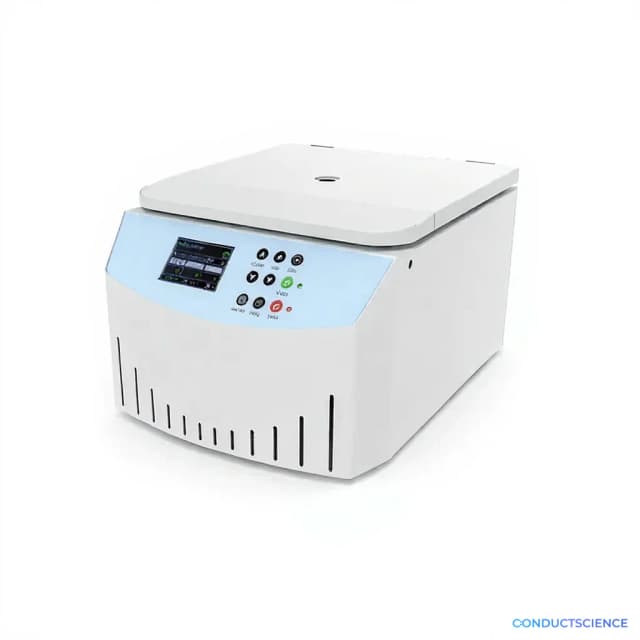
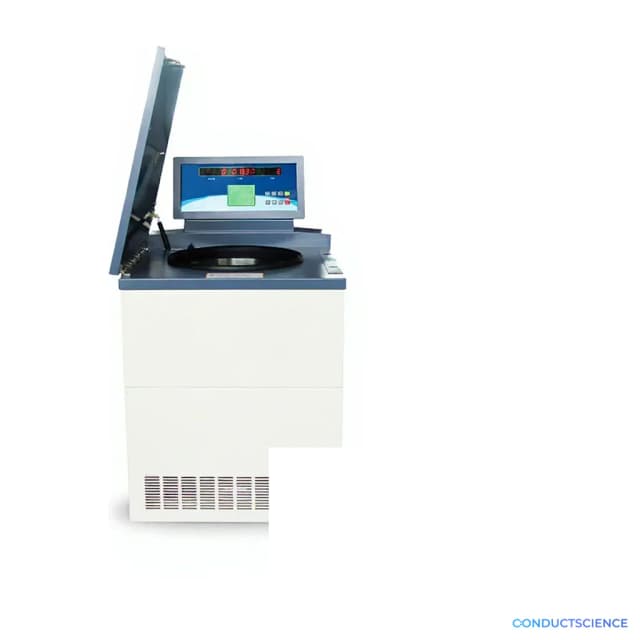
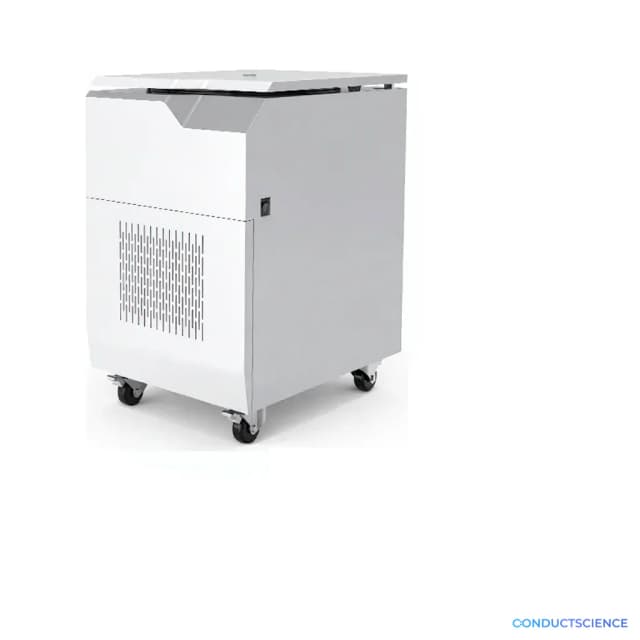
Multi-rotor Table Top High Speed Refrigerated Centrifuge
High-speed refrigerated benchtop centrifuge with 21,000 rpm capability, temperature control from -20°C to 40°C, and multi-rotor compatibility for demanding laboratory separations.

Louise Corscadden, PhD
Director of Science · ConductScience
Ask Louise about Multi-rotor Table Top High Speed Refrigerated Centrifuge fit, setup, configuration, or quote prep.
Already working with us? Sign in to connect this with My Scientist.
Key Specifications
Full details →- Model fit
- Configured during quote
- SKU family
- BIO-0318
- Shipping box
- 44.0 x 67.0 x 75.0 cm
- Ordering
- Online checkout and quote request available
- Category
- Centrifuges
- Build notes
- Confirm accessories, station layout, and support needs before purchase
The Multi-rotor Table Top High Speed Refrigerated Centrifuge is a high-performance benchtop centrifuge designed for demanding laboratory applications requiring precise temperature control and high centrifugal forces. Operating at speeds up to 21,000 rpm with a maximum relative centrifugal force of 30,700×g, this instrument provides the separation capabilities needed for complex sample processing workflows.
The integrated refrigeration system maintains sample temperatures from -20°C to 40°C, enabling temperature-sensitive separations while minimizing sample degradation. With a maximum capacity of 4×500ml and multi-rotor compatibility, the system accommodates diverse sample volumes and tube formats. The precision speed control (±1% or ±120rpm) and programmable timing (1s to 99min59s) ensure reproducible results across experimental protocols.
How It Works
Centrifugal separation operates on the principle of differential sedimentation, where particles of different densities, sizes, or shapes separate under the influence of centrifugal force. As the rotor accelerates, samples experience forces many times greater than gravity, causing denser components to migrate toward the bottom of the tube while less dense components remain in the supernatant. The relationship between centrifugal force and separation efficiency follows the equation RCF = 1.118 × 10⁻⁵ × r × N², where r is the radius and N is the rotational speed.
The integrated refrigeration system uses a closed-loop cooling circuit to maintain precise temperature control throughout the separation process. This is critical for temperature-sensitive biological samples, as heat generated during high-speed rotation can denature proteins, disrupt cellular structures, or alter chemical equilibria. The multi-rotor design allows optimization of separation parameters for different sample types and volumes.
Speed precision is maintained through feedback control systems that monitor and adjust rotor velocity in real-time. The ±1% or ±120rpm specification ensures reproducible centrifugal forces across runs, which is essential for quantitative separations and protocol standardization.
Features & Benefits
Automation Level
- semi-automated
Max speed
- 21,000 rpm
Max. Capacity
- 4*500ml
Speed Precision
- ±1% or ±20rpm
Timing Range
- 1s~99min59s
Weight
- 142kg
Noise
- ≤65dB
Consumption
- 1200W
External Size(W*D*H)
- 670*750*440mm
Package Size(W*D*H)
- 900*820*700mm
No.
- Rotor
Brand
- ConductScience
Research Domain
- Analytical Chemistry
- Cell Biology
- Clinical Diagnostics
- Materials Science
- Microbiology
- Pharmaceutical QC
Temperature Range
- -20~40℃
Power/Voltage
- AC110~220V, 50/60Hz
Max force
- 30,700 ×g
Shipping weight
- 110.0 lb
Shipping box
- L: 44.0 cm
- W: 67.0 cm
- H: 75.0 cm
| Feature | This Product | Typical Alternative | Advantage |
|---|---|---|---|
| Maximum Speed | 21,000 rpm | Entry-level models typically offer 15,000-18,000 rpm | Higher speeds enable faster separations and access to greater centrifugal forces for challenging samples. |
| Temperature Control | -20°C to 40°C refrigeration | Many benchtop models offer limited or no temperature control | Critical for preserving temperature-sensitive samples and preventing thermal denaturation during separation. |
| Maximum RCF | 30,700×g | Standard models often limited to 20,000-25,000×g | Higher centrifugal forces enable more complete separations and faster processing of dense materials. |
| Speed Precision | ±1% or ±120rpm | Basic models may have ±2-3% speed variation | Improved precision ensures reproducible centrifugal forces critical for standardized protocols. |
| Sample Capacity | 4×500ml maximum with multi-rotor compatibility | Fixed-rotor systems often limited to specific tube formats | Multi-rotor design provides flexibility to optimize for different sample volumes and throughput needs. |
| Noise Level | ≤65dB operation | Varies by model, with some exceeding 70dB | Quieter operation enables use in shared laboratory spaces without acoustic isolation. |
This refrigerated centrifuge combines high-speed capability (21,000 rpm, 30,700×g) with precise temperature control and multi-rotor versatility. The integrated refrigeration system and superior speed precision distinguish it from basic benchtop models, while the compact design provides ultracentrifuge-level performance in a standard laboratory footprint.
Practical Tips
Verify speed accuracy periodically using a tachometer and check temperature with an independent probe at various set points.
Why: Speed and temperature precision are critical for reproducible separations and protocol standardization.
Clean the rotor chamber weekly with mild detergent and inspect rotors for cracks or corrosion before each use.
Why: Regular maintenance prevents sample contamination and ensures safe operation at high speeds.
Always balance samples within 0.1g across opposing positions and use balance tubes when necessary.
Why: Proper balancing prevents rotor damage and excessive vibration that can affect separation quality.
Pre-chill tubes and samples when working at low temperatures to minimize temperature fluctuations.
Why: Temperature stability during loading and operation is essential for maintaining sample integrity.
If noise levels exceed 65dB, stop operation and check rotor installation and chamber cleanliness.
Why: Increased noise often indicates mechanical problems that can lead to equipment failure or safety hazards.
Document centrifugation parameters including actual temperature readings for each protocol.
Why: Complete documentation enables protocol optimization and troubleshooting of separation issues.
Never exceed the maximum rated speed for installed rotors and always ensure lid is properly secured before operation.
Why: Exceeding rotor specifications or improper lid closure creates serious safety hazards at high speeds.
Setup Guide
What’s in the Box
- Multi-rotor refrigerated centrifuge main unit
- Standard rotor set (typical)
- Tube adapters for common formats (typical)
- Power cord
- User manual and operation guide
- Installation and setup documentation
- Warranty registration materials (typical)
Warranty
ConductScience provides a standard one-year manufacturer warranty covering parts and labor, with technical support available for installation guidance and operational questions. Extended service plans and preventive maintenance contracts are available for mission-critical applications.
Compliance
What types of rotors are compatible with this centrifuge system?
The system supports multi-rotor configurations with maximum capacity of 4×500ml. Consult the rotor compatibility chart in the product datasheet for specific rotor types, tube formats, and maximum speeds for each configuration.
How accurate is the temperature control during high-speed operation?
The refrigeration system maintains the set temperature within the specified range of -20°C to 40°C. Temperature stability during operation depends on ambient conditions, sample heat load, and run duration. Verify temperature accuracy with an independent probe for critical applications.
Can this centrifuge handle density gradient separations?
Yes, the combination of precise speed control (±1% or ±120rpm), temperature regulation, and high RCF capability (30,700×g) makes it suitable for density gradient work. Select appropriate rotors and gradients based on your specific separation requirements.
What maintenance procedures are required for optimal performance?
Regular maintenance includes rotor inspection, chamber cleaning, and refrigeration system checks. The noise level specification (≤65dB) can serve as an indicator of proper operation. Consult the maintenance schedule in the user manual for specific intervals.
How does this compare to ultracentrifuges for subcellular fractionation?
This high-speed centrifuge reaches 30,700×g, suitable for many subcellular separations including mitochondria and nuclei. Ultracentrifuges provide higher forces (>100,000×g) needed for ribosome and virus isolation, but require more specialized infrastructure.
What sample volume flexibility does the 4×500ml capacity provide?
The multi-rotor design accommodates various tube sizes from microtubes to 500ml bottles. Total capacity depends on rotor configuration, allowing optimization for sample volume and throughput requirements.
Is the timing precision sufficient for kinetic studies?
The timing range of 1s to 99min59s with precise control supports both rapid pulse centrifugation and extended kinetic experiments. The ±1% speed precision ensures consistent conditions for time-course studies.
Have a question about this product?
Have a question? Just ask.
Send it over and we'll email you a personalized answer — no call, no scheduling.
Prefer to talk it through?
Replacement Parts & Consumables

Upgrade Options