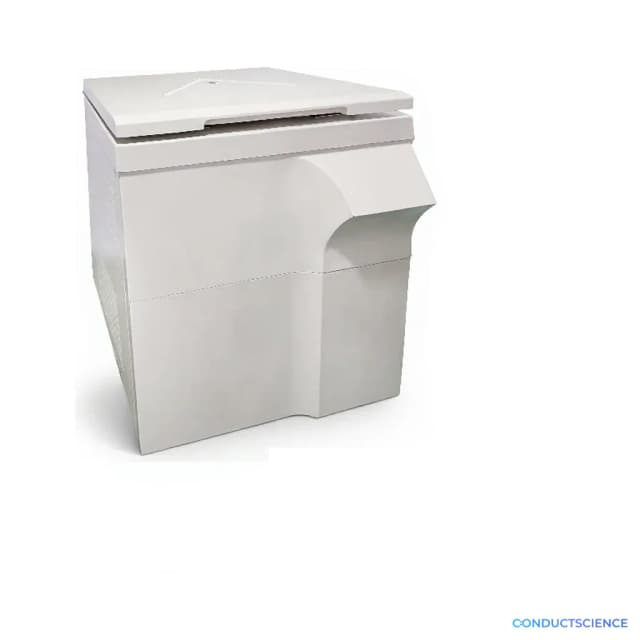
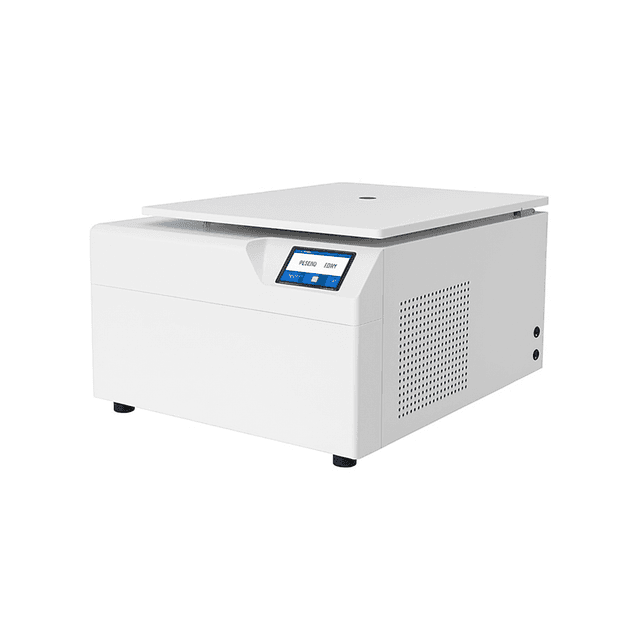
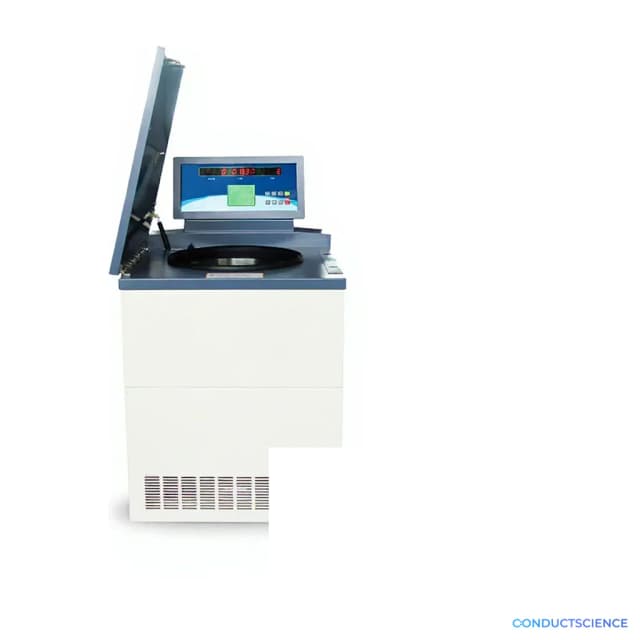
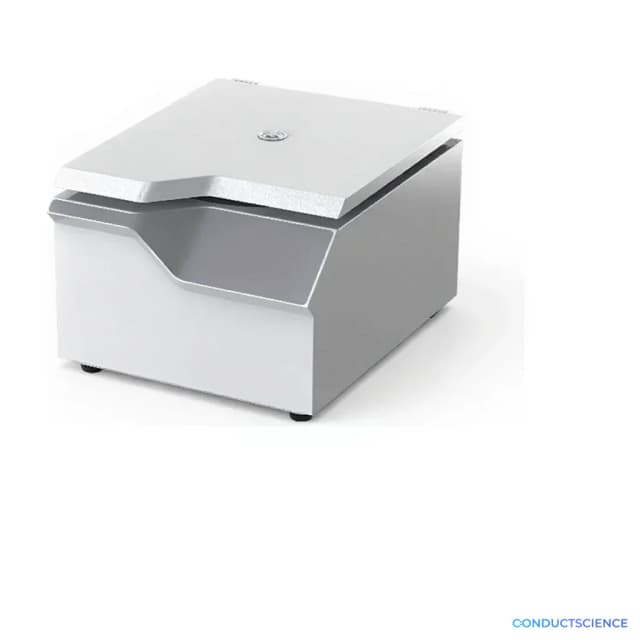
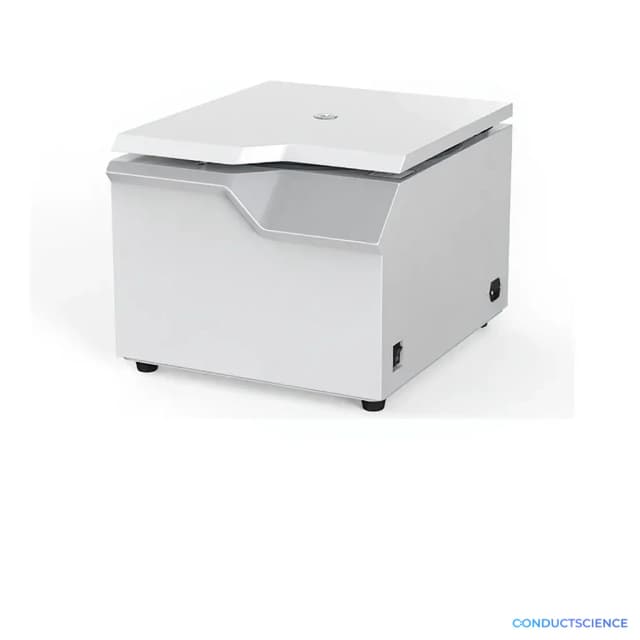
Low Speed Refrigerated Centrifuge
Low-speed refrigerated centrifuge operating up to 6,000 rpm with temperature control from -20°C to 40°C, accommodating 4×750ml sample capacity for temperature-sensitive separations.

Louise Corscadden, PhD
Director of Science · ConductScience
Ask Louise about Low Speed Refrigerated Centrifuge fit, setup, configuration, or quote prep.
Already working with us? Sign in to connect this with My Scientist.
Key Specifications
Full details →- Model fit
- Configured during quote
- SKU family
- BIO-0269
- Shipping box
- 29527.56 x 157.48 x 38.0 cm
- Ordering
- Online checkout and quote request available
- Category
- Centrifuges
- Build notes
- Confirm accessories, station layout, and support needs before purchase
The Low Speed Refrigerated Centrifuge provides controlled centrifugal separation with precise temperature regulation for sample processing in research and clinical laboratories. Operating at speeds up to 6,000 rpm with maximum relative centrifugal force of 5,502×g, this unit accommodates up to 4×750ml sample capacity while maintaining temperature control from -20°C to 40°C with ±1°C accuracy.
The instrument features a quiet operation profile at ≤62dB and offers flexible timing control from 1 second to 99 hours 59 minutes 59 seconds including jog function. Speed precision is maintained at ±10 rpm throughout the operational range. The refrigerated design enables temperature-sensitive sample processing while the substantial 120 kg net weight provides operational stability during high-speed separations.
How It Works
Centrifugal separation operates on the principle of applying centrifugal force to overcome Brownian motion and gravitational settling, enabling rapid separation of particles based on density differences. The rotor assembly generates centrifugal acceleration proportional to the square of angular velocity and radius, creating forces up to 5,502 times gravitational acceleration to drive separation processes that would otherwise require extended settling periods.
The integrated refrigeration system maintains precise temperature control through active cooling, preventing thermal degradation of temperature-sensitive samples during extended centrifugation protocols. The temperature regulation system operates from -20°C to 40°C with ±1°C accuracy, enabling processing of samples requiring specific thermal conditions for optimal separation or preservation of biological activity.
The timing control system provides flexible operation from brief pulse centrifugation (1 second) to extended separations approaching 100 hours, with jog function capability for incremental acceleration and deceleration. Speed regulation maintains ±10 rpm precision across the operational range, ensuring reproducible centrifugal force application for quantitative separation procedures.
Features & Benefits
Automation Level
- semi-automated
Max speed
- 6,000 rpm
Maximum Capacity
- 4*750ml
Speed Precision
- ±10rpm
Noise
- ≤62dB
Timing Range
- 1s~99h59min59s/jog
Temperature Accuracy
- ±1℃
External Size(W*D*H)mm
- 750*590*890
Package Size(WD*H)mm
- 830*700*1060
Net Weight(kg)
- 120
Gross Weight(kg)
- 165
Rotor No.
- Max. Capacity
Brand
- ConductScience
Research Domain
- Analytical Chemistry
- Cell Biology
- Clinical Diagnostics
- Environmental Monitoring
- Microbiology
- Pharmaceutical QC
Temperature Range
- -20~40℃
Power/Voltage
- AC220V, 50/60Hz(Atandard); AC110V, 50/60Hz(Optional): External transformer
Max force
- 5,502 ×g
Shipping weight
- 264.55 lb
Shipping box
- L: 29527.56 cm
- W: 157.48 cm
- H: 38.0 cm
| Feature | This Product | Typical Alternative | Advantage |
|---|---|---|---|
| Maximum Speed Range | 6,000 rpm with 5,502×g maximum RCF | Entry-level models often limited to 3,000-4,000 rpm | Higher speed capability enables more efficient separation of dense precipitates and cellular components in research protocols. |
| Temperature Control Range | -20°C to 40°C with ±1°C accuracy | Basic refrigerated models often limited to 4°C to room temperature | Extended temperature range accommodates diverse sample requirements including frozen sample processing and temperature-sensitive protocols. |
| Sample Capacity | 4×750ml maximum capacity configuration | Smaller units typically accommodate 4×100ml to 4×250ml | Larger capacity enables high-throughput sample processing and bulk preparation procedures in research environments. |
| Speed Precision | ±10 rpm precision control | Standard models often provide ±50 rpm or lower precision | Precise speed control ensures reproducible centrifugal force application for quantitative separation protocols. |
| Timing Flexibility | 1s to 99h59min59s range with jog function | Basic models often limited to standard preset times | Extended timing range supports both pulse centrifugation and extended separation protocols with incremental control capability. |
| Noise Performance | ≤62dB operational noise level | Standard centrifuges often operate at 65-70dB | Quieter operation enables use in shared laboratory spaces without acoustic interference during extended protocols. |
The BKC-TL5RIII combines extended temperature control range, precise speed regulation, and large sample capacity in a low-noise design suitable for research environments requiring temperature-sensitive sample processing. The system provides operational flexibility through extended timing control and jog functionality while maintaining reproducible performance through precise speed control.
Practical Tips
Verify temperature accuracy monthly using a calibrated reference thermometer placed in the sample chamber during a typical protocol run.
Why: Temperature accuracy directly affects sample integrity and separation reproducibility in temperature-sensitive protocols.
Clean and inspect rotor assemblies after each use, particularly when processing samples containing proteins or other materials that may cause corrosion.
Why: Regular rotor maintenance prevents imbalance issues and extends component lifespan while ensuring safe operation.
Allow the refrigeration system to pre-cool to target temperature before loading samples, particularly for protocols requiring precise thermal control.
Why: Pre-cooling ensures immediate temperature control upon sample loading and prevents thermal shock to temperature-sensitive samples.
Use appropriate tube filling levels (typically 75-80% of tube capacity) to prevent sample spillage during acceleration and deceleration phases.
Why: Proper filling levels prevent cross-contamination and maintain sample integrity while reducing cleanup requirements.
If excessive vibration occurs, immediately stop operation and verify sample balance across all rotor positions before resuming.
Why: Unbalanced loads can damage the centrifuge mechanism and create safety hazards during high-speed operation.
Ensure the lid is fully closed and locked before initiating operation, and never attempt to open during rotation.
Why: Safety interlocks prevent accidental exposure to rotating components, which can cause severe injury at operational speeds.
Record actual operational parameters including final speed, temperature, and duration for each protocol run to ensure reproducibility.
Why: Documented parameters enable protocol optimization and troubleshooting while supporting regulatory compliance in validated environments.
Setup Guide
What’s in the Box
- Low Speed Refrigerated Centrifuge BKC-TL5RIII main unit
- Power cord and electrical connections
- User manual and operation documentation
- Rotor assembly (typical)
- Safety interlock mechanisms (typical)
- Temperature calibration certificate (typical)
Warranty
ConductScience provides standard one-year manufacturer warranty covering defects in materials and workmanship, with technical support for operational guidance and maintenance procedures.
Compliance
What rotor types are compatible with this centrifuge model?
The system accommodates rotors with maximum capacity of 4×750ml configuration. Consult product datasheet for specific rotor compatibility and maximum capacity specifications for different rotor designs.
How quickly does the refrigeration system reach target temperature?
Temperature stabilization time depends on ambient conditions and target temperature differential. The system maintains ±1°C accuracy once stabilized across the -20°C to 40°C operational range.
What maintenance procedures are required for optimal performance?
Regular maintenance includes rotor cleaning and inspection, refrigeration system servicing, and periodic speed calibration verification. Consult product manual for specific maintenance schedules and procedures.
Can the centrifuge operate at room temperature without refrigeration?
Yes, the temperature control system operates from -20°C to 40°C, allowing ambient temperature operation within this range while maintaining ±1°C temperature accuracy.
What safety features prevent operation with unbalanced loads?
Consult product datasheet for specific imbalance detection and safety interlock mechanisms. The 120 kg construction weight provides operational stability during balanced operation.
How does this model compare to higher speed centrifuges?
This low-speed model operates up to 6,000 rpm with 5,502×g maximum RCF, suitable for applications requiring moderate centrifugal force with temperature control, compared to ultracentrifuges operating at higher speeds for density gradient separations.
What data logging or connectivity options are available?
Consult product datasheet for available data recording, connectivity, or computer interface options for protocol documentation and process monitoring.
Have a question about this product?
Have a question? Just ask.
Send it over and we'll email you a personalized answer — no call, no scheduling.
Prefer to talk it through?
Replacement Parts & Consumables
Upgrade Options