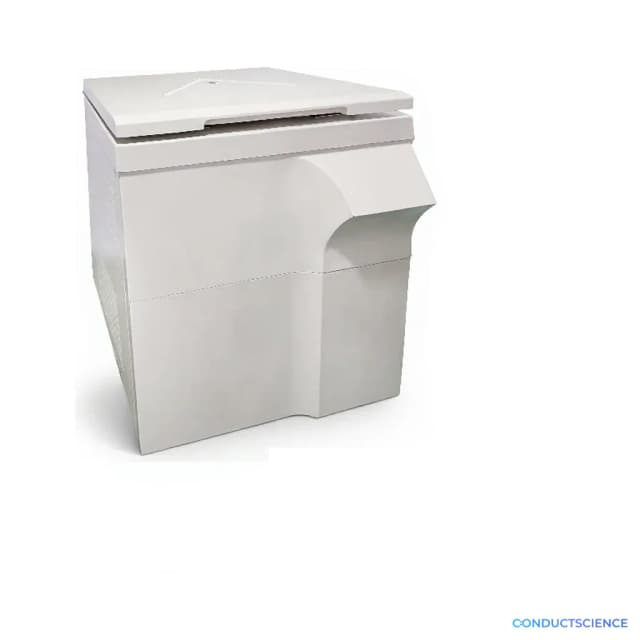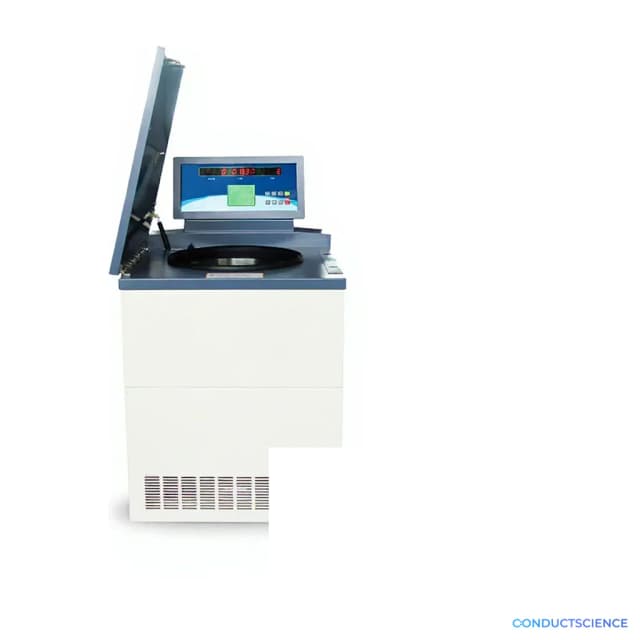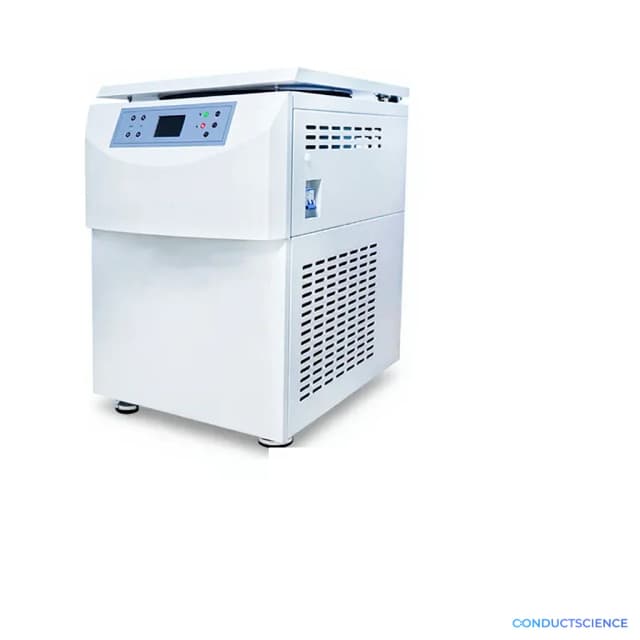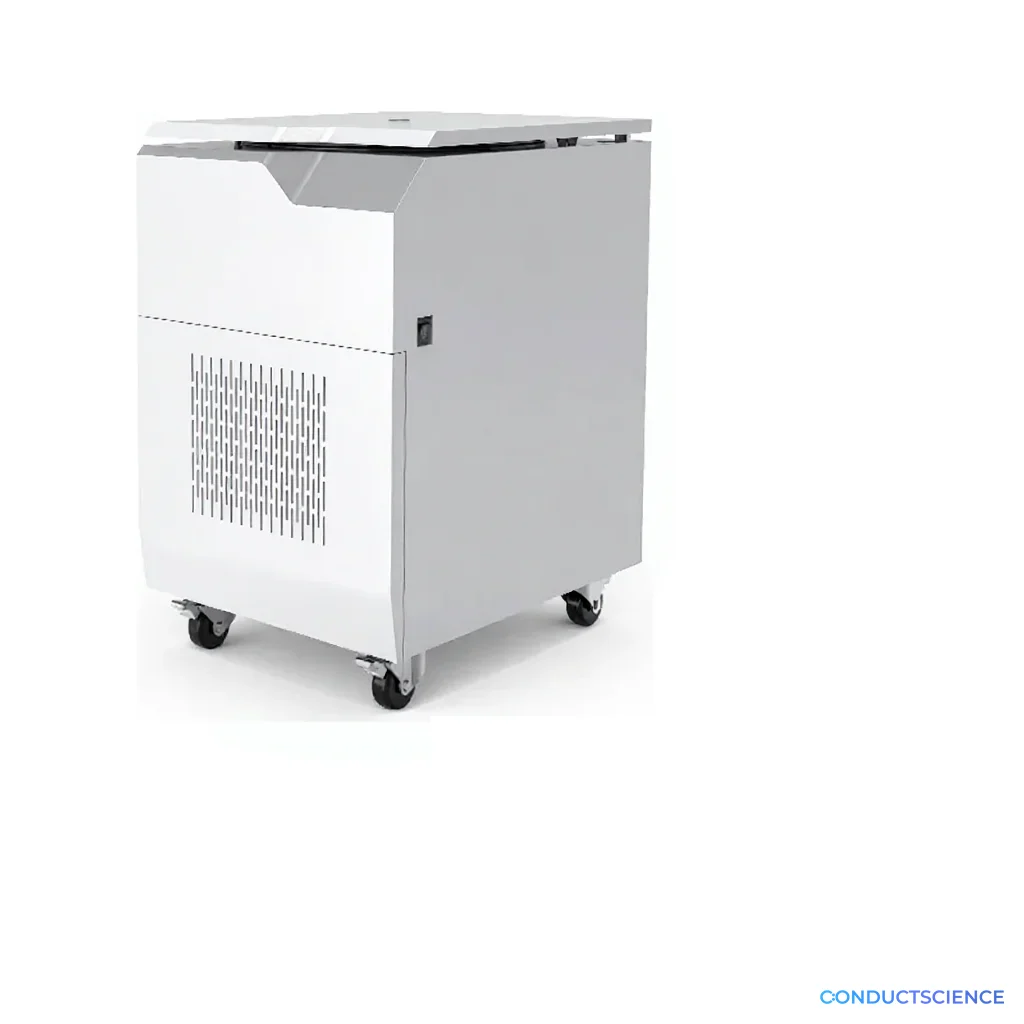
Floor Type Low Speed Centrifuge
Floor-standing laboratory centrifuge operating at up to 6000 rpm (5111×g) with 4×750ml capacity for routine sample separation and processing applications.

Louise Corscadden, PhD
Director of Science · ConductScience
Ask Louise about Floor Type Low Speed Centrifuge fit, setup, configuration, or quote prep.
Already working with us? Sign in to connect this with My Scientist.
Key Specifications
Full details →- Model fit
- Configured during quote
- SKU family
- BIO-0275
- Shipping box
- 82.0 x 50.0 x 63.5 cm
- Ordering
- Online checkout and quote request available
- Category
- Centrifuges
- Build notes
- Confirm accessories, station layout, and support needs before purchase
The Floor Type Low Speed Centrifuge is a benchtop laboratory centrifuge designed for routine sample processing and separation applications requiring moderate centrifugal forces. This instrument operates at speeds up to 6000 rpm with a maximum relative centrifugal force (RCF) of 5111×g, providing sufficient separation capability for most biological samples, cell pellets, and laboratory preparations.
The centrifuge accommodates a maximum volume of 4×750ml samples and features precise speed control with ±10 rpm accuracy. The timing system offers flexible operation from 1 second to 99 hours and 59 minutes, with both continuous and short-span modes. Operating noise is maintained at ≤65 dB, suitable for standard laboratory environments. The unit requires AC220V power supply at 50/60Hz frequency.
How It Works
Centrifugal separation operates on the principle of differential sedimentation under applied centrifugal force. When samples are rotated at high speed, particles experience a centrifugal force proportional to their mass, the square of the angular velocity, and their distance from the axis of rotation. This force causes particles to migrate radially outward, with denser particles sedimenting faster than less dense particles.
The relative centrifugal force (RCF) is calculated as RCF = 11.18 × r × (rpm/1000)², where r is the radius in centimeters. At maximum speed of 6000 rpm, this centrifuge generates forces up to 5111×g, sufficient to pellet most biological particles including cells, bacteria, and protein precipitates. The separation efficiency depends on particle size, density difference between particles and medium, and the applied centrifugal force and time.
The timing control system allows precise control of separation duration, enabling optimization for different sample types. Continuous mode permits extended runs for difficult separations, while short-span mode provides precise timing for routine applications. The ±10 rpm speed accuracy ensures reproducible results between runs.
Features & Benefits
Automation Level
- semi-automated
Max speed
- 6,000 rpm
Speed Accuracy
- ±10rpm
Max. Volume
- 4*750ml
Timing Range
- 1s~99h59min, Continuous/Short-span
Noise
- ≤65dB
Dimension(L*W*H)
- 500*635*820mm
Package Size(L*W*H)
- 700*580*1100mm
NO.
- Rotors Type
Max. RCF(×g)
- Adapters
Brand
- ConductScience
Research Domain
- Analytical Chemistry
- Cell Biology
- Clinical Diagnostics
- Materials Science
- Microbiology
- Pharmaceutical QC
Power/Voltage
- AC220V, 50/60Hz
Weight
- 105kg(220V), 110kg(110V)
Capacity
- Max. Speed(rpm)
Max force
- 5,111 ×g
Shipping weight
- 91.0 lb
Shipping box
- L: 82.0 cm
- W: 50.0 cm
- H: 63.5 cm
| Feature | This Product | Typical Alternative | Advantage |
|---|---|---|---|
| Maximum Speed | 6000 rpm | Entry-level models often limited to 3000-4000 rpm | Higher speed enables faster separation times and more complete pelleting of fine particles. |
| Sample Capacity | 4×750ml maximum volume | Benchtop units typically accommodate smaller tube volumes | Large capacity reduces the number of runs needed for batch sample processing. |
| Timing Range | 1s to 99h59min with continuous and short-span modes | Basic models often limited to shorter timing ranges | Extended timing capability supports both rapid clarification and lengthy density gradient separations. |
| Speed Accuracy | ±10 rpm precision | Budget centrifuges may have less precise speed control | Accurate speed control ensures reproducible RCF values for protocol standardization. |
| Design Configuration | Floor-standing with 91kg mass | Benchtop models are lighter but less stable | Heavy floor mounting provides superior vibration dampening during high-speed operation. |
This centrifuge combines high-speed capability up to 6000 rpm with large sample capacity and precise timing control. The floor-standing design ensures stable operation at maximum speed, while the extended timing range supports diverse separation protocols from quick clarification to extended gradient work.
Practical Tips
Verify speed accuracy annually using a calibrated tachometer or frequency counter during routine maintenance.
Why: Speed drift affects RCF calculations and can compromise separation reproducibility over time.
Clean the rotor chamber daily with mild detergent and inspect for corrosion or sample residue buildup.
Why: Accumulated debris can cause imbalance and corrosion can weaken critical components.
Allow the centrifuge to reach full speed before starting the timer for consistent separation results.
Why: Acceleration time varies with load and affects the total centrifugal force-time integral.
Never open the lid while the rotor is spinning, even at low speeds, and wait for complete stop.
Why: Rotating parts can cause serious injury and lid interlocks prevent accidental contact with moving rotor.
If excessive vibration occurs, immediately stop operation and check for unbalanced loading or worn rotor bearings.
Why: Continued operation with imbalance can damage the motor and compromise instrument accuracy.
Record actual run conditions (speed, time, temperature) rather than set points for reproducible protocols.
Why: Actual operating parameters may differ slightly from settings and affect separation outcomes.
Pre-balance samples to within 0.1g when using the maximum 750ml capacity to minimize rotor stress.
Why: Large volume imbalances create substantial forces that can exceed rotor design limits.
Setup Guide
What’s in the Box
- Floor Type Low Speed Centrifuge main unit
- Standard swing-out rotor (typical)
- Sample adapters set (typical)
- Power cord
- Operating manual
- Performance verification certificate (typical)
Warranty
ConductScience provides a standard one-year manufacturer warranty covering parts and labor, with technical support available for installation guidance and operational questions.
Compliance
What rotor types are compatible with this centrifuge?
Consult product datasheet for specific rotor compatibility. The unit accommodates rotors supporting up to 4×750ml capacity with maximum 6000 rpm rating.
How do I ensure proper sample balance for safe operation?
Load samples of equal volume and density in opposing positions. Use water-filled tubes as counterbalances if necessary to maintain rotor balance within manufacturer specifications.
What maintenance schedule is recommended for optimal performance?
Perform daily cleaning of rotor and chamber, weekly inspection of rotor for cracks or wear, and annual professional calibration verification of speed and timing accuracy.
Can this centrifuge handle temperature-sensitive samples?
Consult product datasheet for temperature control capabilities. Pre-chill rotors and samples if maintaining low temperatures during separation is critical for sample integrity.
What safety features prevent operation with unbalanced loads?
Consult product datasheet for specific safety systems. Most centrifuges include vibration sensors that automatically stop operation if excessive imbalance is detected.
How does the RCF relate to separation efficiency for different sample types?
Higher RCF values increase separation speed but may damage delicate samples. Start with lower forces (1000-2000×g) for cells and increase as needed for complete pelleting.
Have a question about this product?
Have a question? Just ask.
Send it over and we'll email you a personalized answer — no call, no scheduling.
Prefer to talk it through?
Replacement Parts & Consumables
Upgrade Options