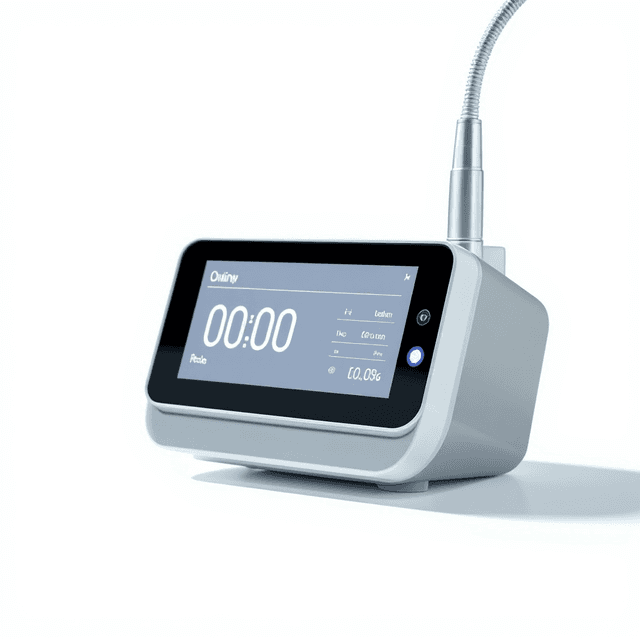
Online Dissolved Oxygen Sensor
Fluorescence-based dissolved oxygen sensor providing continuous online monitoring from 0-20.00 mg/L with ±1% accuracy using green light excitation technology.
| Measuring range | Accuracy |
| 0-20.00mg/L 0 to 200 % air saturation | ±1% F.S |
| Automation Level | semi-automated |
| Brand | ConductScience |

The Online Dissolved Oxygen Sensor employs green light excitation fluorescence lifetime detection technology for continuous dissolved oxygen monitoring in aqueous systems. This optical sensor measures dissolved oxygen concentrations by analyzing the fluorescence lifetime of a specialized fluorophore when exposed to green light excitation. The sensor provides real-time monitoring capabilities across a range of 0-20.00 mg/L or 0-200% air saturation with ±1% full-scale accuracy.
Unlike traditional electrochemical dissolved oxygen sensors, this fluorescence-based system requires no electrolyte solutions and exhibits minimal interference from common water contaminants. The sensor is designed for continuous online monitoring applications where stable, long-term dissolved oxygen measurements are required without frequent maintenance interventions.
How It Works
The sensor operates on the principle of fluorescence quenching by molecular oxygen. A specialized fluorophore coating on the sensor tip is excited by green light from an LED source, causing it to emit red fluorescence. The presence of dissolved oxygen molecules in the surrounding water causes collisional quenching of the excited fluorophore, reducing both the intensity and lifetime of the emitted fluorescence.
The sensor measures the fluorescence lifetime rather than intensity, making it largely immune to variations in LED intensity, detector sensitivity, or optical window contamination. The fluorescence lifetime is inversely proportional to the dissolved oxygen concentration according to the Stern-Volmer equation. By precisely measuring the phase shift between the excitation and emission signals, the sensor calculates the fluorescence lifetime and converts this to dissolved oxygen concentration.
This optical measurement technique eliminates the need for consumable electrolytes, reference electrodes, or frequent membrane replacement required by traditional Clark-type electrochemical sensors. The fluorescence-based approach provides stable, drift-free measurements over extended deployment periods.
Features & Benefits
Measuring range
- Accuracy
0-20.00mg/L 0 to 200 % air saturation
- ±1% F.S
Automation Level
- semi-automated
Brand
- ConductScience
Research Domain
- Analytical Chemistry
- Environmental Monitoring
- Food Science
- Industrial Hygiene
- Microbiology
- Pharmaceutical QC
Weight
- 0.26 kg
Dimensions
- L: 15.0 mm
- W: 5.0 mm
- H: 5.0 mm
Comparison Guide
| Feature | This Product | Typical Alternative | Advantage |
|---|---|---|---|
| Measurement Principle | Green light excitation fluorescence lifetime detection | Many models use electrochemical Clark-type sensors or basic fluorescence intensity measurement | Lifetime measurement provides superior stability and immunity to optical interference compared to intensity-based methods. |
| Measurement Range | Entry-level sensors often have narrower ranges or lower resolution | Wide range covers typical environmental and industrial applications without requiring multiple sensors. | |
| Accuracy Specification | ±1% full-scale accuracy | Basic models may offer ±2-5% accuracy | High accuracy suitable for regulatory monitoring and precise process control applications. |
| Maintenance Requirements | No electrolyte or membrane replacement needed | Electrochemical sensors require regular electrolyte and membrane replacement | Reduced operating costs and maintenance downtime for continuous monitoring applications. |
| Interference Resistance | Minimal interference from common water contaminants | Electrochemical sensors susceptible to poisoning from H2S, heavy metals, and other contaminants | Reliable operation in challenging water quality conditions without signal drift or sensor poisoning. |
This fluorescence-based dissolved oxygen sensor provides high-accuracy continuous monitoring with minimal maintenance requirements. The green light excitation technology offers superior long-term stability and interference resistance compared to electrochemical alternatives, making it well-suited for demanding online monitoring applications.
Practical Tips
Perform initial calibration using both zero-oxygen water (prepared with sodium sulfite) and air-saturated water at known temperature.
Why: Two-point calibration ensures accuracy across the full measurement range and compensates for any sensor-specific response characteristics.
Clean the optical window monthly with mild detergent solution and soft brush to remove biofouling without scratching the sensing surface.
Why: Biofouling can gradually reduce optical transmission and affect measurement accuracy over time.
Install the sensor where water flow velocity is 0.1-0.3 m/s to ensure adequate mass transfer without causing mechanical stress.
Why: Proper flow conditions optimize sensor response time while preventing damage from excessive turbulence or stagnation effects.
If readings become erratic, check for air bubble entrapment on the sensing surface and ensure adequate water circulation.
Why: Air bubbles can cause measurement artifacts by creating locally oxygen-rich microenvironments around the sensor.
Monitor temperature simultaneously with dissolved oxygen measurements for proper temperature compensation and data interpretation.
Why: Oxygen solubility varies significantly with temperature, and accurate compensation is essential for meaningful dissolved oxygen data.
Ensure all electrical connections are properly sealed and rated for wet environments to prevent short circuits.
Why: Water intrusion into electrical connections can damage equipment and create safety hazards in monitoring installations.
Record calibration dates and drift observations in a maintenance log to track sensor performance over time.
Why: Systematic tracking helps identify when recalibration or sensor replacement is needed and supports quality assurance documentation.
If sensor response becomes slow, check for fouling or coating degradation that may require cleaning or fluorophore replacement.
Why: Gradual response time deterioration often indicates physical changes to the sensing surface that can be addressed through proper maintenance.
Setup Guide
What’s in the Box
- Online dissolved oxygen sensor probe (typical)
- Connection cable with waterproof connector (typical)
- Mounting hardware and brackets (typical)
- User manual and calibration instructions (typical)
- Calibration certificate (typical)
Warranty
ConductScience provides a standard 1-year manufacturer warranty covering defects in materials and workmanship, with technical support for installation and operation guidance.
Compliance
How does the fluorescence lifetime measurement principle differ from electrochemical dissolved oxygen sensors?
Fluorescence lifetime measurement is inherently more stable because it measures the temporal characteristics of fluorescence decay rather than signal intensity. This makes it immune to optical window fouling, LED aging, and detector sensitivity changes that affect conventional optical sensors and eliminates the electrode poisoning and electrolyte depletion issues of electrochemical sensors.
What calibration frequency is required for accurate measurements?
Fluorescence-based sensors typically require less frequent calibration than electrochemical sensors due to their inherent stability. Initial two-point calibration should be verified monthly, with full recalibration performed quarterly or when drift exceeds acceptable limits for the application.
How does temperature affect the dissolved oxygen measurements?
Dissolved oxygen solubility is temperature-dependent following Henry's Law. The sensor requires temperature compensation for accurate readings, typically provided by integrated temperature measurement or external temperature input to the monitoring system.
What maintenance is required for long-term deployment?
Routine maintenance involves periodic cleaning of the optical window to remove biofouling or sediment accumulation. The fluorophore coating is stable but may require replacement after extended use or exposure to harsh chemicals. No electrolyte or membrane replacement is needed.
Can the sensor operate in high-salinity or contaminated water?
The optical measurement principle is largely immune to common water contaminants that interfere with electrochemical sensors. Salinity does not directly affect the fluorescence measurement, though it may influence oxygen solubility calculations. Heavy biofouling can eventually affect optical transmission.
What is the response time for detecting changes in dissolved oxygen?
Response time depends on the mass transfer characteristics of the sensing membrane and typically ranges from 30-90 seconds for 90% of step change. This is generally faster than electrochemical sensors and suitable for most process monitoring applications.
How does this compare to portable dissolved oxygen meters for field measurements?
This online sensor provides continuous monitoring capability versus spot measurements from portable meters. While portable meters may offer slightly higher accuracy for grab samples, online sensors provide trend data and can trigger alarms for process control applications.
Have a question about this product?
Accessories
Enhance your setup with compatible accessories
Frequently Bought Together
Upgrade Options