Online DO Electrode
Optical dissolved oxygen electrode using luminescence quenching technology for continuous monitoring in aqueous systems without consumable electrolytes.

Louise Corscadden, PhD
Director of Science · ConductScience
Ask Louise about Online DO Electrode fit, setup, configuration, or quote prep.
Already working with us? Sign in to connect this with My Scientist.
Key Specifications
Full details →- Model fit
- Configured during quote
- SKU family
- CS-LH-IND004
- Shipping box
- 15.0 x 5.0 x 5.0 cm
- Ordering
- Online checkout and quote request available
- Category
- Industrial Sensors
- Build notes
- Confirm accessories, station layout, and support needs before purchase
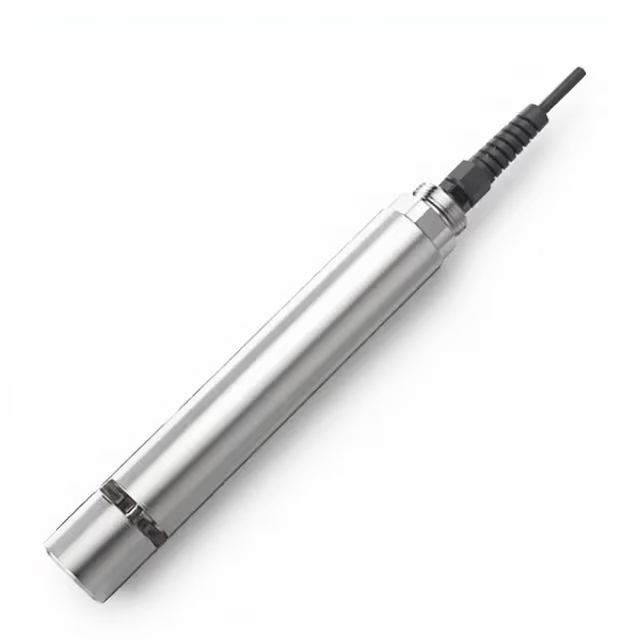
The Online DO Electrode employs luminescence-based optical sensing technology for continuous dissolved oxygen monitoring in aqueous systems. The sensor features a luminescent coating that responds to oxygen concentration through photoluminescence quenching. Green light from an LED excites the luminescent material, which emits red light upon relaxation. The decay time of this red emission correlates inversely with dissolved oxygen concentration - higher oxygen levels decrease the emission decay time.
The electrode incorporates an internal reference system using a red LED that provides measurement stability and compensation for environmental factors. This optical measurement principle eliminates the consumable electrolyte requirements of traditional Clark-type electrodes and provides stable, drift-resistant readings suitable for continuous monitoring applications in water quality assessment and industrial process control.
How It Works
The electrode operates on the principle of dynamic luminescence quenching by molecular oxygen. A green LED transmits excitation light to the sensor surface, which contains a luminescent coating (typically ruthenium-based complexes or platinum porphyrins). Upon photoexcitation, the luminescent molecules transition to an excited state and subsequently emit red light as they return to the ground state.
Dissolved oxygen molecules interact with the excited luminescent material through collisional quenching, reducing both the intensity and lifetime of the red emission. The electrode measures the decay time of the red luminescence, which exhibits a Stern-Volmer relationship with oxygen concentration - higher oxygen concentrations result in shorter decay times due to increased quenching efficiency.
A red LED provides internal reference signals between measurement cycles to compensate for temperature effects, coating aging, and optical component drift. This dual-wavelength approach enhances measurement stability and reduces calibration frequency compared to intensity-based optical sensors.
Features & Benefits
Automation Level
- semi-automated
Brand
- ConductScience
Research Domain
- Analytical Chemistry
- Environmental Monitoring
- Food Science
- Industrial Hygiene
- Microbiology
- Pharmaceutical QC
Shipping weight
- 0.26 lb
Shipping box
- L: 15.0 cm
- W: 5.0 cm
- H: 5.0 cm
| Feature | This Product | Typical Alternative | Advantage |
|---|---|---|---|
| Sensing Principle | Luminescence quenching with green LED excitation | Electrochemical Clark-type sensors | Eliminates electrolyte consumption and membrane maintenance requirements |
| Internal Reference | Red LED reference system | Temperature compensation only | Provides additional stability against optical component aging and drift |
| Maintenance Requirements | Optical window cleaning only | Regular membrane and electrolyte replacement | Reduces operational costs and maintenance downtime in continuous monitoring |
| Response Characteristics | Luminescence decay time measurement | Current or voltage measurement | Less susceptible to electrical interference and sample matrix effects |
This optical electrode provides low-maintenance dissolved oxygen monitoring through luminescence quenching technology with internal reference compensation. The non-consumptive measurement principle enables long-term deployment with minimal intervention.
Practical Tips
Calibrate in both air-saturated water and zero oxygen solution for two-point calibration to ensure accuracy across the full measurement range.
Why: Two-point calibration accounts for non-linear response characteristics and offset errors.
Clean the optical window weekly with deionized water and a soft cloth to prevent biofilm accumulation.
Why: Biofilm formation reduces light transmission and causes measurement drift.
Ensure adequate water circulation around the sensor tip during measurements for representative readings.
Why: Stagnant water layers can create oxygen gradients that affect measurement accuracy.
If readings become erratic, check for air bubbles trapped on the sensor surface or contamination of the optical window.
Why: Air bubbles and surface contamination interfere with optical signal transmission.
Allow 2-3 minutes for thermal equilibration when moving between samples of different temperatures.
Why: Temperature changes affect both oxygen solubility and luminescence characteristics.
Avoid exposing the sensor to strong organic solvents that may damage the luminescent coating.
Why: Solvent exposure can cause coating degradation and permanent sensor damage.
Setup Guide
What’s in the Box
- Online DO electrode with integrated cable (typical)
- Protective sensor cap (typical)
- Calibration solutions (typical)
- User manual and calibration certificate (typical)
- Mounting hardware (typical)
Warranty
ConductScience provides standard manufacturer warranty coverage including technical support for calibration procedures and troubleshooting assistance. Luminescent coating performance may vary with exposure conditions and requires periodic recalibration.
Compliance
How often does the luminescent coating require replacement?
Coating lifetime depends on exposure conditions, but typically provides 1-2 years of stable performance with proper maintenance. Monitor calibration drift to assess coating condition.
What interferes with optical dissolved oxygen measurements?
Heavy turbidity, colored compounds, and biofilm formation on the sensor window can affect light transmission. Hydrogen sulfide may also interfere with some luminescent coatings.
Can this electrode measure oxygen in high-salinity samples?
Optical sensors are generally less affected by ionic strength than electrochemical sensors, but salinity affects oxygen solubility. Ensure calibration accounts for sample matrix effects.
What is the typical response time compared to Clark electrodes?
Optical sensors typically respond faster than membrane-covered electrodes since there is no diffusion barrier. Response time is usually 30-90 seconds for 90% of step change.
How does temperature affect the luminescence measurement?
Temperature affects both oxygen solubility and luminescence lifetime. The internal reference LED helps compensate for temperature effects on the optical components.
What data output formats are available?
Output depends on the connected meter or data logger. Most systems provide analog voltage, digital communication, or data logging capability. Consult meter specifications.
Can the electrode be used in flow-through systems?
Yes, optical sensors work well in flowing systems and actually benefit from good mixing around the sensor tip for representative measurements and reduced biofilm formation.
Have a question about this product?
Have a question? Just ask.
Send it over and we'll email you a personalized answer — no call, no scheduling.
Prefer to talk it through?