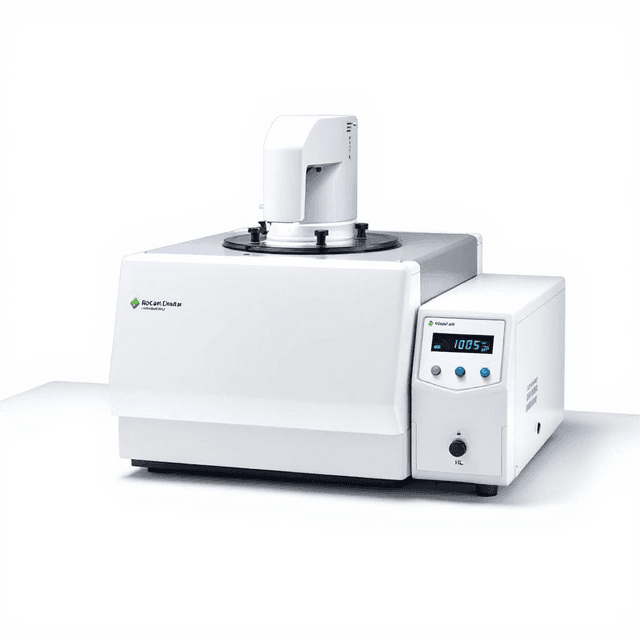
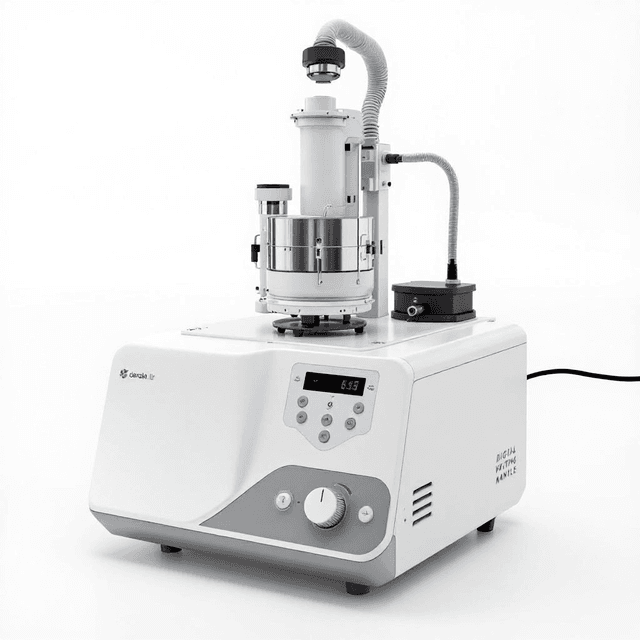
Rotary Evaporator - 0.5L
Constant-temperature film evaporation with stepless speed control.
Ideal for concentration, crystallization, drying, and solvent recovery in pharmaceutical and chemical applications.

Louise Corscadden, PhD
Director of Science · ConductScience
Ask Louise about Rotary Evaporator - 0.5L fit, setup, configuration, or quote prep.
Already working with us? Sign in to connect this with My Scientist.
Key Specifications
Full details →- Model fit
- Configured during quote
- SKU family
- BIO-RE-52A
- Shipping box
- 42.0 x 43.6 x 38.0 cm
- Ordering
- Online checkout and quote request available
- Category
- Benchtop Instruments
- Build notes
- Confirm accessories, station layout, and support needs before purchase
Product Overview
The rotary evaporator uses constant-temperature heating and film evaporation under vacuum. Stepless speed control rotates the flask, forming a uniform film on its inner wall. A temperature-controlled water bath heats the flask, while a glass condenser cools the solvent vapor for recovery in the collecting flask.
Key Features
- Stepless speed control (0–120 rpm)
- PID temperature adjustment (0–99°C, ±1°C accuracy)
- Automatic motorized lift control (150 mm stroke)
- High evaporation and solvent recovery rates
- Durable construction with anti-corrosion coating
How It Works
Features & Benefits
| Parameter | Specification |
|---|---|
| Model | BK-RE-1A |
| Rotary flask | 1 L; 24# standard joint |
| Collecting flask | 0.5 L; 24# standard joint |
| Glass material | GG-17 |
| Housing material | Steel with sprayed anti-corrosion coating |
| Heating unit size | 250 × 388 × 169 mm |
| Chamber size | Ø220 × 140 mm |
| Heating power | 1 kW |
| Temperature range | 0–99°C |
| Temperature accuracy | ±1°C |
| Temperature sensor | PT100 |
| Vacuum | 0.096 MPa |
| Rotation motor power | 30 W |
| Rotation speed | 0–120 rpm |
| Lift mechanism | Motorized |
| Lifting power | 15 W |
| Lifting stroke | 150 mm |
| Speed control | Stepless speed controller |
| Sealing method | Fluorine rubber skeleton oil seal |
| Condenser size | Ø85 × 450 mm |
| Charging valve | 19# standard joint |
| Standard power supply | 220 V, 50 Hz |
| Optional power supply | 220 V, 60 Hz |
| External dimensions (W × D × H) | 640 × 340 × (860–1010) mm |
| Package dimensions (W × D × H) | 740 × 550 × 580 mm |
| Gross weight | 38 kg |
| Included accessories | One 1 L rotary flask; one 0.5 L collecting flask |
| Optional accessories | Vacuum pump, recirculating chiller, transparent cover |
| Feature | This Product | Typical Alternative | Advantage |
|---|---|---|---|
| Collection Flask Capacity | 0.5L capacity | Entry-level models often range from 0.25L to 1L capacity | Provides adequate volume for small-scale laboratory work while maintaining compact footprint. |
| Rotation Speed Range | 0-120 RPM variable control | Basic models may offer fixed speeds or narrower ranges | Variable speed control allows optimization for different solvent types and sample viscosities. |
| Maximum Operating Temperature | Room temperature to 99°C | Budget models may have lower maximum temperatures | Sufficient temperature range covers most common organic solvents while protecting heat-sensitive compounds. |
| Vacuum Performance | -0.098 MPa maximum vacuum | Lower-cost units may achieve less vacuum depth | Strong vacuum capability enables lower evaporation temperatures and better process control. |
| Heating Power | 1 kW heating capacity | Compact models typically offer 0.5-1.5 kW heating power | Adequate power for efficient heating while maintaining precise temperature control. |
This 0.5L rotary evaporator provides essential features for small-scale laboratory applications with variable rotation control, adequate vacuum performance, and sufficient heating capacity. The compact design and budget-friendly approach make it accessible for routine solvent removal tasks without compromising core functionality.
Practical Tips
Always start with low rotation speeds and gradually increase to prevent sample splashing and optimize evaporation efficiency.
Why: Prevents sample loss and allows identification of optimal operating parameters for each solvent type.
Ensure adequate ventilation and use appropriate cold traps to prevent solvent vapors from reaching the vacuum pump.
Why: Protects laboratory personnel and prevents vacuum pump contamination with condensable vapors.
Clean glassware immediately after use and inspect ground glass joints regularly for chips or scratches.
Why: Prevents contamination and maintains vacuum integrity for consistent performance.
Verify temperature accuracy periodically using a calibrated thermometer in the heating bath.
Why: Ensures reproducible processing conditions and protects heat-sensitive samples from overheating.
If evaporation rates are slow, check vacuum connections, clean condenser surfaces, and verify heating bath temperature.
Why: Poor vacuum or inefficient condensation are common causes of reduced evaporation efficiency.
Record rotation speed, temperature, and vacuum level settings for each sample type to develop standard operating procedures.
Why: Enables reproducible results and faster setup for routine applications.
Use boiling chips or stirring bars for samples prone to superheating or bumping during evaporation.
Why: Provides nucleation sites for smooth evaporation and prevents sudden violent boiling.
Setup Guide
What’s in the Box
- Main rotary evaporator unit (typical)
- Evaporation flask with ground glass joint (typical)
- Condenser assembly (typical)
- Collection flask 0.5L (typical)
- Heating bath (typical)
- Power cord (typical)
- Operating manual (typical)
- Basic maintenance kit (typical)
Warranty
ConductScience provides a standard one-year manufacturer warranty covering defects in materials and workmanship, with technical support available for operational guidance and troubleshooting assistance.
Compliance
Have a question about this product?
Have a question? Just ask.
Send it over and we'll email you a personalized answer — no call, no scheduling.
Prefer to talk it through?