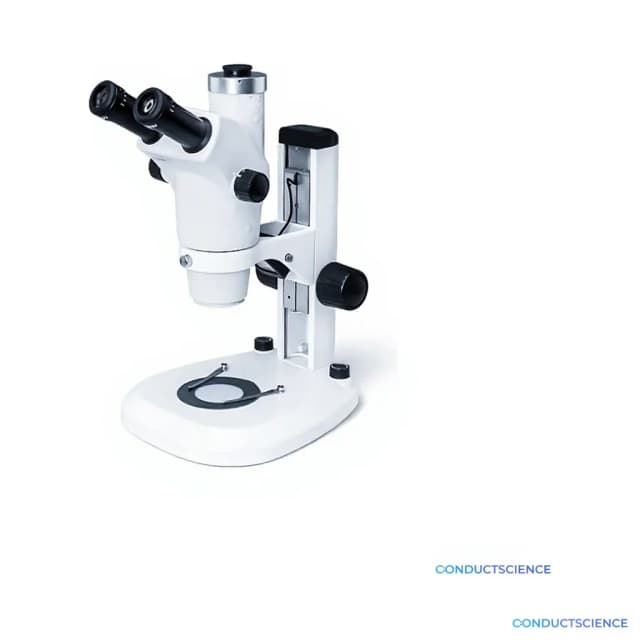
Stereo Microscope
Stereo microscope with 12.5:1 zoom ratio, 6.3x-80x magnification range, dual objective nosepiece, and LED illumination with color temperature control for detailed specimen examination.
| Automation Level | manual |
| Eyepiece | Working distance 80mm |
| High eye point, large field of view, flat field ey | Magnification |
| 6.3x | 34.92mm |
| 80x | 2.75mm |
| Zoom ratio | 12.5:1 |

The ConductScience Stereo Microscope (BIO-0534) provides high-resolution stereoscopic imaging with a 12.5:1 zoom ratio and total magnification range of 6.3x-80x. This vertical arm microscope features a 2-port objective nosepiece for simultaneous mounting of dual primary objectives, enabling rapid switching between magnification ranges without mechanical adjustment. The integrated coaxial focusing mechanism provides both coarse and fine adjustment controls for precise specimen positioning.
The ultra-thin LED base delivers 5W total illumination power with adjustable color temperature and brightness controls displayed digitally. High eye point eyepieces with 80mm working distance and 50-76mm interpupillary distance adjustment accommodate extended observation periods while maintaining ergonomic positioning. The flat field optics ensure uniform image quality across the entire field of view, supporting detailed morphological analysis and documentation workflows.
How It Works
Stereo microscopy utilizes two separate optical paths positioned at slight angles to create stereoscopic depth perception, mimicking natural binocular vision. Each eyepiece receives light from a distinct objective lens pathway, producing parallax that enables three-dimensional visualization of specimen topography and internal structures. The 12.5:1 zoom mechanism adjusts magnification continuously by altering the focal length relationship between objective and eyepiece lenses.
The dual-port objective nosepiece allows simultaneous mounting of two primary objectives with different magnification powers. Illumination from the LED base reflects off the specimen surface and transmits through the objective lenses to the eyepieces. The coaxial focusing system moves the entire optical assembly vertically while maintaining parfocal alignment between objectives, ensuring specimens remain in focus during magnification changes.
Features & Benefits
Automation Level
- manual
Eyepiece
- Working distance 80mm
High eye point, large field of view, flat field ey
- Magnification
6.3x
- 34.92mm
80x
- 2.75mm
Zoom ratio
- 12.5:1
Total magnification
- 6.3x-80x
Interpupillary distance
- 50-76mm
Nosepiece
- 2-port objective nosepiece for simultaneous mounting of 2 primary objectives
Body
- Vertical arm type coarse and fine adjustment coaxial focusing mechanism, bracket lens body integrate
Base
- Ultra-thin base, multiple LEDs (total power 5W), base with color temperature display and brightness
Brand
- ConductScience
Research Domain
- Analytical Chemistry
- Cell Biology
- Developmental Biology
- Environmental Monitoring
- Histopathology
- Materials Science
Weight
- 29.98 kg
Dimensions
- L: 42.0 mm
- W: 43.6 mm
- H: 38.0 mm
Comparison Guide
| Feature | This Product | Typical Alternative | Advantage |
|---|---|---|---|
| Zoom Ratio | 12.5:1 continuous zoom with 6.3x-80x total magnification | Entry-level models often provide 6:1 to 8:1 zoom ratios with more limited magnification ranges | Greater magnification flexibility reduces the need for objective changes during specimen examination workflows. |
| Objective Configuration | 2-port nosepiece for simultaneous mounting of dual objectives | Single objective mounting requires manual changes between magnification ranges | Rapid switching between specialized objectives without realignment improves workflow efficiency during multi-scale analysis. |
| Working Distance | 80mm working distance with high eye point eyepieces | Standard models often provide 60-75mm working distance with conventional eyepieces | Extended working distance accommodates specimen manipulation and larger sample containers while maintaining comfortable viewing position. |
| Illumination Control | Digital color temperature and brightness display with 5W LED system | Basic models typically offer simple intensity adjustment without temperature control or digital feedback | Quantitative illumination control enables reproducible imaging conditions for documentation and measurement protocols. |
| Focusing Mechanism | Coaxial coarse and fine adjustment with vertical arm design | Separate focus controls or rack-and-pinion systems without integrated adjustment | Integrated focusing system maintains parfocal alignment while providing precise positioning control for critical measurements. |
This stereo microscope provides research-grade optical performance with 12.5:1 zoom capability and dual-objective flexibility in a compact design. The digital illumination controls and extended working distance support both routine examination and precision measurement workflows.
Practical Tips
Verify parfocal alignment between objectives using a test specimen with fine detail at maximum magnification.
Why: Proper parfocal adjustment ensures specimens remain in focus when switching between objectives in the dual-port nosepiece.
Clean objective lenses with lens paper and appropriate solvents, avoiding contact with internal optical surfaces.
Why: Contaminated objectives reduce image contrast and resolution, affecting measurement accuracy and documentation quality.
Adjust color temperature based on specimen type and documentation requirements before beginning extended observation sessions.
Why: Consistent illumination conditions improve image repeatability and reduce observer eye strain during prolonged use.
If zoom mechanism becomes stiff, check for debris in the optical path and verify proper objective installation.
Why: Mechanical resistance in the zoom system can indicate contamination or misalignment that affects optical performance.
Use the 80mm working distance to position calibration standards alongside specimens for scale reference in documentation.
Why: Extended working distance allows simultaneous positioning of measurement standards and specimens for accurate dimensional analysis.
Allow LED illumination to stabilize for 10-15 minutes before critical measurements to minimize thermal drift effects.
Why: LED output characteristics change with temperature, potentially affecting illumination uniformity and color temperature stability.
Position frequently used specimens within the zoom range sweet spot (20x-40x) for optimal image quality.
Why: Mid-range magnifications typically provide the best balance of resolution, field of view, and optical aberration correction.
Store the microscope with dust covers on all optical surfaces and objectives retracted to prevent contamination.
Why: Dust and airborne particles on optical surfaces scatter light and degrade image contrast over time.
Setup Guide
What’s in the Box
- Stereo microscope main unit with vertical arm
- Ultra-thin LED base with digital display
- High eye point eyepieces (pair)
- 2-port objective nosepiece
- Primary objectives (2 units, typical)
- Power adapter and cord
- User manual and calibration guide
- Dust covers for optics (typical)
Warranty
ConductScience provides a standard one-year manufacturer warranty covering optical and mechanical components with technical support for calibration and operational guidance.
Compliance
References
Background reading relevant to this product:
What is the actual working distance when using different magnifications across the 6.3x-80x range?
The eyepieces maintain 80mm working distance throughout the magnification range, though effective specimen clearance may vary based on objective selection in the dual-port nosepiece.
Can the dual objectives be parfocal, and how is alignment maintained during switching?
The 2-port nosepiece design allows simultaneous mounting for rapid switching, with parfocal alignment dependent on objective specifications and proper installation height adjustment.
What are the optical specifications for resolution and numerical aperture at maximum magnification?
Consult product datasheet for specific resolution limits and numerical aperture values, as these depend on the primary objectives selected for the nosepiece.
How stable is the coaxial focusing mechanism for precision measurements?
The vertical arm design with integrated coarse and fine adjustment maintains mechanical stability, though specific positioning repeatability should be verified during calibration procedures.
What color temperature range is available, and can it be calibrated for photographic documentation?
The LED base provides adjustable color temperature with digital display, though specific temperature range and calibration procedures should be confirmed in the technical specifications.
Is the microscope suitable for fluorescence applications with appropriate filter sets?
This is a brightfield stereo microscope design; fluorescence capability would require additional optical components and excitation sources not included in the standard configuration.
What is the maximum specimen height that can be accommodated under the objectives?
Maximum specimen height depends on the 80mm working distance minus the specific objective focal distances and any additional specimen stage thickness.
Have a question about this product?
Accessories
Enhance your setup with compatible accessories
Frequently Bought Together
Upgrade Options
Related Products