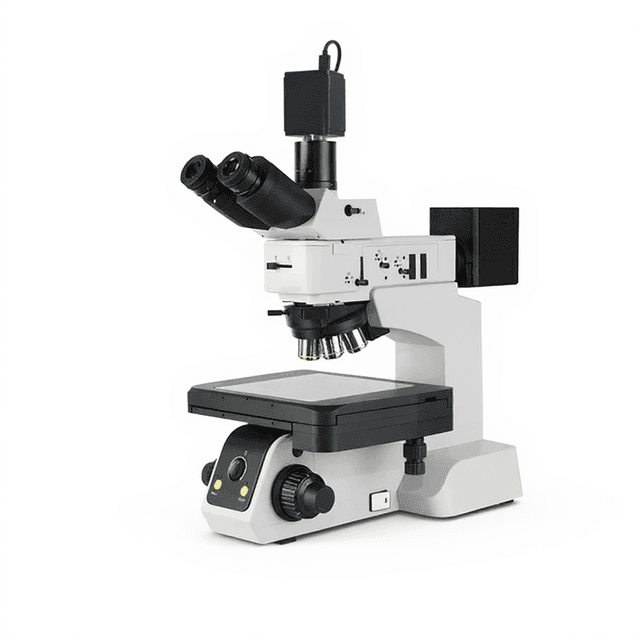
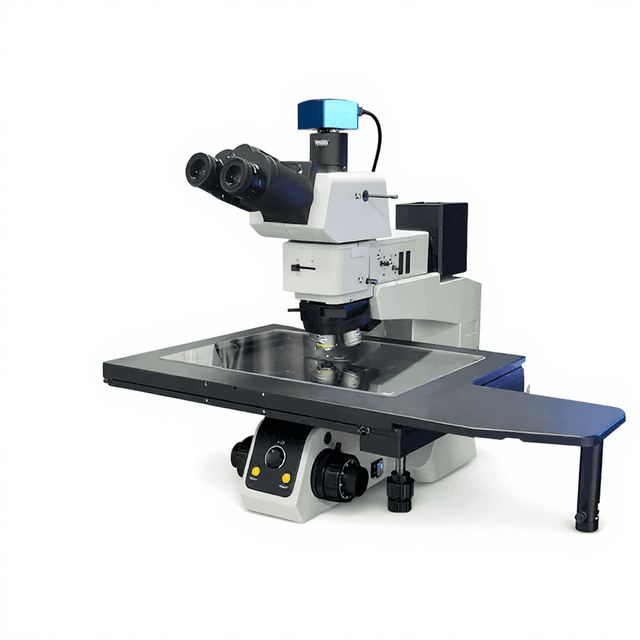
Binocular/Trinocular Biological Microscope
Laboratory biological microscope with binocular/trinocular viewing, 40X-1600X magnification range, mechanical stage, and LED illumination for routine cellular and tissue examination.

Louise Corscadden, PhD
Director of Science · ConductScience
Ask Louise about Binocular/Trinocular Biological Microscope fit, setup, configuration, or quote prep.
Already working with us? Sign in to connect this with My Scientist.
Key Specifications
Full details →- Model fit
- Configured during quote
- SKU family
- MCX-0010
- Shipping box
- 4.9 x 6.6 x 6.6 cm
- Ordering
- Online checkout and quote request available
- Category
- Microscopy
- Build notes
- Confirm accessories, station layout, and support needs before purchase
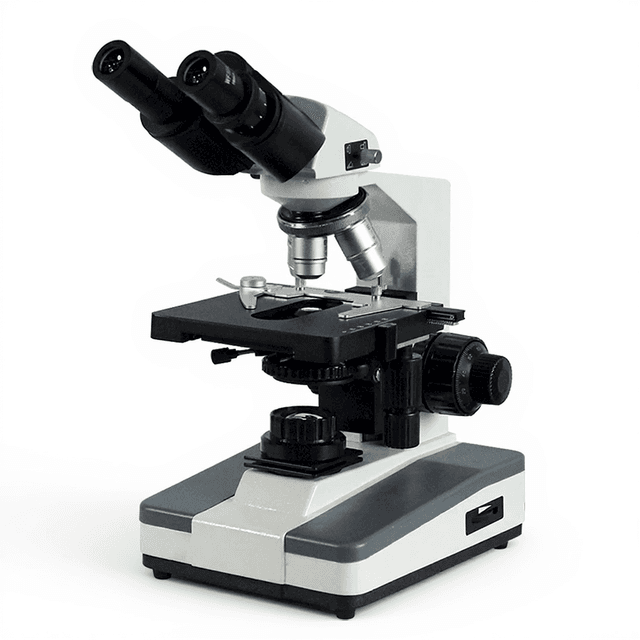
The ConductScience Binocular/Trinocular Biological Microscope (MCX-0010) is a laboratory-grade optical microscope designed for routine biological and clinical examination applications. The system features both binocular and trinocular viewing configurations with a 45° inclined, 360° rotatable eyepiece tube for ergonomic operation during extended observation sessions.
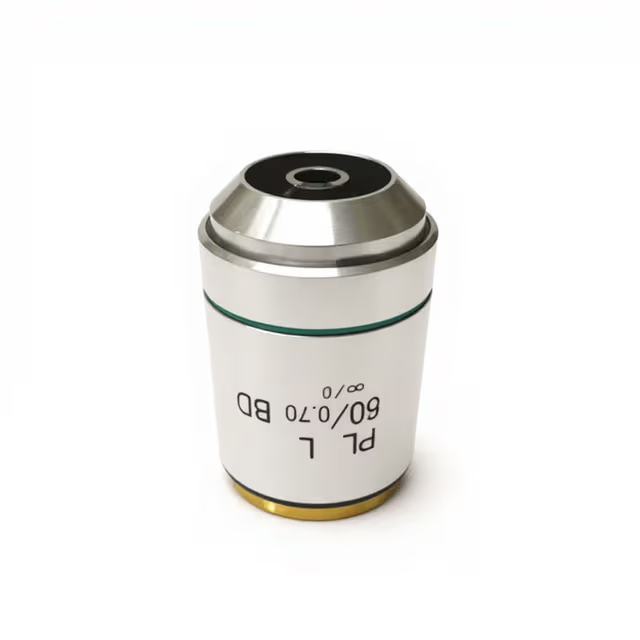
Equipped with plan achromatic objectives ranging from 4X to 100X oil immersion, the microscope provides magnification capabilities from 40X to 1600X. The coaxial coarse and fine focusing system offers 2 μm precision over a 22mm range, while the double-layer mechanical stage with vernier scales enables precise specimen positioning. LED illumination with brightness control and an N.A. 1.25 Abbe condenser with iris diaphragm provide optimal specimen contrast and resolution for brightfield microscopy applications.
How It Works
The microscope operates on the principle of transmitted light brightfield microscopy, where specimens are illuminated from below by LED light that passes through the specimen and is collected by the objective lens. The Plan achromatic objective system corrects for spherical aberration and field curvature, providing flat fields of view with improved edge-to-edge sharpness compared to standard achromatic objectives.
Light from the LED source passes through the N.A. 1.25 Abbe condenser, which focuses illumination onto the specimen plane. The iris diaphragm controls the numerical aperture of the illuminating cone, optimizing contrast and resolution for different specimens. The coaxial focusing mechanism moves the stage vertically relative to the objective, bringing specimens into sharp focus with 2 μm precision through the fine focus adjustment.
The quadruple nosepiece allows rapid magnification changes between the four objectives (4X, 10X, 40X, 100X oil), while the mechanical stage provides precise X-Y positioning with 0.1mm vernier readability over a 75mm × 50mm translation range.
Features & Benefits
Automation Level
- manual
Product Type
- Microscope
Microscope Type
- Biological / Compound
Viewing Head
- Trinocular
Application
- Clinical Research
- Life Science
Skill Level
- Beginner / Student
Brand
- ConductScience
Research Domain
- Analytical Chemistry
- Cell Biology
- Clinical Diagnostics
- Developmental Biology
- Histopathology
- Microbiology
Shipping weight
- 6.3 lb
Shipping box
- L: 4.9 cm
- W: 6.6 cm
- H: 6.6 cm
| Feature | This Product | Typical Alternative | Advantage |
|---|---|---|---|
| Objective Quality | Plan achromatic objectives with numerical apertures up to 1.25 (oil) | Entry-level models often provide standard achromatic objectives with higher aberrations | Plan objectives deliver improved edge-to-edge sharpness and reduced field curvature for more accurate imaging across the entire field of view. |
| Magnification Range | 40X to 1600X total magnification with dual eyepiece options | Basic models may offer more limited magnification ranges | Wide magnification range supports both overview screening and detailed cellular examination in a single instrument. |
| Stage Precision | Double-layer mechanical stage with 0.1mm vernier scales and 75mm × 50mm travel | Simple stages often lack precise positioning controls | Quantitative positioning enables systematic field examination and coordinate-based specimen mapping. |
| Focus System | Coaxial coarse/fine focusing with 2 μm precision over 22mm range | Basic models may have separate focus knobs with lower precision | Coaxial design provides ergonomic operation while 2 μm precision supports critical focus applications at high magnifications. |
| Illumination System | LED illumination with brightness control and N.A. 1.25 Abbe condenser | Lower-end systems may use halogen lamps or simpler condensers | LED provides stable illumination with longer life and reduced heat, while high-NA condenser maximizes resolution potential. |
| Viewing Configuration | Binocular/trinocular head with 45° inclination and 360° rotation | Basic models often have fixed monocular or binocular configurations | Flexible viewing arrangement accommodates multiple users and allows camera integration for documentation and analysis. |
This microscope combines plan achromatic optics, precision mechanical components, and flexible viewing configurations to provide comprehensive brightfield microscopy capabilities. The coaxial focusing, double-layer mechanical stage, and high-NA condenser support both routine examination and more demanding applications requiring precise positioning and optimal resolution.
Practical Tips
Verify parfocality between objectives using a test slide, adjusting objective positions if necessary during initial setup.
Why: Proper parfocality minimizes refocusing when changing magnifications, improving workflow efficiency and reducing specimen movement.
Clean objective front elements with lens tissue and optical cleaning solution, working from center outward in circular motions.
Why: Contaminated objectives reduce image contrast and resolution, particularly affecting high-magnification observations.
Adjust condenser iris diaphragm to approximately 70-80% of objective numerical aperture for optimal contrast-resolution balance.
Why: Proper condenser adjustment maximizes resolution while maintaining specimen contrast, particularly important for unstained specimens.
If field illumination is uneven, center the condenser and verify bulb alignment or LED positioning.
Why: Uniform illumination is essential for accurate imaging and prevents interpretation artifacts from uneven lighting.
Use immersion oil sparingly on the 100X objective, ensuring complete coverage without excess that can trap bubbles.
Why: Proper oil immersion technique maintains the high numerical aperture and prevents image degradation from air gaps or optical artifacts.
Avoid excessive LED brightness settings to prevent specimen heating and potential photodamage in sensitive samples.
Why: Controlled illumination preserves specimen integrity and extends LED life while providing adequate contrast for observation.
Record mechanical stage coordinates when examining multiple fields for systematic documentation and later relocalization.
Why: Coordinate documentation enables systematic field mapping and facilitates return to specific specimen areas for follow-up examination.
Regularly lubricate mechanical stage tracks according to manufacturer specifications to maintain smooth operation.
Why: Proper lubrication prevents mechanical wear and ensures consistent stage movement precision over extended use.
Setup Guide
What’s in the Box
- Binocular/trinocular microscope head with 45° viewing angle
- WF10X/18mm plan eyepieces (pair)
- WF16X/11mm plan eyepieces (pair)
- Plan achromatic objectives: 4X/0.10, 10X/0.25, 40X/0.65, 100X/1.25 oil
- Double-layer mechanical stage with specimen clips
- N.A. 1.25 Abbe condenser with iris diaphragm
- LED illumination system with brightness control
- Power adapter (typical)
- Immersion oil for 100X objective (typical)
- Dust cover (typical)
- User manual and basic maintenance guide (typical)
Warranty
ConductScience provides a one-year manufacturer warranty covering defects in materials and workmanship, with technical support for setup and operational guidance.
Compliance
References
Background reading relevant to this product:
What is the working distance and numerical aperture progression across the objective set?
The objectives provide numerical apertures of 0.10 (4X), 0.25 (10X), 0.65 (40X), and 1.25 (100X oil immersion). Consult product datasheet for specific working distances as these vary with objective design.
Is the mechanical stage compatible with standard slide dimensions and multiwell plates?
The 140mm × 140mm stage accommodates standard 75mm × 25mm slides with 75mm × 50mm travel range. Multiwell plate compatibility depends on plate dimensions relative to stage size and objective working distances.
What immersion oil specification is required for the 100X objective?
The 100X/1.25 oil immersion objective requires Type A immersion oil with refractive index 1.515. Consult objective manufacturer specifications for viscosity and dispersion requirements.
Can the trinocular port accommodate different camera systems?
The trinocular port accepts standard C-mount camera adapters. Camera compatibility depends on sensor size, pixel pitch, and adapter optical magnification for proper field matching.
What is the resolution limit at maximum magnification?
Theoretical resolution with the 100X/1.25 NA objective is approximately 0.27 μm using green light (550nm). Practical resolution depends on specimen contrast, illumination setup, and optical alignment quality.
How does LED illumination compare to halogen for critical microscopy applications?
LED provides stable intensity, longer life, and reduced heat generation but may have different spectral characteristics than halogen. Consider color temperature and spectrum for applications requiring specific illumination wavelengths.
What maintenance procedures are required for long-term performance?
Regular maintenance includes objective cleaning, condenser alignment verification, mechanical stage lubrication, and LED replacement when needed. Consult user manual for specific maintenance intervals.
Is the focusing mechanism suitable for time-lapse or repeated measurements?
The coaxial focusing with 2 μm precision supports repeated measurements. For time-lapse applications, consider mechanical stability and potential drift over extended periods.
Have a question about this product?
Have a question? Just ask.
Send it over and we'll email you a personalized answer — no call, no scheduling.
Prefer to talk it through?
Accessories
Enhance your setup with compatible accessories
Frequently Bought Together
Upgrade Options
Related Products