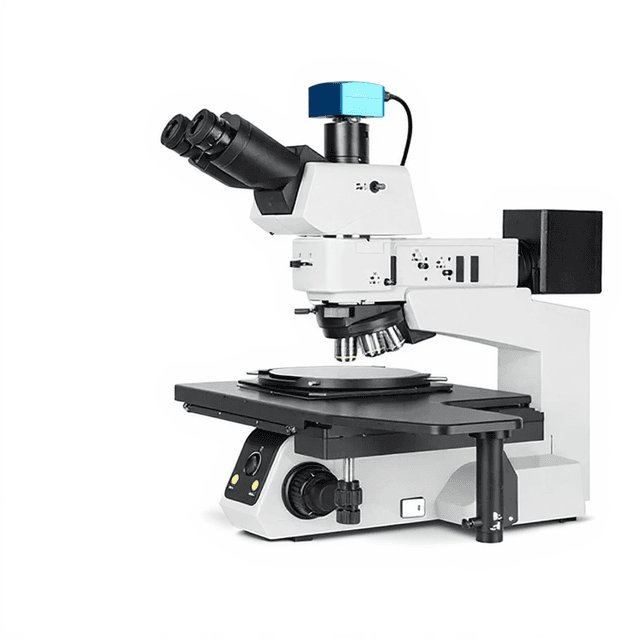
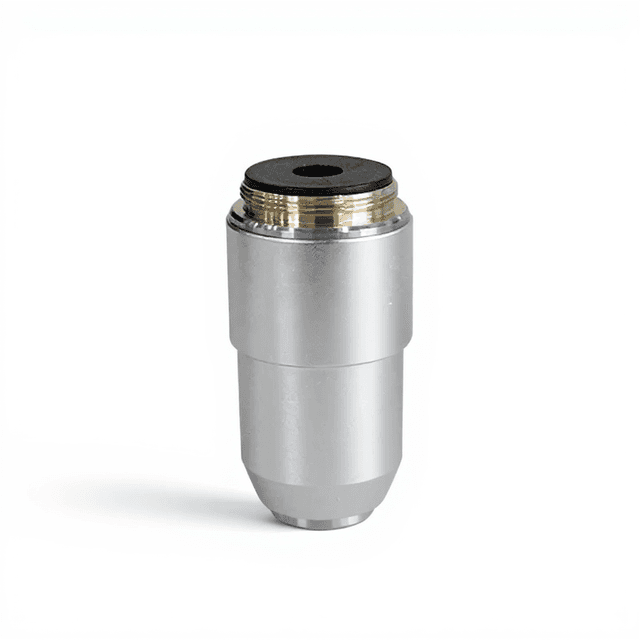
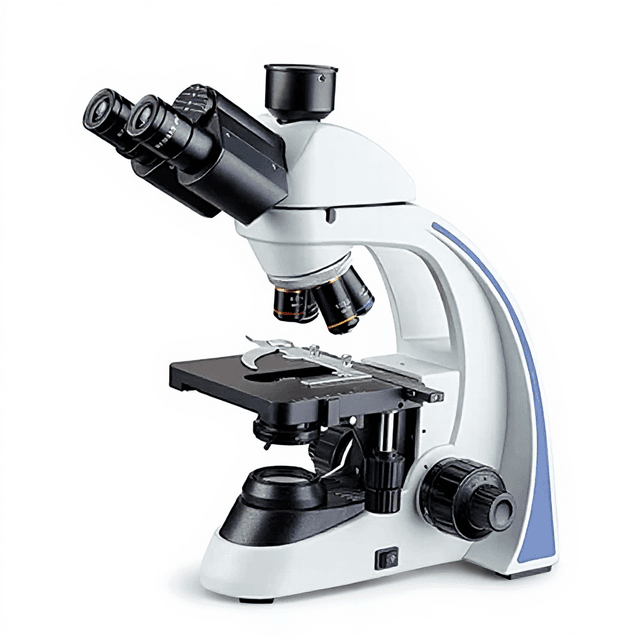
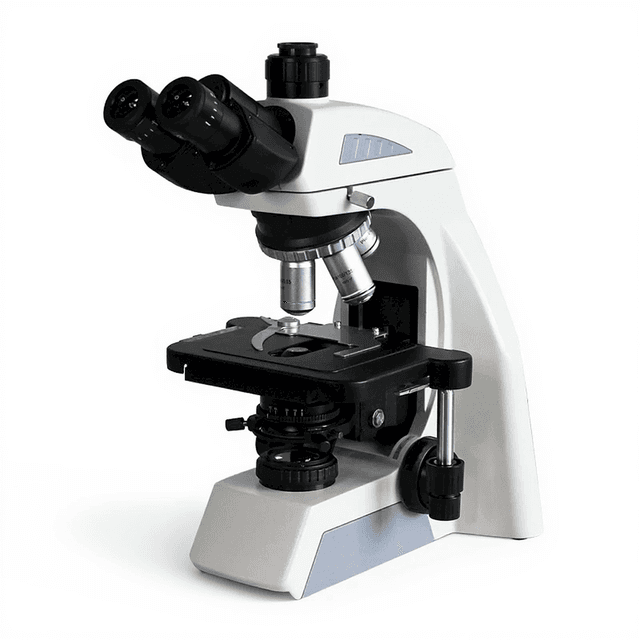
Three eye phase contrast microscope
Multi-objective compound microscope with integrated phase contrast capability for cellular and microbiological examination, featuring 10X eyepiece and objectives from 4X to 100X oil immersion.

Louise Corscadden, PhD
Director of Science · ConductScience
Ask Louise about Three eye phase contrast microscope fit, setup, configuration, or quote prep.
Already working with us? Sign in to connect this with My Scientist.
Key Specifications
Full details →- Model fit
- Configured during quote
- SKU family
- BIO-0535
- Shipping box
- 42.0 x 43.6 x 38.0 cm
- Ordering
- Online checkout and quote request available
- Category
- Microscopy
- Build notes
- Confirm accessories, station layout, and support needs before purchase
The ConductScience Three Eye Phase Contrast Microscope is a multi-objective brightfield and phase contrast microscopy system designed for cellular and microbiological examination. This compound microscope features a standard eyepiece magnification of 10X with multiple objective lenses providing total magnifications from 40X to 1000X. The integrated phase contrast capability at 10X magnification enables visualization of unstained, transparent specimens by converting phase differences into amplitude variations.
The microscope incorporates four objective lenses with numerical apertures ranging from 0.10 (4X) to 1.25 (100X oil immersion), providing researchers with flexibility for both low-magnification surveys and high-resolution oil immersion imaging. The phase contrast functionality allows examination of living cells, bacteria, and other transparent specimens without the need for staining, preserving specimen viability during observation.
How It Works
Phase contrast microscopy exploits the phase differences that occur when light passes through specimens of varying thickness and refractive index. In conventional brightfield microscopy, transparent specimens produce minimal contrast because they primarily alter the phase rather than the amplitude of transmitted light. The phase contrast system converts these nearly invisible phase changes into visible amplitude variations.
The phase contrast objective contains a phase ring that introduces a quarter-wavelength phase shift to the diffracted light passing through the specimen, while undiffracted background light passes through an annular aperture. When these two light paths recombine at the image plane, interference occurs that converts phase differences into brightness variations, rendering transparent structures visible with enhanced contrast.
The multiple objective system provides magnification flexibility from 40X (4X objective × 10X eyepiece) to 1000X (100X oil immersion objective × 10X eyepiece). The numerical aperture progression from 0.10 to 1.25 enables both wide-field surveys at lower magnifications and high-resolution imaging at greater magnifications, with the oil immersion objective providing maximum resolution for detailed cellular ultrastructure examination.
Features & Benefits
Automation Level
- manual
Category
- Magnification rate
Eyepiece
- 10X
16X
- Φ11mm
Numerical Aperture
- work distance
4X
- 0.10
10X
- 0.25
40X
- 0.65
100X(Oil)
- 1.25
Phase contrast objective
- 10X
0.25
- 7.31mm
Brand
- ConductScience
Research Domain
- Cell Biology
- Clinical Diagnostics
- Environmental Monitoring
- Histopathology
- Microbiology
- Pharmaceutical QC
Shipping weight
- 29.98 lb
Shipping box
- L: 42.0 cm
- W: 43.6 cm
- H: 38.0 cm
| Feature | This Product | Typical Alternative | Advantage |
|---|---|---|---|
| Magnification Range | 40X to 1000X total magnification (4X, 10X, 40X, 100X objectives with 10X eyepiece) | Entry-level models often provide 40X to 400X ranges with fewer objectives | Complete magnification coverage eliminates the need for objective changes during multi-scale examinations |
| Phase Contrast Integration | Built-in phase contrast capability at 10X magnification | Many basic microscopes lack phase contrast or require expensive add-on kits | Enables live cell observation without staining artifacts that could affect cell viability or behavior |
| Numerical Aperture Range | 0.10 to 1.25 NA across all objectives | Lower-cost systems often have reduced NA values limiting resolution | Maximizes resolution capability at each magnification for detailed structural analysis |
| Oil Immersion Capability | 100X oil immersion objective with NA 1.25 | Budget models may lack oil immersion or have lower NA oil objectives | Provides maximum theoretical resolution for bacterial identification and cellular ultrastructure studies |
| Viewing Configuration | Three-eye design with binocular viewing plus camera port | Standard binocular models require beam splitters for photography | Simultaneous visual observation and image capture without optical compromises |
This microscope combines comprehensive magnification capabilities with integrated phase contrast functionality in a three-eye configuration optimized for both visual examination and documentation. The complete numerical aperture range from 0.10 to 1.25 ensures optimal performance across all magnification levels.
Practical Tips
Verify phase ring alignment monthly or whenever image quality appears degraded by checking ring centering with the phase telescope.
Why: Proper phase ring alignment is critical for optimal contrast enhancement in unstained specimens.
Clean immersion oil from the 100X objective immediately after use with appropriate lens cleaning solution and soft lens paper.
Why: Oil residue can harden and damage objective coatings if left on the lens surface.
Always start specimen examination with the 4X objective before progressing to higher magnifications to locate areas of interest.
Why: Lower magnification provides wider fields of view for efficient specimen navigation and prevents damage from contact with high-NA objectives.
If phase contrast images appear washed out or lack contrast, check condenser centering and ensure the correct phase annulus is selected.
Why: Misaligned phase rings or incorrect annulus selection prevents proper phase-to-amplitude conversion.
Use Köhler illumination setup to ensure even field illumination and optimal image contrast across the entire field of view.
Why: Proper illumination setup maximizes image quality and reduces artifacts that could interfere with accurate observations.
Handle objectives carefully during installation and cleaning, supporting the objective body rather than grasping the front lens element.
Why: Objectives contain precision optics that can be damaged by excessive force or improper handling.
Store the microscope with the 4X objective in position to minimize risk of accidental contact with the slide.
Why: The low numerical aperture 4X objective has the longest working distance, reducing collision risk during storage.
Setup Guide
What’s in the Box
- Microscope body with stage and focusing mechanism
- 10X eyepiece
- 4X objective (NA 0.10)
- 10X phase contrast objective (NA 0.25)
- 40X objective (NA 0.65)
- 100X oil immersion objective (NA 1.25)
- Illumination system with power cord
- Immersion oil (typical)
- Dust covers (typical)
- User manual and documentation (typical)
Warranty
ConductScience provides a standard one-year manufacturer warranty covering defects in materials and workmanship, with technical support available for setup and operational assistance.
Compliance
References
Background reading relevant to this product:
What is the resolution limit at maximum magnification?
With the 100X oil immersion objective (NA 1.25), theoretical resolution approaches 0.22 micrometers using standard illumination wavelengths, suitable for detailed bacterial and cellular ultrastructure examination.
Can this microscope accommodate different slide thicknesses?
The system is optimized for standard 1.0-1.2mm thick slides, though fine focus adjustment allows for slight thickness variations. Consult product datasheet for specific tolerance ranges.
What maintenance is required for the phase contrast system?
Regular cleaning of phase rings and periodic alignment verification ensure optimal performance. Phase ring centering should be checked if image quality deteriorates.
Is the microscope compatible with digital cameras?
The eyepiece tube accepts standard camera adapters, though specific compatibility depends on the camera mounting system. Consult product datasheet for recommended adapter specifications.
What type of immersion oil should be used?
Use Type A immersion oil with refractive index 1.515 at 23°C for optimal performance with the 100X objective. Synthetic oils offer better stability than natural oils.
How often should objectives be cleaned?
Clean objectives after each use session, particularly the oil immersion lens. Use appropriate lens cleaning solutions and techniques to prevent damage to optical coatings.
Have a question about this product?
Have a question? Just ask.
Send it over and we'll email you a personalized answer — no call, no scheduling.
Prefer to talk it through?
Related Products