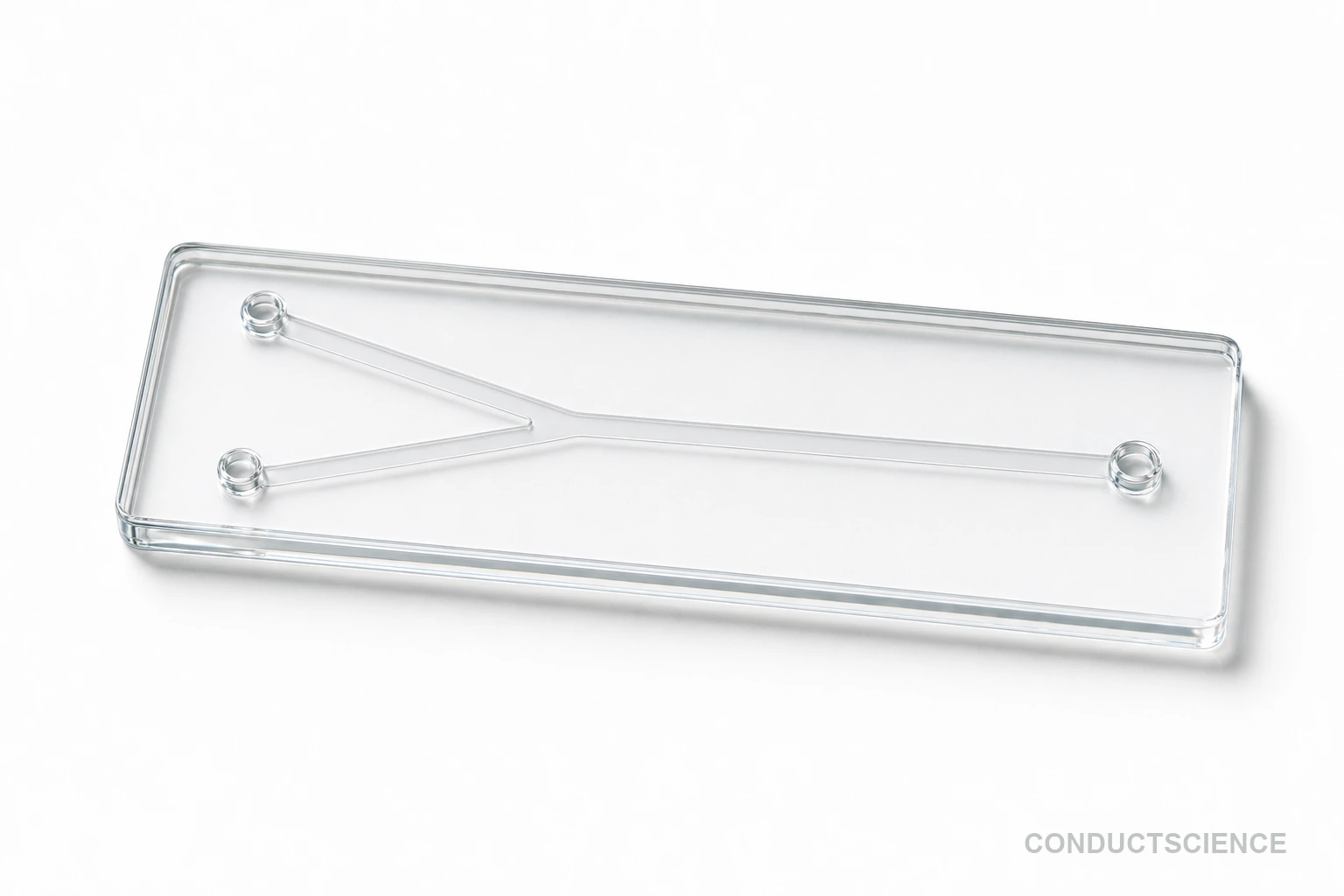
Y-Junction Chemical Reaction Microfluidic Chip
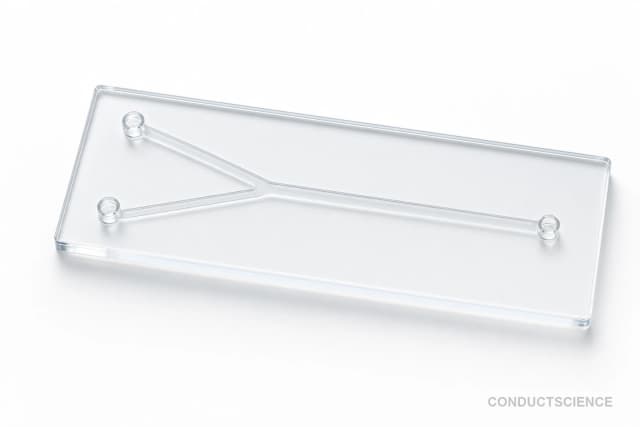
Y-junction microfluidic chip in standard slide format for controlled mixing of two fluid streams in chemical synthesis and reaction studies. Reusable chip — designed for multiple experimental runs. Compatible with standard microfluidic tubing: ste...

The Y-Junction Chemical Reaction Microfluidic Chip provides controlled mixing of two fluid streams for chemical synthesis and reaction studies in microfluidic environments. The glass chip features a Y-shaped channel configuration in standard microscope slide format (25 x 76 mm), enabling laminar flow mixing of reagents with precise spatial and temporal control.
Channel spacing options of 4.5 mm or 9 mm accommodate different experimental requirements, while included catheter fittings facilitate connection to syringe pumps or pressure-driven flow systems. The glass substrate offers chemical compatibility with organic solvents and biological buffers commonly used in microfluidic applications.
Key Specs
| Material | Borosilicate glass (glass-glass bonding) |
|---|---|
| Geometry | Y-junction with specified angle and laminar flow mixing section |
| Ports | 3 ports (Inlet 1, Inlet 2, Outlet) |
| Chip footprint | 25.4 x 76.2mm standard glass slide |
| Channel width | 150 um, 200 um |
| Channel depth | 50 um |
| Bonding | glass-glass |
| Packaging | Standard glass chip with PEEK/stainless steel connectors |
| Source | suppliers/wenhao/docs/glass-chips-catalog.json; 3.2.001.05.0030-0037 |
This source-backed block lists available source configurations; confirm selected width/bonding when quoting.
How It Works
The Y-junction design creates laminar flow mixing where two input streams converge at a controlled angle, allowing molecular diffusion to drive mass transfer between the fluid phases. At low Reynolds numbers typical in microfluidic systems, turbulent mixing is absent, and mixing occurs primarily through molecular diffusion across the interface between the two streams.
The mixing efficiency and reaction kinetics depend on channel geometry, flow rates, and fluid properties. Residence time within the chip determines reaction completion, while the diffusion distance controls mixing uniformity. The glass substrate provides optical transparency for real-time monitoring of mixing patterns and reaction progress using microscopy or spectroscopic techniques.
Features & Benefits
Pack Size
- 5-Pack
- 10-Pack
- 25-Pack
Weight
- 0.03 kg
Dimensions
- L: 76.0 mm
- W: 25.0 mm
- H: 2.0 mm
Comparison Guide
| Feature | This Product | Typical Alternative | Advantage |
|---|---|---|---|
| Channel Configuration | Y-junction geometry with dual input streams | T-junction or serpentine mixing channels | Provides controlled laminar mixing with predictable flow patterns for quantitative analysis. |
| Substrate Material | Glass construction | PDMS or plastic substrates | Offers superior chemical compatibility and optical clarity for solvent-based reactions. |
| Form Factor | Standard microscope slide format (25 x 76 mm) | Custom chip dimensions | Ensures compatibility with standard microscope stages and imaging equipment. |
| Channel Spacing | 4.5 mm or 9 mm spacing options | Fixed spacing configurations | Accommodates different experimental setups and flow system connections. |
This Y-junction chip combines glass substrate durability with standard slide format convenience, offering flexible channel spacing and included fittings for versatile microfluidic mixing applications.
Practical Tips
Match flow rates between input channels to achieve symmetric mixing patterns at the junction.
Why: Unbalanced flows create asymmetric mixing zones that compromise reaction uniformity.
Clean channels immediately after use with appropriate solvents followed by deionized water rinse.
Why: Prevents accumulation of reaction products that can clog channels or interfere with subsequent experiments.
Use dye solutions to visualize mixing patterns before introducing experimental reagents.
Why: Allows optimization of flow conditions and verification of mixing performance without consuming valuable samples.
If mixing appears incomplete, reduce flow rates to increase residence time or check for channel blockages.
Why: Insufficient mixing time is the most common cause of incomplete reactions in microfluidic systems.
Allow system to reach steady state before collecting data, typically 3-5 residence times.
Why: Transient flow conditions can produce variable results that don't represent true mixing performance.
Use secondary containment when working with hazardous chemicals in case of chip failure or leakage.
Why: Glass chips can crack under pressure, potentially releasing reactive chemicals.
Setup Guide
What’s in the Box
- Y-Junction microfluidic chip
- Catheter fittings
- User manual (typical)
- Storage container (typical)
Warranty
ConductScience provides a standard one-year manufacturer warranty covering defects in materials and workmanship, with technical support for setup and operation questions.
Compliance
What flow rate range is optimal for this chip?
Flow rates typically range from 0.1 to 100 μL/min depending on viscosity and desired mixing characteristics. Higher flow rates reduce residence time but may require higher pressures.
How do I achieve uniform mixing with this Y-junction design?
Uniform mixing requires balanced flow rates from both inputs and sufficient residence time for molecular diffusion. Consider the diffusion coefficient of your analytes when setting flow rates.
What solvents are compatible with the glass substrate?
Glass chips are compatible with most organic solvents, aqueous buffers, and acids. Avoid hydrofluoric acid and strong bases that can etch glass surfaces.
Can I use this chip for temperature-controlled reactions?
Yes, the glass substrate can withstand moderate heating and cooling. Use a temperature-controlled microscope stage or heating block for thermal control.
How do I prevent bubble formation in the channels?
Degas solutions before use, prime channels slowly, and maintain steady flow rates. Surface treatment with surfactants can also reduce bubble nucleation.
What is the typical lifetime of the chip?
With proper cleaning between uses, chips can be used for dozens of experiments. Replace if channels become permanently stained or if cracks develop.
Have a question about this product?
Upgrade Options