Behavioral Tracking for Bumblebee
Bombus terrestris
Foraging, learning, and pesticide neurotoxicity in Bombus terrestris. ConductVision delivers automated tracking and quantitative parameter extraction across the full assay catalog below.
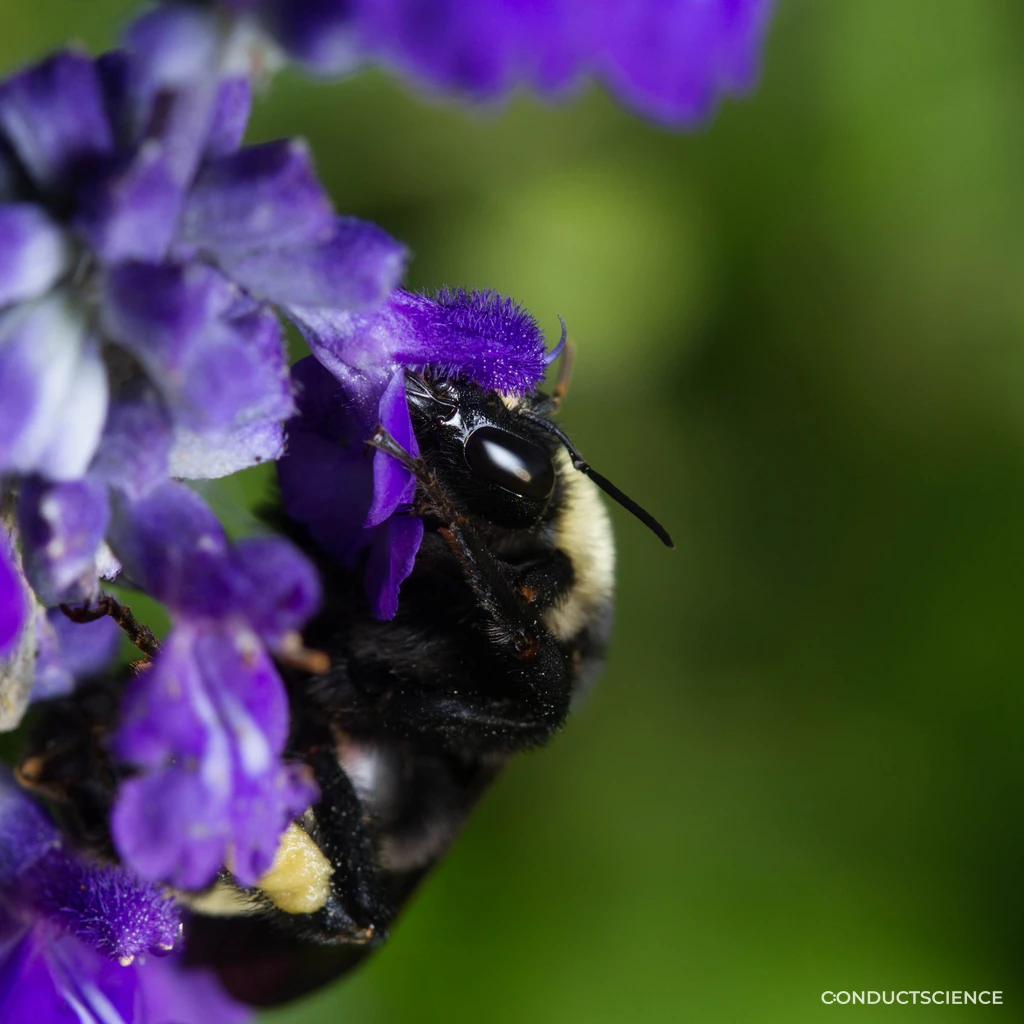
Why Bumblebee in Behavioral Research
Bumblebees are essential pollinators and a sensitive model for cognitive ecology, neonicotinoid neurotoxicity, and motor learning. Their robust foraging behavior, individual marking tractability, and colony structure enable powerful behavioral and pharmacological studies of insect cognition.
Chittka L, Niven J. (2009). Are bigger brains better? Curr Biol, 19(21), R995-R1008. PMID: 19922859
Klein S, et al. (2017). Why bees are so vulnerable to environmental stressors. Trends Ecol Evol, 32(4), 268-278. PMID: 28111032
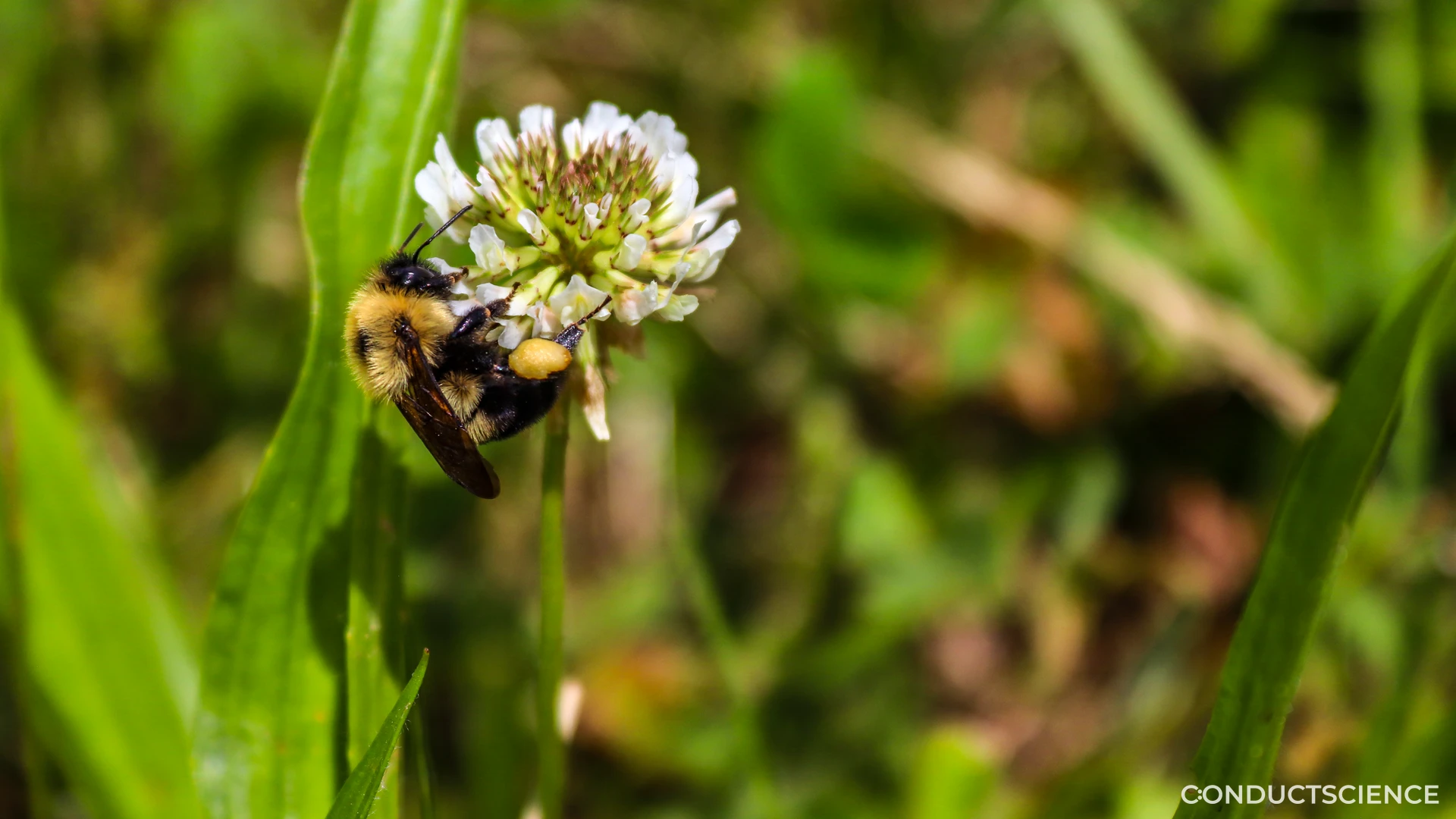
What We Measure in Bumblebee
Validated assays with quantitative parameter tracking for Bombus terrestris.
Bumblebees learn floral associations rapidly and remember reward contingencies across days. Visit duration, flower preference, and choice accuracy across training trials reveal associative learning.
| Parameter | Unit | Description |
|---|---|---|
| Visit duration | s | Time per flower |
| Choice accuracy | % | Rewarded flower visits |
| Visits to criterion | count | Learning speed |
| Foraging trip duration | min | Round-trip from colony |
Chittka L. (1992). The colour hexagon: a chromaticity diagram based on photoreceptor excitations. J Comp Physiol A, 170, 533-543.
Bumblebees discriminate UV, blue, and green via three photoreceptor classes and learn associations to color, pattern, and symmetry. Discrimination thresholds quantify visual cognition.
| Parameter | Unit | Description |
|---|---|---|
| Discrimination accuracy | % | Correct choice rate |
| Generalization gradient | slope | Performance vs stimulus distance |
| Reversal learning | trials | Cognitive flexibility |
| Detection threshold | JND | Just-noticeable difference |
Dyer AG, Chittka L. (2004). Bumblebees (Bombus terrestris) sacrifice foraging speed to solve difficult colour discrimination tasks. J Comp Physiol A, 190(9), 759-763. PMID: 15278386
Free-flight tracking quantifies flight speed, path tortuosity, and homing performance. Used for neonicotinoid impact assessment and mushroom-body learning research.
| Parameter | Unit | Description |
|---|---|---|
| Flight speed | m/s | Translational velocity |
| Path tortuosity | index | Straightness ratio |
| Homing latency | s | Return to colony |
| Flight duration | min | Time aloft per trip |
Stelzer RJ, Chittka L. (2010). Bumblebee foraging rhythms under the midnight sun measured with radiofrequency identification. BMC Biol, 8, 93. PMID: 20618965
Sub-lethal neonicotinoid exposure impairs learning, memory, motor control, and homing. Standardized PER conditioning and locomotion track neural impact.
| Parameter | Unit | Description |
|---|---|---|
| PER acquisition rate | % | Conditioned response |
| Locomotion velocity | mm/s | Motor output |
| Memory at 24h | % | Long-term retention |
| Mortality at 96h | % | Acute toxicity |
Whitehorn PR, et al. (2012). Neonicotinoid pesticide reduces bumble bee colony growth and queen production. Science, 336(6079), 351-352. PMID: 22461500
Bumblebees vibrate flowers to release pollen from poricidal anthers. Vibration frequency, duration, and amplitude reveal sensorimotor control unique to Bombus.
| Parameter | Unit | Description |
|---|---|---|
| Buzz frequency | Hz | Vibration cycle rate |
| Buzz duration | s | Per-flower vibration time |
| Pollen yield | mg | Released pollen mass |
| Posture angle | deg | Body orientation on anther |
De Luca PA, Vallejo-Marín M. (2013). What’s the buzz about? The ecology and evolutionary significance of buzz-pollination. Curr Opin Plant Biol, 16(4), 429-435. PMID: 23751734
More Behavioral Tests for Bumblebee
Spatial Navigation
Key Parameters: Visit sequence, path optimization (TSP)
Lihoreau M, et al. (2010). PMID: 20660954
Olfactory Learning (PER)
Key Parameters: Acquisition, retention curves
Riveros AJ, Gronenberg W. (2009). Apidologie, 40(4), 471-483.
Hive Thermoregulation
Key Parameters: Wing fanning rate, brood temperature
Heinrich B. (1979). Bumblebee Economics. Harvard.
Social Information Use
Key Parameters: Following experienced foragers
Leadbeater E, Chittka L. (2007). PMID: 17418528
Conspecific vs Heterospecific Recognition
Key Parameters: Approach time, choice accuracy
Dawson EH, Chittka L. (2014). Anim Behav, 89, 117-123.
ConductScience Hardware for Bumblebee Research
Flight Arena with RFID Tag System
Individual bee tracking
Artificial Flower Array
Programmable reward stimuli
Multi-Camera Video Tracker
3D flight reconstruction
Colony Observation Box
In-hive behavior
PER Conditioning Setup
Olfactory learning assays
Citations & Further Reading
- Chittka L, Niven J. (2009). Are bigger brains better? Curr Biol, 19(21), R995-R1008. PMID: 19922859
- Klein S, et al. (2017). Why bees are so vulnerable to environmental stressors. Trends Ecol Evol, 32(4), 268-278. PMID: 28111032
- Chittka L. (1992). The colour hexagon: a chromaticity diagram based on photoreceptor excitations. J Comp Physiol A, 170, 533-543.
- Dyer AG, Chittka L. (2004). Bumblebees (Bombus terrestris) sacrifice foraging speed to solve difficult colour discrimination tasks. J Comp Physiol A, 190(9), 759-763. PMID: 15278386
- Stelzer RJ, Chittka L. (2010). Bumblebee foraging rhythms under the midnight sun measured with radiofrequency identification. BMC Biol, 8, 93. PMID: 20618965
- Whitehorn PR, et al. (2012). Neonicotinoid pesticide reduces bumble bee colony growth and queen production. Science, 336(6079), 351-352. PMID: 22461500
- De Luca PA, Vallejo-Marín M. (2013). What’s the buzz about? The ecology and evolutionary significance of buzz-pollination. Curr Opin Plant Biol, 16(4), 429-435. PMID: 23751734
Other Model Systems
Discuss Your Bumblebee Research
Tell us about your models, assays, and experimental goals — we’ll show you how ConductVision fits your workflow.