Primary Assay — Bumblebee
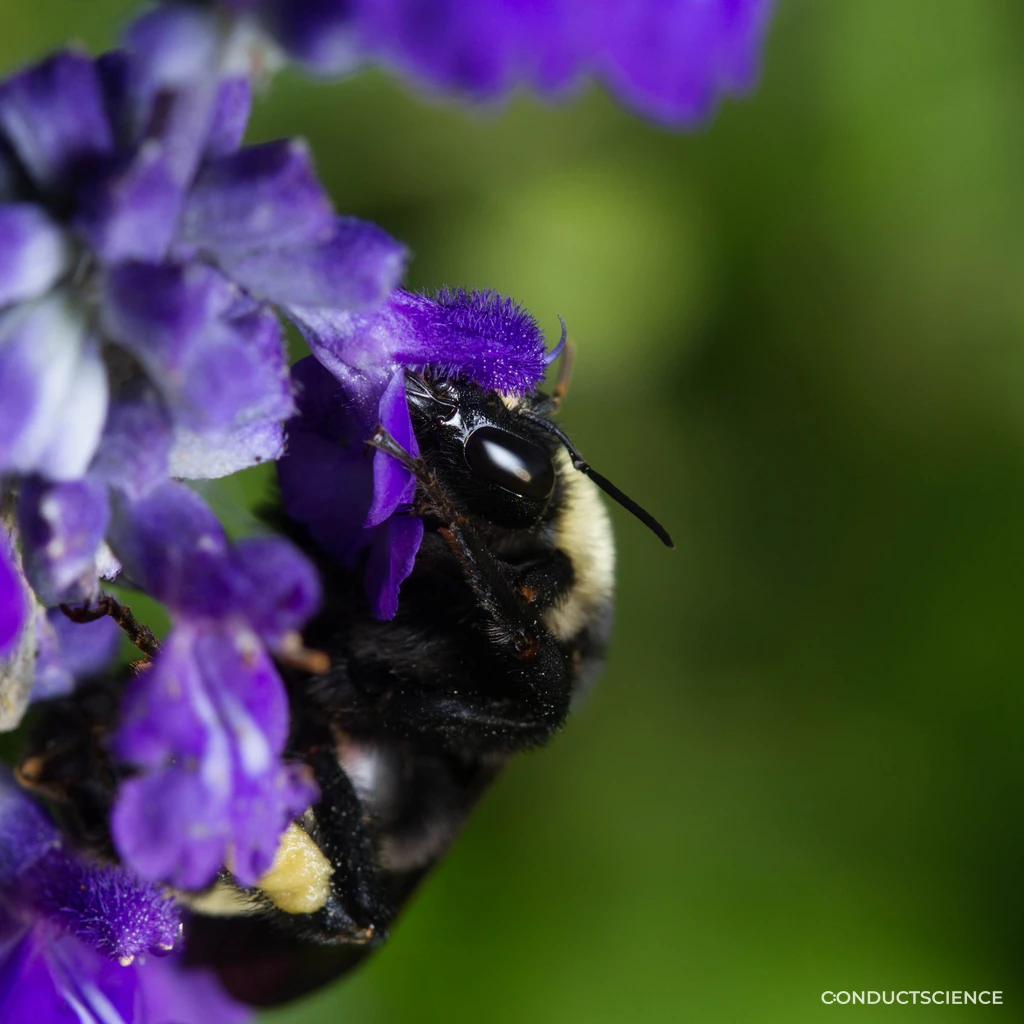
Buzz Pollination
Bombus terrestris
Bumblebees vibrate flowers to release pollen from poricidal anthers. Vibration frequency, duration, and amplitude reveal sensorimotor control unique to Bombus.
Quantitative Output
Measured Parameters
Every parameter is automatically tracked frame-by-frame in the ConductVision pipeline for Bombus terrestris.
| Parameter | Unit | Description |
|---|---|---|
| Buzz frequency | Hz | Vibration cycle rate |
| Buzz duration | s | Per-flower vibration time |
| Pollen yield | mg | Released pollen mass |
| Posture angle | deg | Body orientation on anther |
References
Citations for Buzz Pollination
- De Luca PA, Vallejo-Marín M. (2013). What’s the buzz about? The ecology and evolutionary significance of buzz-pollination. Curr Opin Plant Biol, 16(4), 429-435. PMID: 23751734
Compatible Equipment
Hardware for Bumblebee Research
Flight Arena with RFID Tag System
Individual bee tracking
Artificial Flower Array
Programmable reward stimuli
Multi-Camera Video Tracker
3D flight reconstruction
Colony Observation Box
In-hive behavior
PER Conditioning Setup
Olfactory learning assays
Related Assays
Other Bumblebee Primary Assays
08
Foraging / Flower Choice
Bombus terrestris
Bumblebees learn floral associations rapidly and remember reward contingencies across days. Visit duration, flower prefe…
08
Color / Pattern Discrimination
Bombus terrestris
Bumblebees discriminate UV, blue, and green via three photoreceptor classes and learn associations to color, pattern, an…
08
Flight Tracking
Bombus terrestris
Free-flight tracking quantifies flight speed, path tortuosity, and homing performance. Used for neonicotinoid impact ass…
Run Buzz Pollination on ConductVision
Our team will configure the protocol, camera rig, and analysis pipeline for your bumblebee facility.