Primary Assay — Goldfish
Spatial Memory (Plus Maze / Hole-Board)
Carassius auratus
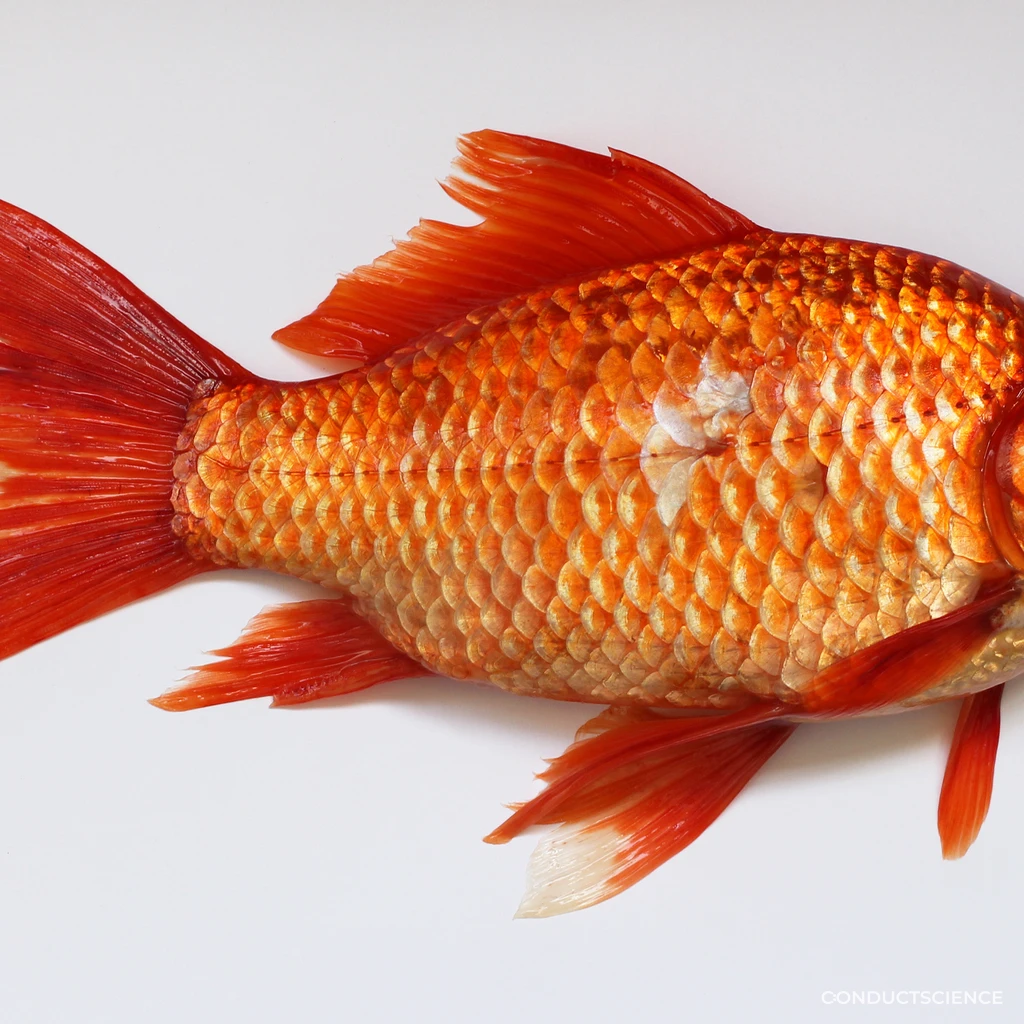
Goldfish learn the location of a goal in a plus maze or aquatic hole-board. Trials to criterion and place vs cue strategy reveal teleost spatial cognition.
Quantitative Output
Measured Parameters
Every parameter is automatically tracked frame-by-frame in the ConductVision pipeline for Carassius auratus.
| Parameter | Unit | Description |
|---|---|---|
| Trials to criterion | count | Acquisition speed |
| Latency to goal | s | Decision and travel time |
| Place vs cue use | index | Strategy preference |
| Reversal learning trials | count | Flexibility |
References
Citations for Spatial Memory (Plus Maze / Hole-Board)
- Rodríguez F, et al. (2002). PMID: 11923454
Compatible Equipment
Hardware for Goldfish Research
Aquatic Plus-Maze Tank
Spatial cognition
Shuttle-Box Avoidance System
Operant learning
Schooling / Shoaling Arena
Group behavior
Vestibular Rotation Platform with Eye Tracker
VOR plasticity
Two-Choice Color Discrimination Tank
Visual cognition
Related Assays
Other Goldfish Primary Assays
14
Active Avoidance (Shuttle Box)
Carassius auratus
Goldfish learn to cross a barrier to avoid a shock paired with a tone or light. Acquisition curves and asymptotic perfor…
14
Schooling / Shoaling
Carassius auratus
Goldfish form loose shoals with measurable polarization, nearest-neighbor distance, and group cohesion. Used for sociali…
14
Vestibulo-Ocular Reflex (VOR)
Carassius auratus
Whole-body rotation evokes compensatory eye movement gains. Goldfish are a classical model for cerebellar VOR plasticity…
Run Spatial Memory (Plus Maze / Hole-Board) on ConductVision
Our team will configure the protocol, camera rig, and analysis pipeline for your goldfish facility.