Behavioral Tracking for Goldfish
Carassius auratus
Spatial memory, vestibular biology, and behavioral toxicology in Carassius auratus. ConductVision delivers automated tracking and quantitative parameter extraction across the full assay catalog below.
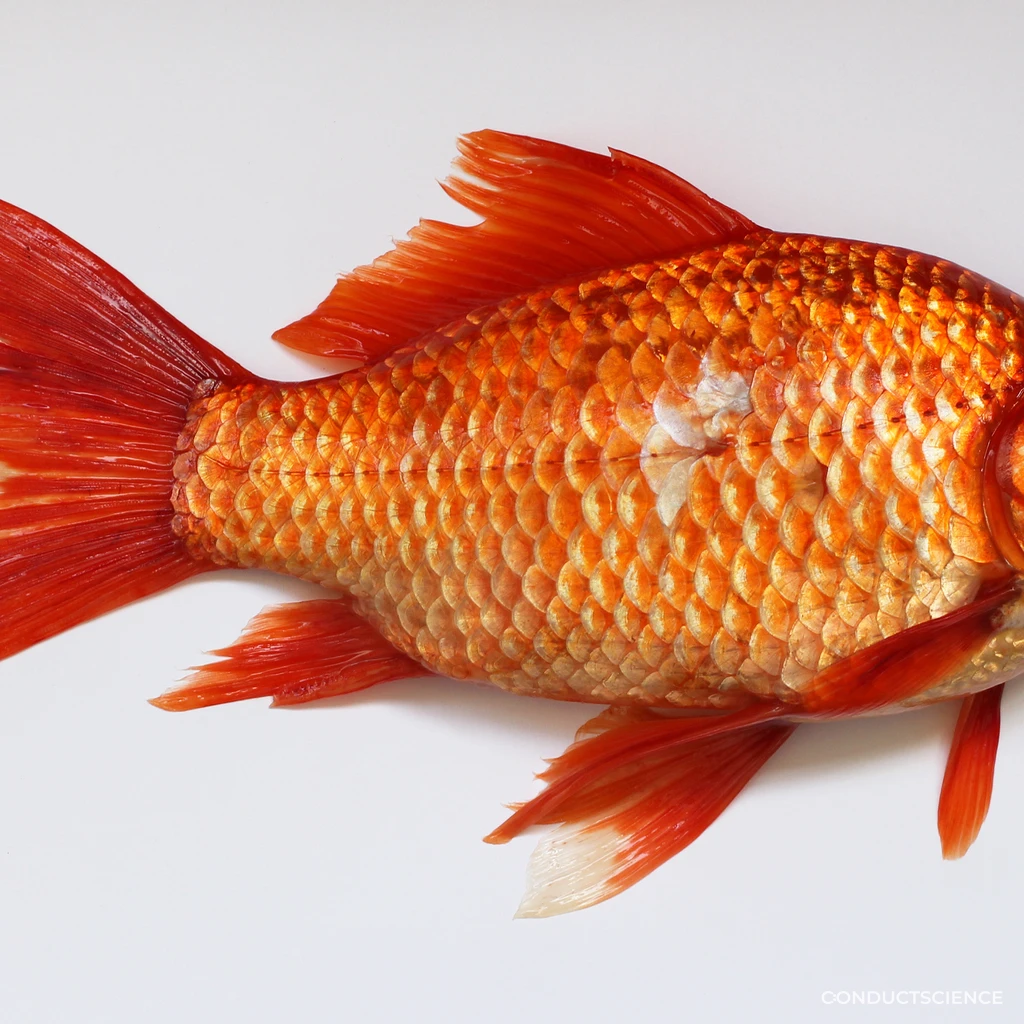
Why Goldfish in Behavioral Research
The goldfish is a long-standing model for spatial cognition, vestibular and lateral-line research, and behavioral toxicology. Its hardiness, robust shoaling, and trainability support classical conditioning and operant studies in a teleost system.
Macphail EM. (1982). Brain and Intelligence in Vertebrates. Clarendon Press.
Rodríguez F, et al. (2002). Conservation of spatial memory function in the pallial forebrain of reptiles and ray-finned fishes. J Neurosci, 22(7), 2894-2903. PMID: 11923454
What We Measure in Goldfish
Validated assays with quantitative parameter tracking for Carassius auratus.
Goldfish learn the location of a goal in a plus maze or aquatic hole-board. Trials to criterion and place vs cue strategy reveal teleost spatial cognition.
| Parameter | Unit | Description |
|---|---|---|
| Trials to criterion | count | Acquisition speed |
| Latency to goal | s | Decision and travel time |
| Place vs cue use | index | Strategy preference |
| Reversal learning trials | count | Flexibility |
Rodríguez F, et al. (2002). PMID: 11923454
Goldfish learn to cross a barrier to avoid a shock paired with a tone or light. Acquisition curves and asymptotic performance benchmark associative learning.
| Parameter | Unit | Description |
|---|---|---|
| Avoidance rate | % | Successful avoidances |
| Latency to cross | s | CS to shuttle |
| Acquisition trials | count | To 80% criterion |
| Extinction trials | count | To return to baseline |
Bitterman ME. (1965). Phyletic differences in learning. Am Psychol, 20, 396-410.
Goldfish form loose shoals with measurable polarization, nearest-neighbor distance, and group cohesion. Used for sociality, drug, and pollutant testing.
| Parameter | Unit | Description |
|---|---|---|
| Polarization | index | Heading alignment |
| Nearest-neighbor distance | BL | Inter-fish spacing |
| Time in group | % | Cohesion |
| Group radius | BL | Spread |
Pitcher TJ. (1986). Functions of shoaling behaviour in teleosts. In: The Behaviour of Teleost Fishes.
Whole-body rotation evokes compensatory eye movement gains. Goldfish are a classical model for cerebellar VOR plasticity.
| Parameter | Unit | Description |
|---|---|---|
| VOR gain | ratio | Eye velocity / head velocity |
| Phase lag | deg | Eye-head timing |
| Adaptation rate | %/h | Gain change with mismatch |
| Frequency tuning | Hz | Response across rotation freq |
Marsh E, Baker R. (1997). Normal and adapted visuooculomotor reflexes in goldfish. J Neurophysiol, 77(3), 1099-1118. PMID: 9084584
Goldfish discriminate hues across the visible spectrum and into UV via four cone classes. Two-choice operant assays reveal teleost color cognition.
| Parameter | Unit | Description |
|---|---|---|
| Discrimination accuracy | % | Correct hue choice |
| JND across spectrum | nm | Wavelength resolution |
| Trials to criterion | count | Acquisition |
| Generalization gradient | slope | Across novel hues |
Neumeyer C. (1992). Tetrachromatic color vision in goldfish: evidence from color mixture experiments. J Comp Physiol A, 171, 639-649.
More Behavioral Tests for Goldfish
Feeding (Schedule-Induced)
Novel Tank Diving
Key Parameters: Time at bottom, latency to upper half
Cachat J, et al. (2010). Behav Brain Res. PMID: 20211657
Predator Response (Shadow / Model)
Key Parameters: Freeze duration, escape
Pfeiffer W. (1962). Biol Rev, 37, 495-511.
Olfactory Discrimination
Key Parameters: Approach to amino-acid stimuli
Caprio J. (1978). PMID: 631019
Cognitive Flexibility (Reversal)
Key Parameters: Reversal trials, perseverative errors
López JC, et al. (2003). Brain Behav Evol, 61(2), 95-106. PMID: 12698017
ConductScience Hardware for Goldfish Research
Aquatic Plus-Maze Tank
Spatial cognition
Shuttle-Box Avoidance System
Operant learning
Schooling / Shoaling Arena
Group behavior
Vestibular Rotation Platform with Eye Tracker
VOR plasticity
Two-Choice Color Discrimination Tank
Visual cognition
Citations & Further Reading
- Macphail EM. (1982). Brain and Intelligence in Vertebrates. Clarendon Press.
- Rodríguez F, et al. (2002). Conservation of spatial memory function in the pallial forebrain of reptiles and ray-finned fishes. J Neurosci, 22(7), 2894-2903. PMID: 11923454
- Rodríguez F, et al. (2002). PMID: 11923454
- Bitterman ME. (1965). Phyletic differences in learning. Am Psychol, 20, 396-410.
- Pitcher TJ. (1986). Functions of shoaling behaviour in teleosts. In: The Behaviour of Teleost Fishes.
- Marsh E, Baker R. (1997). Normal and adapted visuooculomotor reflexes in goldfish. J Neurophysiol, 77(3), 1099-1118. PMID: 9084584
- Neumeyer C. (1992). Tetrachromatic color vision in goldfish: evidence from color mixture experiments. J Comp Physiol A, 171, 639-649.
Other Model Systems
Discuss Your Goldfish Research
Tell us about your models, assays, and experimental goals — we’ll show you how ConductVision fits your workflow.