Behavioral Tracking for Hydra
Hydra vulgaris
Whole-body regeneration, neural net dynamics, and behavioral ethology in Hydra vulgaris. ConductVision delivers automated tracking and quantitative parameter extraction across the full assay catalog below.
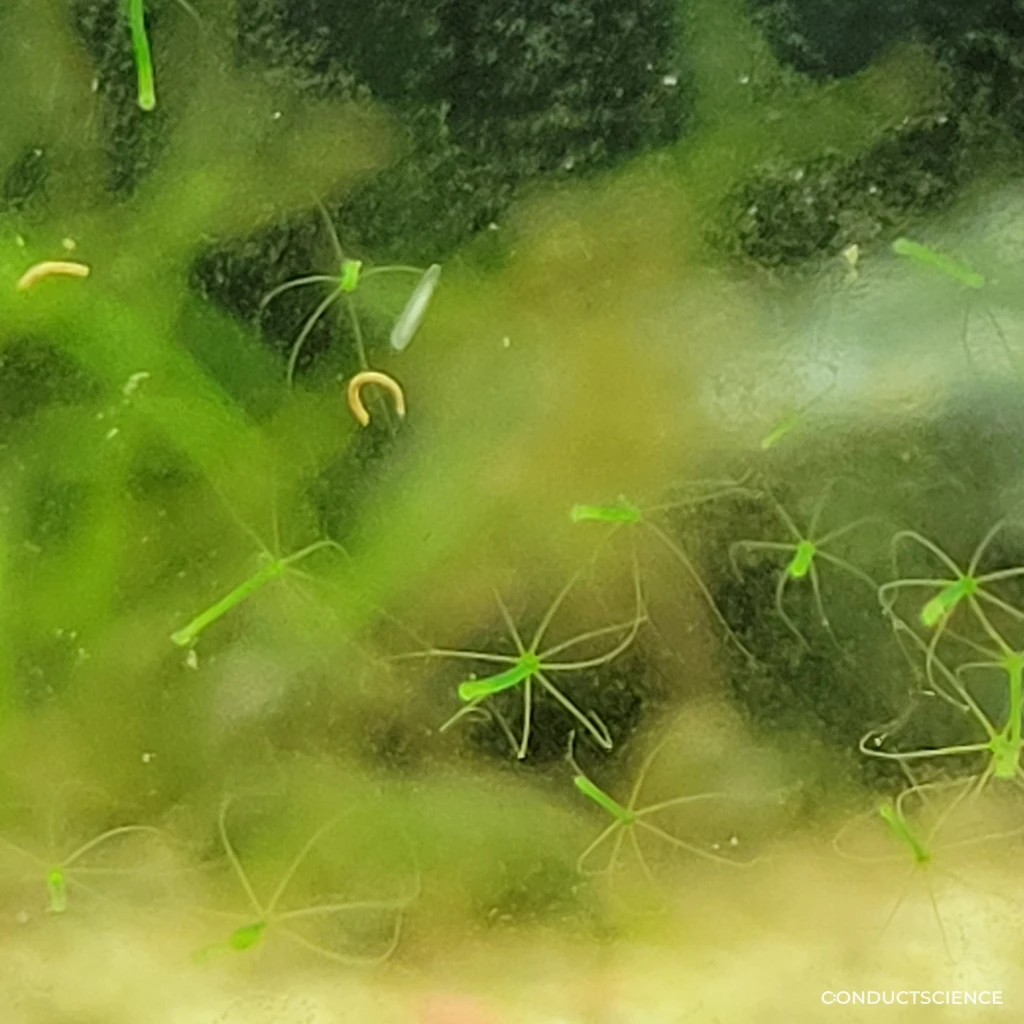
Why Hydra in Behavioral Research
Hydra is a unique freshwater cnidarian with a simple diffuse nerve net, whole-body regenerative capacity, and a tractable behavioral repertoire (contraction bursts, somersaulting, feeding). It is a frontier model for whole-organism imaging, behavior, and the evolution of nervous systems.
Dupre C, Yuste R. (2017). Non-overlapping neural networks in Hydra vulgaris. Curr Biol, 27(8), 1085-1097. PMID: 28366745
Bode HR. (2003). Head regeneration in Hydra. Dev Dyn, 226(2), 225-236. PMID: 12557201
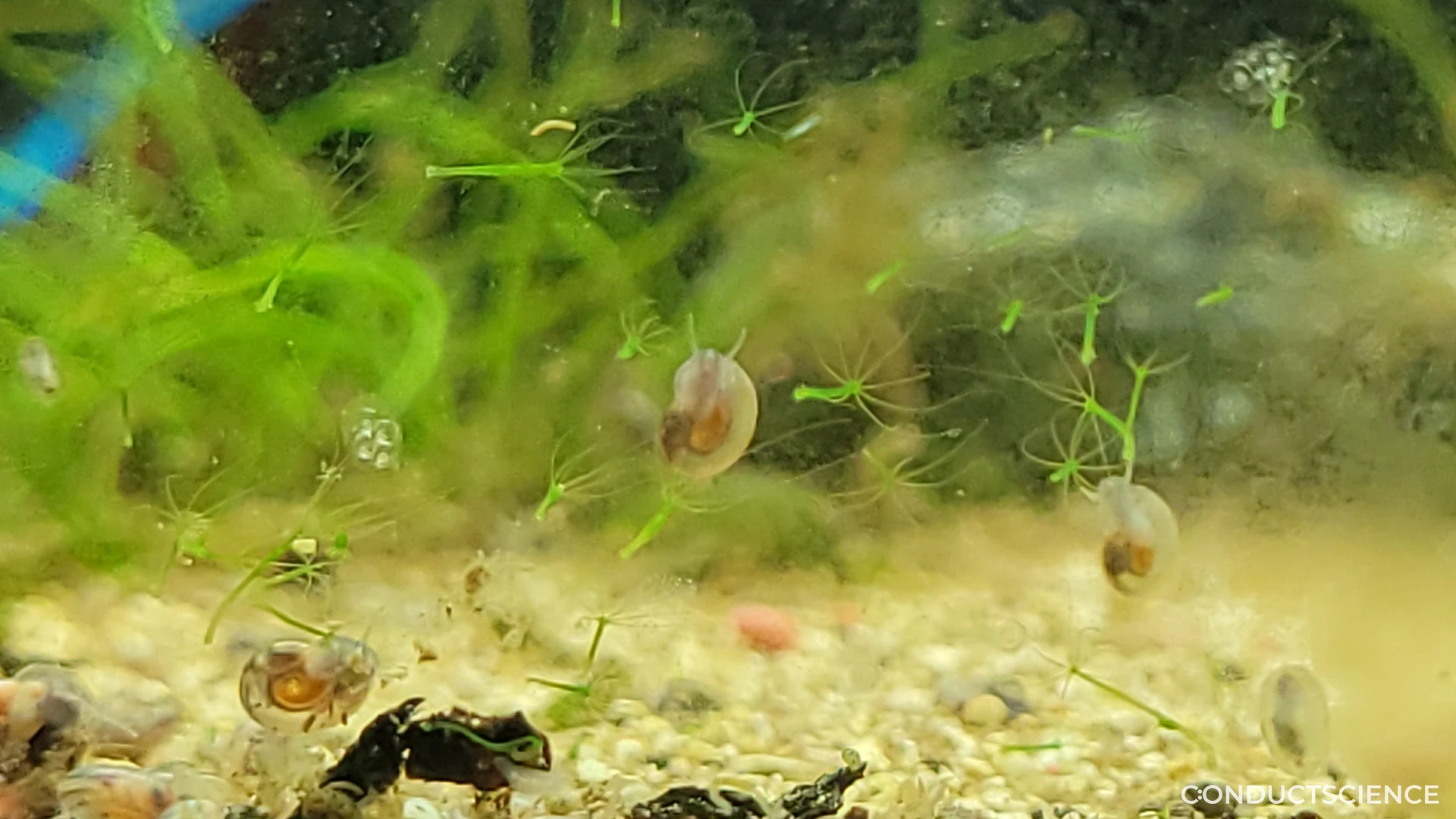
What We Measure in Hydra
Validated assays with quantitative parameter tracking for Hydra vulgaris.
Hydra exhibits rhythmic full-body contractions every few minutes, driven by RP1 nerve-net oscillators. CB rate, amplitude, and inter-burst interval index neural-net excitability.
| Parameter | Unit | Description |
|---|---|---|
| CB frequency | bursts/h | Contraction rate |
| CB amplitude | % body length | Shortening magnitude |
| Inter-burst interval | s | Period between bursts |
| Body elongation | mm | Resting length |
Passano LM, McCullough CB. (1964). Co-ordinating systems and behaviour in Hydra. I. Pacemaker system of the periodic contractions. J Exp Biol, 41, 643-664. PMID: 14225981
Reduced glutathione released by prey triggers stereotyped tentacle contraction and mouth opening. Latency and duration of the feeding response measure chemosensation.
| Parameter | Unit | Description |
|---|---|---|
| Mouth-opening latency | s | Glutathione to mouth open |
| Tentacle contraction angle | deg | Tentacle bending |
| Feeding response duration | min | Prolonged response |
| Threshold concentration | µM | Sensitivity to glutathione |
Lenhoff HM. (1961). Activation of the feeding reflex in Hydra littoralis. I. Role played by reduced glutathione. J Gen Physiol, 45, 331-344. PMID: 13759906
Hydra moves by detaching its base, tumbling, and reattaching. Somersault frequency and step distance quantify locomotion, modulated by light and food state.
| Parameter | Unit | Description |
|---|---|---|
| Somersault rate | events/h | Locomotion frequency |
| Step distance | mm/event | Per-tumble translation |
| Direction bias | deg | Phototaxis-driven heading |
| Inchworm bout fraction | % | Alternative locomotion |
Han S, et al. (2018). Comprehensive machine learning analysis of Hydra behavior reveals a stable basal behavioral repertoire. eLife, 7, e32605. PMID: 29589829
Hydra moves toward dim light and away from bright light despite lacking eyes. Distribution along a light gradient quantifies whole-body photic sensitivity.
| Parameter | Unit | Description |
|---|---|---|
| Light-zone occupancy | % | Time in test gradient |
| Movement bias | deg | Heading vs light source |
| Locomotion rate change | fold | Light-driven activity |
| Adaptation time | min | Time-course of response |
Plachetzki DC, et al. (2012). The origins of novel protein interactions during animal opsin evolution. PLoS One, 7(8), e44025. PMID: 22937154
After bisection, Hydra regenerates head and body and recovers full behavioral repertoire over days. Recovery time-course of CBs, feeding, and locomotion indexes neural-net regeneration.
| Parameter | Unit | Description |
|---|---|---|
| CB recovery time | h post-bisection | Pacemaker reformation |
| Feeding recovery time | h | Mouth and tentacle function |
| Locomotion recovery time | h | Whole-body coordination |
| Head-regeneration completion | days | Morphological endpoint |
Bode HR. (2003). PMID: 12557201
More Behavioral Tests for Hydra
Nematocyst Discharge
Key Parameters: Discharge rate to mechanical/chemical cues
Watson GM, Hessinger DA. (1989). PMID: 2563937
Body-Length Variation
Key Parameters: Length over time, food-dependent
Han S, et al. (2018). PMID: 29589829
Substrate Attachment
Key Parameters: Attachment latency, detachment events
Han S, et al. (2018). PMID: 29589829
Bud Detachment
Key Parameters: Time to bud-off, daughter behavior
Otto JJ, Campbell RD. (1977). J Exp Zool, 201(3), 417-428. PMID: 894020
Calcium Imaging of Whole Nerve Net
Key Parameters: Network firing patterns
Dupre C, Yuste R. (2017). PMID: 28366745
ConductScience Hardware for Hydra Research
Multi-Well Behavioral Imaging Plate
High-throughput Hydra behavior
Time-Lapse Microscopy Stage
Long-duration recording
Light-Gradient Arena
Phototaxis assays
Bisection / Regeneration Tracking Setup
Recovery time-course
GCaMP-Compatible Imaging System
Whole-organism neural recording
Citations & Further Reading
- Dupre C, Yuste R. (2017). Non-overlapping neural networks in Hydra vulgaris. Curr Biol, 27(8), 1085-1097. PMID: 28366745
- Bode HR. (2003). Head regeneration in Hydra. Dev Dyn, 226(2), 225-236. PMID: 12557201
- Passano LM, McCullough CB. (1964). Co-ordinating systems and behaviour in Hydra. I. Pacemaker system of the periodic contractions. J Exp Biol, 41, 643-664. PMID: 14225981
- Lenhoff HM. (1961). Activation of the feeding reflex in Hydra littoralis. I. Role played by reduced glutathione. J Gen Physiol, 45, 331-344. PMID: 13759906
- Han S, et al. (2018). Comprehensive machine learning analysis of Hydra behavior reveals a stable basal behavioral repertoire. eLife, 7, e32605. PMID: 29589829
- Plachetzki DC, et al. (2012). The origins of novel protein interactions during animal opsin evolution. PLoS One, 7(8), e44025. PMID: 22937154
- Bode HR. (2003). PMID: 12557201
Other Model Systems
Discuss Your Hydra Research
Tell us about your models, assays, and experimental goals — we’ll show you how ConductVision fits your workflow.