Primary Assay — Hydra
Locomotion (Somersaulting)
Hydra vulgaris
Hydra moves by detaching its base, tumbling, and reattaching. Somersault frequency and step distance quantify locomotion, modulated by light and food state.
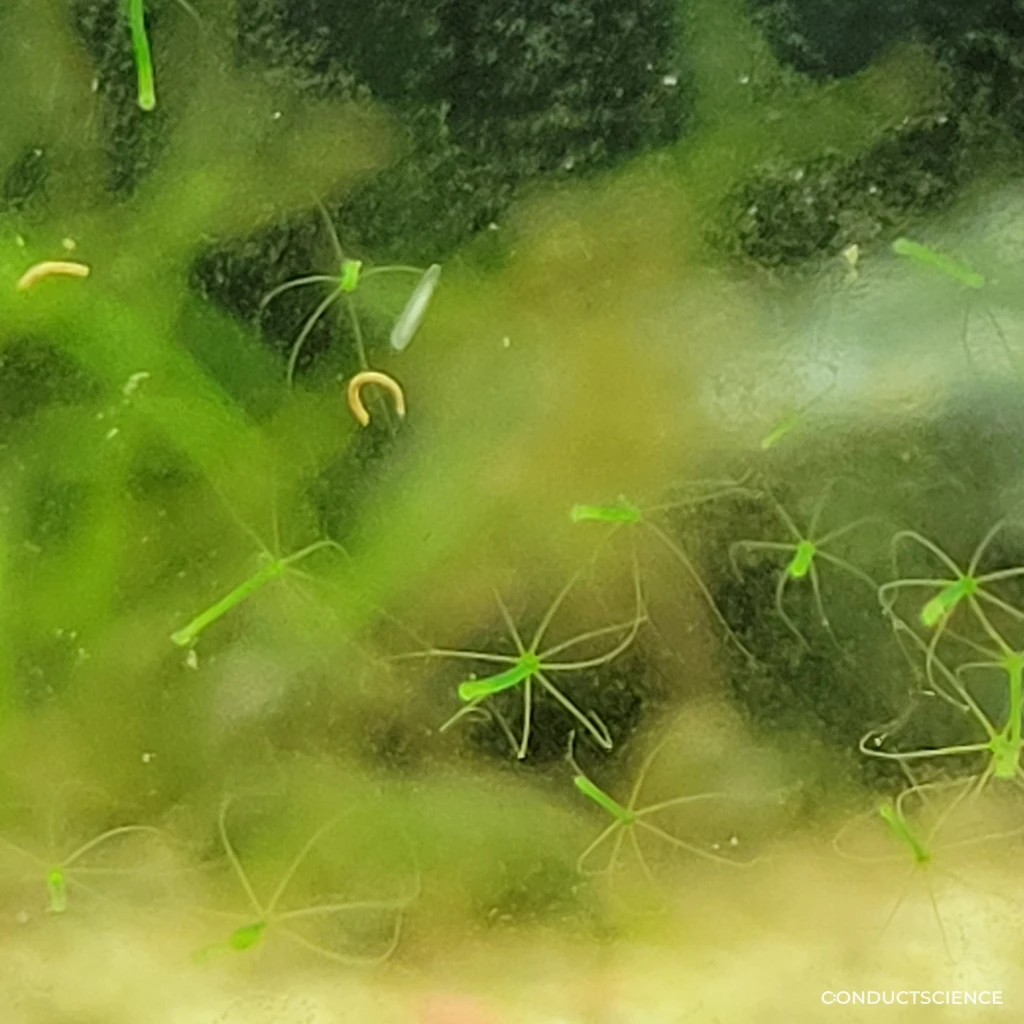
Quantitative Output
Measured Parameters
Every parameter is automatically tracked frame-by-frame in the ConductVision pipeline for Hydra vulgaris.
| Parameter | Unit | Description |
|---|---|---|
| Somersault rate | events/h | Locomotion frequency |
| Step distance | mm/event | Per-tumble translation |
| Direction bias | deg | Phototaxis-driven heading |
| Inchworm bout fraction | % | Alternative locomotion |
References
Citations for Locomotion (Somersaulting)
- Han S, et al. (2018). Comprehensive machine learning analysis of Hydra behavior reveals a stable basal behavioral repertoire. eLife, 7, e32605. PMID: 29589829
Compatible Equipment
Hardware for Hydra Research
Multi-Well Behavioral Imaging Plate
High-throughput Hydra behavior
Time-Lapse Microscopy Stage
Long-duration recording
Light-Gradient Arena
Phototaxis assays
Bisection / Regeneration Tracking Setup
Recovery time-course
GCaMP-Compatible Imaging System
Whole-organism neural recording
Related Assays
Other Hydra Primary Assays
14
Spontaneous Contraction Bursts (CBs)
Hydra vulgaris
Hydra exhibits rhythmic full-body contractions every few minutes, driven by RP1 nerve-net oscillators. CB rate, amplitud…
14
Feeding Response (Glutathione)
Hydra vulgaris
Reduced glutathione released by prey triggers stereotyped tentacle contraction and mouth opening. Latency and duration o…
14
Phototaxis
Hydra vulgaris
Hydra moves toward dim light and away from bright light despite lacking eyes. Distribution along a light gradient quanti…
Run Locomotion (Somersaulting) on ConductVision
Our team will configure the protocol, camera rig, and analysis pipeline for your hydra facility.