Behavioral Tracking for Xenopus Tadpole
Xenopus laevis
ConductVision enables automated quantification of Xenopus laevis tadpole startle responses, swimming locomotion, visual avoidance, and rheotaxis with frame-by-frame precision.

Why Xenopus Tadpoles in Behavioral Research
Xenopus laevis tadpoles are a powerful model for studying vertebrate neural circuit development and sensorimotor integration. Their accessible, well-characterized nervous system enables precise behavioral readouts of circuit function during development. Key behaviors including the Mauthner-cell-mediated escape response, central pattern generator-driven swimming, and visual processing offer quantifiable assays linking neural activity to behavioral output.
Straka H, et al. (2012). Xenopus laevis: an ideal model for studying developmental dynamics of neural network assembly. Dev Neurobiol, 72(4), 649-663. PMID: 21834082
Sillar KT, et al. (2023). From tadpole to adult frog locomotion. Curr Opin Neurobiol, 82, 102753. PMID: 37549591
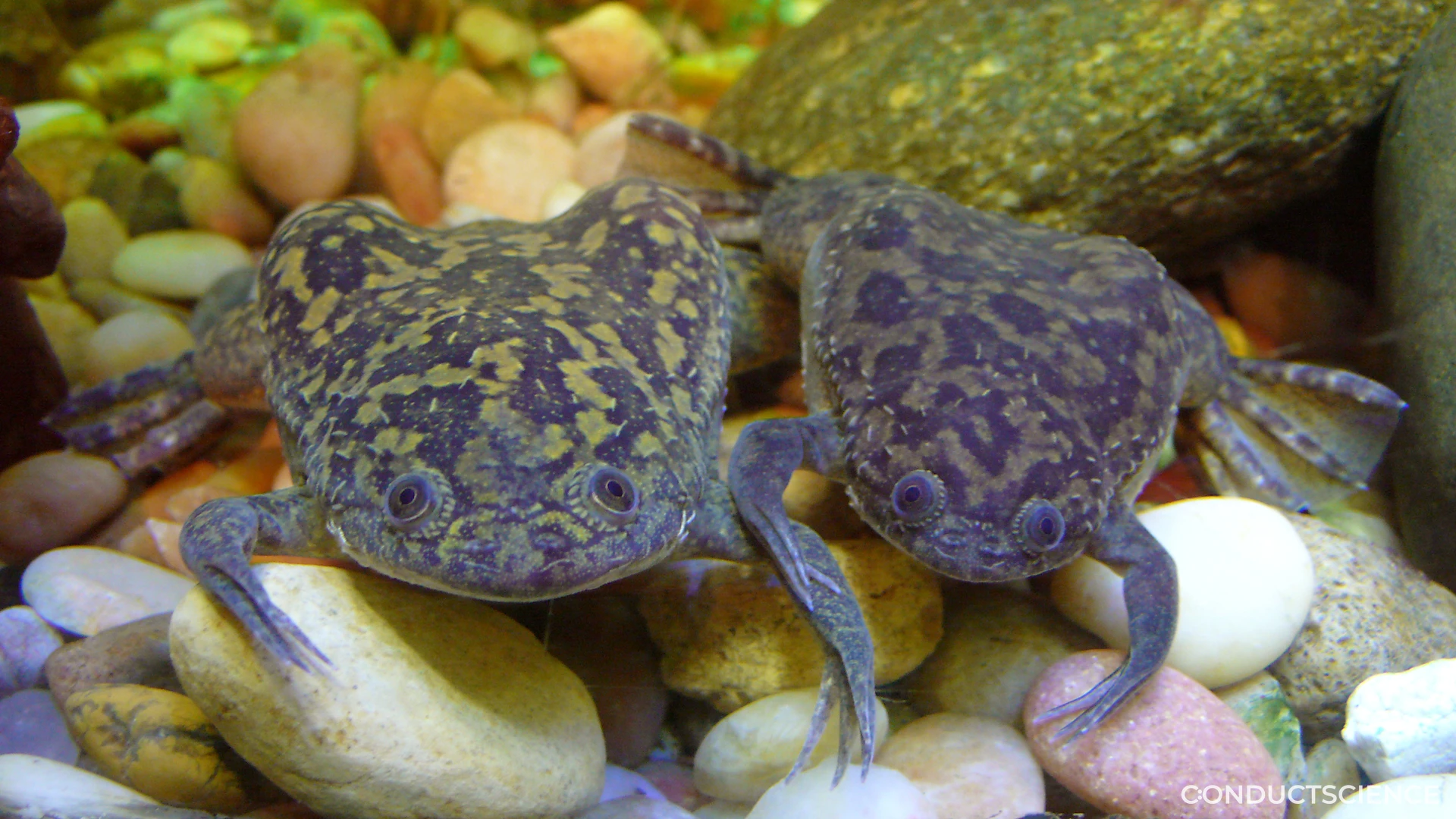
What We Measure in African Clawed Frog Tadpole
Validated assays with quantitative parameter tracking for Xenopus laevis.
High-speed analysis of the C-start escape response mediated by Mauthner cells. This reflex provides a direct readout of reticulospinal circuit function and is sensitive to developmental perturbations.
| Parameter | Unit | Description |
|---|---|---|
| C-start latency | ms | Response initiation time |
| Maximum angular velocity | °/s | Turn speed |
| Post-escape swim distance | mm | Escape trajectory length |
Khakhalin AS, et al. (2014). Excitation and inhibition in recurrent networks mediate collision avoidance in Xenopus tadpoles. Eur J Neurosci, 40(6), 2948-2958. PMID: 24995793
Central pattern generator-driven swimming analysis measuring cycle frequency, bout duration, and tail beat amplitude. These parameters provide direct readouts of spinal locomotor circuit maturation.
| Parameter | Unit | Description |
|---|---|---|
| Cycle frequency | Hz | Swimming rhythm |
| Swim episode duration | s | Bout length |
| Tail beat amplitude | μm | Wave magnitude |
| Inter-episode interval | s | Rest between bouts |
Picton LD, et al. (2018). Control of Xenopus Tadpole Locomotion via Selective Expression of Ih in Excitatory Interneurons. Curr Biol, 28(24), 4134-4142. PMID: 30503615
Sillar KT, et al. (1998). Development and aminergic neuromodulation of a spinal locomotor network controlling swimming in Xenopus larvae. Ann N Y Acad Sci, 860, 318-332. PMID: 9928322
Looming stimulus avoidance assay testing visual processing and collision avoidance circuitry. Tadpoles respond to expanding visual stimuli with characteristic escape behaviors.
| Parameter | Unit | Description |
|---|---|---|
| Avoidance probability | % | Response rate to looming |
| Reaction latency | ms | Time to initiate escape |
| Angular threshold | degrees | Size at response |
Khakhalin AS, et al. (2014). Excitation and inhibition in recurrent networks mediate collision avoidance in Xenopus tadpoles. Eur J Neurosci, 40(6), 2948-2958. PMID: 24995793
Quantification of visually driven eye movements in response to moving gratings. OKR gain and contrast sensitivity provide non-invasive readouts of visual system function.
| Parameter | Unit | Description |
|---|---|---|
| Slow-phase eye velocity | °/s | Tracking speed |
| OKR gain | ratio | Eye velocity / stimulus velocity |
| Contrast threshold | % | Minimum contrast for response |
Gravot CM, et al. (2017). Visual scene parameters influence optokinetic reflex performance in Xenopus laevis tadpoles. J Exp Biol, 220(22), 4213-4224. PMID: 29141881
Viczian AS, et al. (2014). A simple behavioral assay for testing visual function in Xenopus laevis. J Vis Exp, (88), 51726. PMID: 24962702
Orientation and station-keeping behavior in response to water current, mediated by the lateral line system. Provides functional readouts of mechanosensory hair cell development.
| Parameter | Unit | Description |
|---|---|---|
| Upstream orientation | % | Body alignment against current |
| Upstream preference score | ratio | Net displacement toward current |
| Lateral position | mm | Station-keeping in flow |
Simmons AM, et al. (2004). Lateral line-mediated rheotactic behavior in tadpoles of Xenopus laevis. J Comp Physiol A, 190(9), 747-758. PMID: 15300386
More Behavioral Tests for African Clawed Frog Tadpole
Schooling
Key Parameters: Inter-individual distance, group cohesion, nearest-neighbor angle
Lopez V 3rd, et al. (2021). PMID: 33941669
ConductScience Hardware for African Clawed Frog Tadpole Research
Tadpole Observation Chamber
Swimming behavior recording
Vibration Stimulus Platform
Startle/escape triggering
Looming Stimulus Display
Visual avoidance testing
Flow Chamber
Rheotaxis assays
Infrared Camera System
Dark-adapted recording
Citations & Further Reading
- Straka H, et al. (2012). Xenopus laevis: an ideal model for studying developmental dynamics of neural network assembly. Dev Neurobiol, 72(4), 649-663. PMID: 21834082
- Sillar KT, et al. (2023). From tadpole to adult frog locomotion. Curr Opin Neurobiol, 82, 102753. PMID: 37549591
- Khakhalin AS, et al. (2014). Excitation and inhibition in recurrent networks mediate collision avoidance in Xenopus tadpoles. Eur J Neurosci, 40(6), 2948-2958. PMID: 24995793
- Picton LD, et al. (2018). Control of Xenopus Tadpole Locomotion via Selective Expression of Ih in Excitatory Interneurons. Curr Biol, 28(24), 4134-4142. PMID: 30503615
- Sillar KT, et al. (1998). Development and aminergic neuromodulation of a spinal locomotor network controlling swimming in Xenopus larvae. Ann N Y Acad Sci, 860, 318-332. PMID: 9928322
- Gravot CM, et al. (2017). Visual scene parameters influence optokinetic reflex performance in Xenopus laevis tadpoles. J Exp Biol, 220(22), 4213-4224. PMID: 29141881
- Viczian AS, et al. (2014). A simple behavioral assay for testing visual function in Xenopus laevis. J Vis Exp, (88), 51726. PMID: 24962702
- Simmons AM, et al. (2004). Lateral line-mediated rheotactic behavior in tadpoles of Xenopus laevis. J Comp Physiol A, 190(9), 747-758. PMID: 15300386
Other Model Systems
Discuss Your Xenopus Tadpole Research
Tell us about your models, assays, and experimental goals — we’ll show you how ConductVision fits your workflow.