Primary Assay — African Clawed Frog Tadpole
Visual Avoidance (Looming Stimulus)
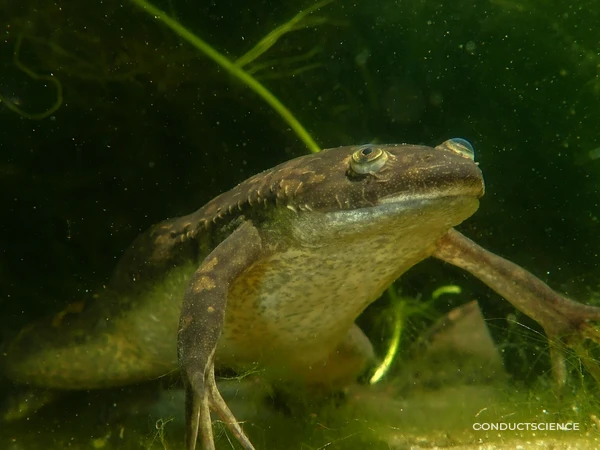
Xenopus laevis
Looming stimulus avoidance assay testing visual processing and collision avoidance circuitry. Tadpoles respond to expanding visual stimuli with characteristic escape behaviors.

Quantitative Output
Measured Parameters
Every parameter is automatically tracked frame-by-frame in the ConductVision pipeline for Xenopus laevis.
| Parameter | Unit | Description |
|---|---|---|
| Avoidance probability | % | Response rate to looming |
| Reaction latency | ms | Time to initiate escape |
| Angular threshold | degrees | Size at response |
References
Citations for Visual Avoidance (Looming Stimulus)
- Khakhalin AS, et al. (2014). Excitation and inhibition in recurrent networks mediate collision avoidance in Xenopus tadpoles. Eur J Neurosci, 40(6), 2948-2958. PMID: 24995793
Compatible Equipment
Hardware for African Clawed Frog Tadpole Research
Tadpole Observation Chamber
Swimming behavior recording
Vibration Stimulus Platform
Startle/escape triggering
Looming Stimulus Display
Visual avoidance testing
Flow Chamber
Rheotaxis assays
Infrared Camera System
Dark-adapted recording
Related Assays
Other African Clawed Frog Tadpole Primary Assays
02
Startle / Escape Response (Mauthner-cell mediated)
Xenopus laevis
High-speed analysis of the C-start escape response mediated by Mauthner cells. This reflex provides a direct readout of …
02
Swimming Locomotion (CPG)
Xenopus laevis
Central pattern generator-driven swimming analysis measuring cycle frequency, bout duration, and tail beat amplitude. Th…
02
Optokinetic Response (OKR)
Xenopus laevis
Quantification of visually driven eye movements in response to moving gratings. OKR gain and contrast sensitivity provid…
Run Visual Avoidance (Looming Stimulus) on ConductVision
Our team will configure the protocol, camera rig, and analysis pipeline for your african clawed frog tadpole facility.