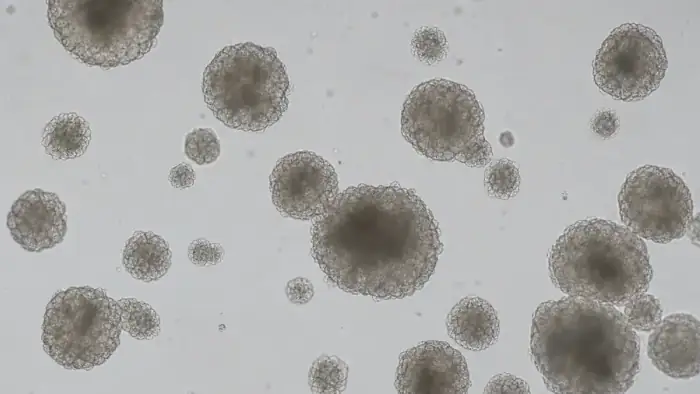
Organoid and spheroid image analysis for 3D culture studies.
Measure 3D culture growth and morphology across populations, not just a few hand-picked structures.
What this page covers
Use this page for brightfield, fluorescence, or confocal images of organoids, spheroids, aggregates, and related 3D culture systems.
Talk through your images
Share a representative field or plate, culture type, imaging mode, and the growth or morphology endpoint you need reported.
Request a meetingMeasurements
- Organoid count
- Diameter
- Area
- Circularity
- Size distribution
- Viability percent
Review outputs
- Object masks
- Population histograms
- Per-well summaries
- Longitudinal comparisons
Image inputs, QC, and outputs
Use this section to decide whether the page matches your assay before requesting a meeting. The goal is to preserve the biological endpoint while making the image analysis repeatable, reviewable, and exportable.
Image inputs
3D culture analysis starts with representative images that match the endpoint your lab reports. Include controls and edge cases so thresholds can be set against real biological variation, not only ideal fields.
- Primary measurements: Organoid count, Diameter, Area, and Circularity
- Matched positive and negative controls when available
- Consistent magnification, channel order, plate layout, or time-point labels
QC and validation
Each workflow should leave a visible trail from raw image to measurement. Review masks, thresholds, and flagged fields before exporting the final table.
- Raw image and overlay review before batch export
- Locked settings for repeated plates, stains, or time points
- QC flags for dim signal, merged objects, uneven background, or failed segmentation
Outputs for analysis
ConductVision should return both visual evidence and structured data so the result can be checked, summarized, and reused in downstream statistics.
- Typical outputs: Object masks, Population histograms, Per-well summaries, and Longitudinal comparisons
- Per-image, per-cell, per-object, or per-well tables where relevant
- CSV exports for Prism, Excel, R, Python, or LIMS handoff
Workflows to start from
Open an existing ConductVision page when the workflow already exists, or request a meeting when your assay needs custom thresholds, outputs, or validation rules.
Organoid and spheroid
Size, count, circularity, and distribution measurements for 3D culture structures.
Viability and assays
Live/dead ratios and response summaries where fluorescence channels are available.
Percent area
Area coverage and segmented region summaries for growth or invasion fields.
Related Life Science pages
Use these pages to move between adjacent assays, specialist microscopy workflows, and the full Life Science atlas.
Organoid Monitor
A pilot films organoid plates around the clock and reports growth, shape and events for every organoid.
Disease and toxicity models in cells and organoids
Which disease and toxicity readouts show in whole organoids, which need microscope images of cells, and the published evidence for each.
Request a Life Science meeting
Share your assay, representative images, and the measurement you need so the team can map the closest ConductVision workflow.
High-content screening
Scale 3D culture readouts into plate-based image screening.
Life Science atlas
Return to the full biology application atlas for cells, assays, tissue, microscopy, and morphology.
Frequently asked questions
These answers cover the practical questions labs usually ask before sending example images or requesting a ConductVision workflow review.
What images work best for 3d culture analysis?
Use representative images from the same microscope, scanner, plate reader, or camera setup used in the study. The most useful examples include controls, typical fields, difficult fields, and any cases that affect Organoid count, Diameter, Area, and Circularity.
Can ConductVision handle custom 3d culture endpoints?
Share a representative field or plate, culture type, imaging mode, and the growth or morphology endpoint you need reported. ConductScience can confirm whether an existing workflow fits or define custom segmentation, thresholding, review, and export rules for the assay.
What results are usually exported from this workflow?
The expected deliverables include Object masks, Population histograms, and Per-well summaries, plus structured tables for downstream analysis. The page also lists the specific measurements and review outputs that are most relevant to this application.
Find out if ConductVision fits your 3d culture workflow
Send representative images, assay details, and the measurement endpoint. ConductScience can confirm the closest existing workflow or scope a custom analysis path.