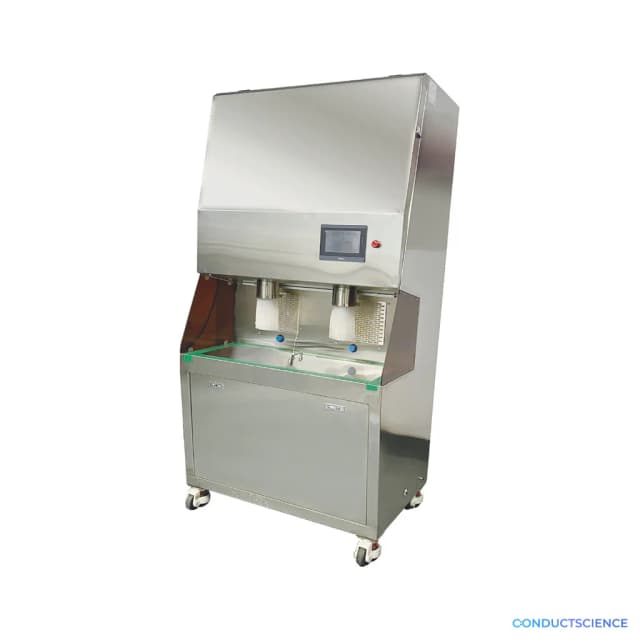
Bedding Disposal Workstation
Negative pressure workstation with HEPA filtration for safe disposal of soiled animal bedding and containment of airborne allergens and particulates during cage dumping operations.

Louise Corscadden, PhD
Director of Science · ConductScience
Ask Louise about Bedding Disposal Workstation fit, setup, configuration, or quote prep.
Already working with us? Sign in to connect this with My Scientist.
Key Specifications
Full details →- Model fit
- Gerbil, Hamster, Rabbit, Mouse, Rat, Guinea pig
- SKU family
- PTY-0036
- Shipping box
- 65.0 x 32.0 x 82.0 cm
- Ordering
- Online checkout and quote request available
- Category
- Bedding & Change Stations
- Build notes
- Confirm accessories, station layout, and support needs before purchase
The Bedding Disposal Workstation provides negative pressure containment for safe handling and disposal of soiled animal bedding in research facilities. This specialized containment system features HEPA exhaust filtration to capture airborne particulates and allergens generated during cage dumping and bedding disposal operations. The workstation creates a controlled environment that protects laboratory personnel from exposure to allergens, pathogens, and particulate matter while maintaining facility air quality standards.
Designed specifically for laboratory animal facilities, the workstation accommodates standard cage dumping procedures while containing contaminants at the source. The negative pressure design ensures airflow direction away from the operator, with HEPA-filtered exhaust removing particles before air recirculation. This containment approach is essential in facilities housing multiple species or conducting allergen-sensitive research protocols.
How It Works
The Bedding Disposal Workstation operates on negative pressure containment principles, where controlled airflow draws contaminated air away from the operator and through HEPA filtration before exhaust. When cage dumping occurs within the workstation, the negative pressure differential ensures that airborne particulates, allergens, and potential pathogens are captured at the source rather than dispersing into the laboratory environment.
The HEPA filtration system removes particles ≥0.3 micrometers with high efficiency, including dust mites, animal dander proteins, bacterial cells, and bedding particulates. The exhaust system maintains consistent airflow velocity across the work surface, creating a protective barrier that prevents operator exposure while allowing normal cage handling procedures. This containment approach is critical for facilities where multiple animal species generate diverse allergen profiles that could affect sensitive personnel.
Features & Benefits
Pressure
- Negative pressure containment
Filtration
- HEPA exhaust
Protection
- Allergen and particulate containment
Automation Level
- manual
Brand
- ConductScience
Research Domain
- Behavioral Pharmacology
- Environmental Monitoring
- Immunology
- Laboratory Animal Science
- Microbiology
- Toxicology
Species
- Gerbil
- Hamster
- Rabbit
- Mouse
- Rat
- Guinea pig
Shipping weight
- 85.0 lb
Shipping box
- L: 65.0 cm
- W: 32.0 cm
- H: 82.0 cm
| Feature | This Product | Typical Alternative | Advantage |
|---|---|---|---|
| Containment Method | Negative pressure containment with HEPA exhaust | Basic ventilation or open dumping stations without specialized containment | Prevents allergen and particulate dispersal that could affect personnel with animal sensitivities |
| Filtration System | HEPA exhaust filtration | Standard exhaust fans without high-efficiency filtration | Removes submicron particles including allergens and potential pathogens before air recirculation |
| Species Compatibility | Mouse, rat, guinea pig, hamster, gerbil, and rabbit bedding | Limited to single species or cage types | Supports diverse research programs without requiring multiple specialized disposal stations |
| Operation Method | Manual control system | Automated systems with complex controls | Provides reliable containment without dependence on automation that could fail during critical operations |
This workstation provides specialized negative pressure containment with HEPA filtration specifically designed for laboratory animal bedding disposal operations. The manual operation ensures reliable performance across multi-species facilities without complex automation dependencies.
Practical Tips
Monitor pressure differential regularly and replace HEPA filters when pressure drop increases significantly.
Why: Filter saturation reduces containment effectiveness and can compromise personnel protection.
Position cages within the containment area before opening to minimize particulate escape during dumping.
Why: Proper positioning maximizes capture efficiency and prevents contamination of surrounding areas.
Use smoke tubes quarterly to verify airflow patterns and ensure negative pressure is maintained across the work surface.
Why: Visual confirmation of airflow direction is critical for validating containment performance.
Train personnel on emergency shutdown procedures and alternative disposal methods if containment fails.
Why: Personnel safety requires backup protocols when primary containment systems are compromised.
If containment seems ineffective, check for filter bypass leaks around the housing seals.
Why: Air leaks around improperly sealed filters can significantly reduce containment effectiveness.
Document pressure readings and filter replacement dates to track system performance trends.
Why: Historical data helps optimize maintenance schedules and identify developing problems early.
Setup Guide
What’s in the Box
- Bedding disposal workstation main unit
- HEPA filter assembly
- Exhaust connection hardware (typical)
- Pressure monitoring gauge (typical)
- Installation manual
- Operation and maintenance guide (typical)
Warranty
ConductScience provides a standard one-year manufacturer warranty covering defects in materials and workmanship, with technical support for installation and operation guidance.
Compliance
What particle size range does the HEPA filtration remove?
HEPA filtration typically removes particles ≥0.3 micrometers with high efficiency, capturing animal dander, dust mites, bacterial cells, and bedding particulates. Consult product datasheet for specific filtration efficiency specifications.
How do I monitor negative pressure performance?
Use pressure monitoring gauges and periodic smoke tube testing to verify airflow direction. Establish baseline pressure readings during installation and monitor routinely to detect filter loading or system degradation.
What maintenance schedule should I follow?
Filter replacement frequency depends on facility usage patterns and particulate loading. Monitor pressure differential increases that indicate filter saturation, typically requiring replacement every 6-12 months in high-use facilities.
Can this handle bedding from multiple animal species?
Yes, the workstation is designed for mouse, rat, guinea pig, hamster, gerbil, and rabbit bedding disposal, accommodating diverse allergen profiles and cage sizes used in multi-species research facilities.
How does this compare to biological safety cabinets for bedding disposal?
Unlike BSCs designed for sterile work, this workstation is optimized specifically for cage dumping operations with containment focused on particulate and allergen capture rather than product protection.
What exhaust requirements are needed for installation?
Requires connection to facility exhaust system or dedicated ventilation unit capable of maintaining specified negative pressure. Consult product specifications for airflow volume requirements.
Is this suitable for biosafety level containment?
The workstation provides containment for standard laboratory animal operations. For specific biosafety level requirements, consult facility biosafety officer to ensure compatibility with institutional containment protocols.
Have a question about this product?
Have a question? Just ask.
Send it over and we'll email you a personalized answer — no call, no scheduling.
Prefer to talk it through?
Accessories
Enhance your setup with compatible accessories
Frequently Bought Together