Benchtop Freeze Dryer - Standard
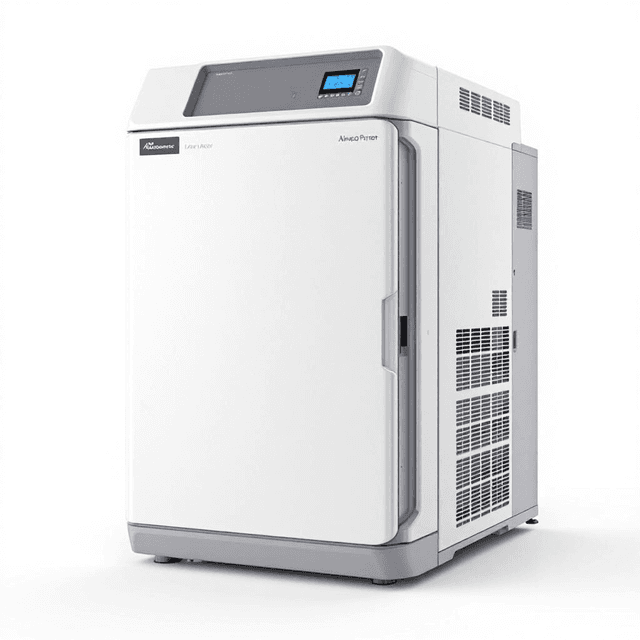
Benchtop freeze dryer using vacuum sublimation to preserve heat-sensitive biological, pharmaceutical, and food samples while maintaining structural integrity and biological activity.
Available in four configurations — standard chamber, manifold, stoppering, and stoppering with manifold — each with −60°C or −80°C cold trap temperature.

Louise Corscadden, PhD
Director of Science · ConductScience
Ask Louise about Benchtop Freeze Dryer - Standard fit, setup, configuration, or quote prep.
Already working with us? Sign in to connect this with My Scientist.
Key Specifications
Full details →- Model fit
- 4 selectable configurations
- SKU family
- Assigned during quote
- Shipping box
- 42.0 x 43.6 x 38.0 cm
- Ordering
- Online checkout and quote request available
- Category
- Benchtop Instruments
- Build notes
- Confirm accessories, station layout, and support needs before purchase
The Benchtop Freeze Dryer (Lyophilizer) removes moisture from frozen samples under controlled vacuum via sublimation, preserving original biological, chemical, and physical properties for long-term storage and reconstitution. A stainless steel cold trap captures sublimated water vapor, while a transparent aviation acrylic chamber cover allows real-time sample monitoring.
Key Features
- Professional gas diversion technology for uniform ice capture across the cold trap
- Energy-efficient, low-noise compressor with extended service life
- Stainless steel cold trap and work surface for easy decontamination
- Aviation acrylic transparent drying chamber with large cold trap opening
- Pre-freezing capability within the cold trap
- Integrated auto-defrost function for routine maintenance
- Environmentally friendly refrigerant (ODP = 0)
- USB data port for process logging
Configuration Guide
- BIO-BK-FD10S — Standard Chamber: 4-tray shelf design, 0.12 m² drying area, ideal for bulk sample trays
- BIO-BK-FD10P — Standard + 8-Port Manifold: 3-tray shelf with 8-port flask manifold for vials and flasks simultaneously
- BIO-BK-FD10T — Stoppering Chamber: 6-tray stoppering design, 0.18 m² drying area, in-chamber vial stoppering under vacuum
- BIO-BK-FD10PT — Stoppering + 8-Port Manifold: Full-featured configuration with stoppering chamber and 8-port manifold
Model Specifications
| Specification | BIO-BK-FD10S | BIO-BK-FD10P | BIO-BK-FD10T | BIO-BK-FD10PT |
|---|---|---|---|---|
| Cold Trap Capacity | 6 L | |||
| Cold Trap Temperature | ≤−60°C standard; −80°C optional | |||
| Cold Trap Size | Φ219 × 140 mm | |||
| Vacuum Degree | ≤5 Pa | |||
| Water Capture | 3–4 L/24h | |||
| Freeze Drying Time | 24–36 h | |||
| Power Consumption | 1300 W | |||
| Power Supply | 220V, 50Hz (standard); 220V/110V, 60Hz (optional) | |||
| Cooling System | Air cooling | |||
| Refrigerant | R600a/R23 (−60°C); R404a/R23 (−80°C) | |||
| Freeze Drying Area | 0.12 m² | 0.08 m² | 0.18 m² | 0.18 m² |
| Trays | 4 | 3 | 6 | 6 |
| Tray Size | Φ200 × 20 mm | Φ180 × 20 mm | Φ200 × 20 mm | Φ200 × 20 mm |
| Drying Chamber Size | Φ260 × 420 mm | Φ260 × 420 mm | Φ260 × 465 mm | Φ260 × 465 mm |
| Suggested Loading | 1.2 L | 0.8 L | 1.8 L | 1.8 L |
| Total Loading Capacity | 2.4 L | 1.6 L | 3.6 L | 3.6 L |
| External Dimensions (mm) | 640 × 610 × 550 | |||
| Net Weight (−60°C) | 80 kg | 45 kg | 49 kg | 55 kg |
| Net Weight (−80°C) | 98 kg | 45 kg | 49 kg | 55 kg |
How It Works
Freeze drying operates through sublimation, the direct transition of ice to vapor without passing through the liquid phase. The process begins with freezing samples to temperatures below their eutectic point, typically -40°C to -80°C, crystallizing both water and any dissolved solutes. Under vacuum conditions (typically 0.1-0.01 mbar), the frozen water sublimes directly to vapor.
The cold trap, maintained at temperatures below the sample chamber, condenses the sublimed water vapor, preventing it from reaching the vacuum pump. This creates a pressure gradient that drives continuous moisture removal from the sample. Temperature and vacuum monitoring ensures optimal conditions throughout the drying cycle.
The dual drying configurations accommodate different sample types: manifold drying for liquid samples in vials using direct vacuum connection, and shelf drying for bulk materials requiring controlled heat input. The auto-defrost function periodically removes accumulated ice from the cold trap, maintaining system efficiency during extended operation.
Features & Benefits
Cold Trap Capacity
- 6L
Vacuum Degree
- ≤5 Pa
Water Capture Rate
- 3–4 L/24h
Power/Voltage
- 1300W / 220V, 50Hz
Refrigerant
- R600a/R23 (−60°C); R404a/R23 (−80°C)
Cooling System
- Air Cooling
Automation Level
- Semi-Automated
Research Domain
- Analytical Chemistry
- Cell Biology
- Food Science
- Materials Science
- Microbiology
- Pharmaceutical QC
Shipping weight
- 176.37 lb
Shipping box
- L: 42.0 cm
- W: 43.6 cm
- H: 38.0 cm
| Feature | This Product | Typical Alternative | Advantage |
|---|---|---|---|
| Drying Configuration Options | Both manifold and shelf drying configurations available | Entry-level models often provide only manifold drying capability | Flexibility to process both liquid samples in vials and bulk materials requiring different heat input methods. |
| Process Monitoring | Digital temperature and vacuum display | Basic models may offer analog gauges with limited precision | Real-time digital monitoring provides accurate process control for consistent drying results. |
| Cold Trap Maintenance | Auto-defrost function for ice removal | Manual defrosting typically required on simpler systems | Automated maintenance reduces downtime and ensures consistent performance during extended operation. |
| System Design | Benchtop configuration with integrated components | Varies by model - some require separate vacuum pumps or external cold traps | Integrated design minimizes setup complexity and laboratory space requirements. |
This standard benchtop freeze dryer offers dual drying configurations and digital process monitoring with automated maintenance features. The integrated design provides research laboratories with flexible sample processing capabilities in a compact format.
| Model | SKU | Listed price | Status | Shipping box |
|---|---|---|---|---|
| BIO-BK-FD10PT | BIO-BK-FD10PT-80C | $5,979.00 | Available | 64.0 x 61.0 x 55.0 cm |
| BIO-BK-FD10PT | BIO-BK-FD10PT-60C | $4,179.00 | Available | 64.0 x 61.0 x 55.0 cm |
| BIO-BK-FD10T | BIO-BK-FD10T-80C | $5,279.00 | Available | 64.0 x 61.0 x 55.0 cm |
| BIO-BK-FD10T | BIO-BK-FD10T-60C | $3,179.00 | Available | 64.0 x 61.0 x 55.0 cm |
| BIO-BK-FD10P | BIO-BK-FD10P-80C | $5,479.00 | Available | 64.0 x 61.0 x 55.0 cm |
| BIO-BK-FD10P | BIO-BK-FD10P-60C | $3,379.00 | Available | 64.0 x 61.0 x 55.0 cm |
| BIO-BK-FD10S | BIO-BK-FD10S-80C | $5,079.00 | Available | 64.0 x 61.0 x 55.0 cm |
| BIO-BK-FD10S | BIO-BK-FD10S-60C | $2,979.00 | Available | 64.0 x 61.0 x 55.0 cm |
Practical Tips
Pre-freeze samples to at least -20°C before loading to ensure complete ice crystal formation and optimal sublimation conditions.
Why: Incomplete freezing can lead to sample collapse and poor drying results.
Verify temperature and vacuum readings periodically using calibrated reference instruments.
Why: Accurate process monitoring is essential for reproducible drying results and sample quality.
Use the auto-defrost function when ice buildup becomes visible in the cold trap chamber.
Why: Ice accumulation reduces cold trap efficiency and can affect vacuum performance.
Record initial sample volume, processing time, and final vacuum readings for each batch.
Why: Documentation helps optimize processing parameters and troubleshoot any quality issues.
If vacuum levels remain high, check for sample outgassing or incomplete freezing before assuming equipment problems.
Why: Sample-related issues are often misdiagnosed as system malfunctions.
Allow cold trap to warm to room temperature before opening for cleaning to prevent thermal shock to glassware.
Why: Rapid temperature changes can cause glass components to crack or shatter.
Setup Guide
What’s in the Box
- Benchtop freeze dryer main unit
- Cold trap system
- Digital display control panel
- Power cable
- Manifold assembly (typical)
- Sample shelf hardware (typical)
- User manual and operation guide
- Maintenance kit (typical)
Warranty
ConductScience provides a standard one-year manufacturer warranty covering parts and labor, with technical support available for operation and maintenance guidance.
Compliance
What is the typical drying time for aqueous samples?
Drying time depends on sample volume, initial moisture content, and desired final moisture levels. Small vial samples (1-5 mL) typically require 12-24 hours, while bulk materials may need 24-48 hours. Consult product datasheet for specific performance data.
Can the system handle organic solvents other than water?
The freeze dryer is primarily designed for aqueous systems. Organic solvents require different vapor pressure and condensation conditions that may not be compatible with the standard cold trap configuration.
What maintenance is required for the cold trap system?
Regular defrosting using the auto-defrost function prevents ice buildup. Periodic cleaning of the cold trap chamber and checking refrigeration system performance ensures optimal operation.
How do I determine if samples are adequately dried?
Monitor vacuum stability and temperature readings. Properly dried samples will show consistent vacuum levels without continued vapor evolution. Final moisture content should be verified using analytical methods appropriate for your specific application.
What is the difference between manifold and shelf drying configurations?
Manifold drying connects individual vials directly to vacuum lines, suitable for liquid samples. Shelf drying places samples on heated shelves for bulk materials requiring controlled heat input during the sublimation process.
Can the system be used for sterile sample processing?
The freeze drying process itself does not provide sterilization. Samples must be sterile before processing, and sterile technique should be maintained during loading and unloading procedures.
Have a question about this product?
Have a question? Just ask.
Send it over and we'll email you a personalized answer — no call, no scheduling.
Prefer to talk it through?