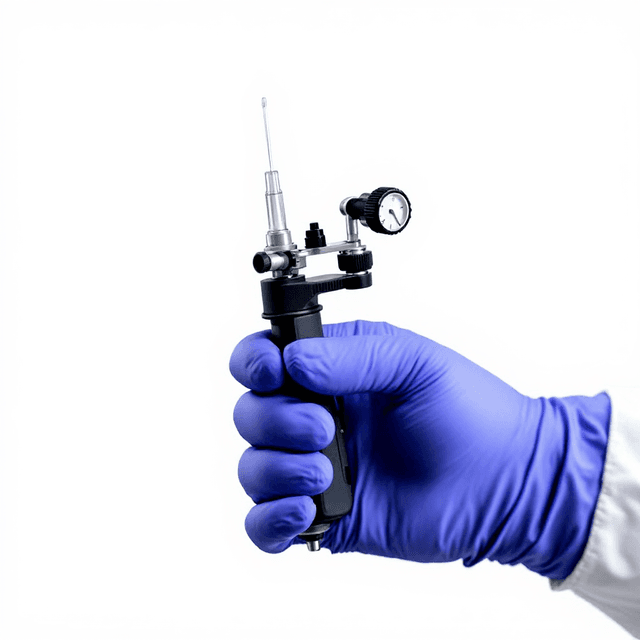
Bidirectional Continuous Syringe Pump
Precision syringe pump with bidirectional and continuous flow modes for oscillating flow applications and physiological simulation studies.

Louise Corscadden, PhD
Director of Science · ConductScience
Ask Louise about Bidirectional Continuous Syringe Pump fit, setup, configuration, or quote prep.
Already working with us? Sign in to connect this with My Scientist.
Key Specifications
Full details →- Model fit
- Configured during quote
- SKU family
- WHM-0032
- Shipping box
- 300.0 x 250.0 x 200.0 cm
- Ordering
- Online checkout and quote request available
- Category
- Lab Equipment
- Build notes
- Confirm accessories, station layout, and support needs before purchase
The Bidirectional Continuous Syringe Pump is a precision fluid delivery system designed for research applications requiring oscillating flow patterns and physiological simulation. This programmable pump delivers precise bidirectional flow control, enabling researchers to replicate complex flow dynamics found in biological systems and industrial processes.
The system provides continuous, programmable operation with the capability to reverse flow direction under automated control. With dimensions of 300 × 250 × 200 mm and weighing 10 kg, the unit offers laboratory-suitable form factor while maintaining the mechanical precision required for demanding research protocols. The bidirectional flow capability supports applications in cardiovascular research, microfluidics, and process simulation studies.
How It Works
The bidirectional continuous syringe pump operates through precision stepper motor control of a syringe plunger mechanism. The system uses programmable motor control algorithms to achieve precise forward and reverse plunger movement, enabling continuous flow in either direction without manual intervention. Flow rate control is achieved through variable motor speed, while flow direction reversal is accomplished through coordinated motor direction changes and valve switching where applicable.
The programmable nature allows users to define complex flow profiles including oscillatory patterns, ramped flow changes, and step functions. Internal control systems monitor position feedback and maintain precise volumetric delivery rates regardless of back-pressure variations within the operating range. The continuous operation capability eliminates the traditional syringe pump limitation of requiring manual refill cycles.
Features & Benefits
Flow Mode
- Bidirectional, continuous, programmable
Automation Level
- semi-automated
Brand
- ConductScience
Research Domain
- Analytical Chemistry
- Cardiovascular
- Cell Biology
- Environmental Monitoring
- Materials Science
- Pharmaceutical QC
Shipping weight
- 10.0 lb
Shipping box
- L: 300.0 cm
- W: 250.0 cm
- H: 200.0 cm
| Feature | This Product | Typical Alternative | Advantage |
|---|---|---|---|
| Flow Direction Control | Bidirectional with programmable reversal | Unidirectional flow requiring external valve systems | Simplifies system setup and reduces component count for oscillating flow applications |
| Operation Mode | Continuous programmable operation | Manual refill cycles or limited automation | Enables uninterrupted long-duration experiments without operator intervention |
| Flow Pattern Capability | Programmable oscillating and custom profiles | Constant flow or basic step changes | Supports complex physiological simulation and dynamic flow studies |
| Laboratory Integration | Compact 300 × 250 × 200 mm footprint | Varies by model and feature set | Fits standard laboratory benchtops while providing advanced flow control |
This pump provides bidirectional and continuous flow capabilities in a laboratory-suitable form factor. The programmable operation enables complex flow patterns for physiological simulation and oscillating flow applications without requiring external valve systems.
Practical Tips
Verify flow rates using an independent measurement method such as gravimetric analysis or flow meters.
Why: Ensures accuracy is maintained across different fluid types and experimental conditions.
Clean fluid pathways with appropriate solvents after each use to prevent cross-contamination and blockages.
Why: Maintains flow accuracy and prevents damage to seals and valves.
Allow the pump to warm up for 10-15 minutes before critical measurements to ensure thermal stability.
Why: Temperature variations can affect motor performance and flow precision.
Check for air bubbles in the system if flow rates appear inconsistent or erratic.
Why: Air bubbles compress under pressure and cause flow irregularities in precision applications.
Record fluid viscosity and temperature when documenting flow rate measurements.
Why: These parameters significantly affect pump performance and are essential for reproducible results.
Use appropriate containment for hazardous fluids and ensure emergency stop procedures are established.
Why: Protects personnel and equipment in case of tubing failure or programming errors.
Program gradual flow rate changes rather than abrupt steps to minimize pressure transients.
Why: Reduces stress on tubing connections and improves flow stability during transitions.
Setup Guide
What’s in the Box
- Bidirectional syringe pump main unit
- Power adapter (typical)
- Control cable (typical)
- Mounting hardware for standard syringes (typical)
- User manual and quick start guide (typical)
- Calibration certificate (typical)
Warranty
ConductScience provides a 1-year manufacturer warranty covering defects in materials and workmanship. Technical support is available for setup assistance and troubleshooting during the warranty period.
Compliance
What syringe sizes are compatible with this pump?
Consult the product datasheet for specific syringe volume ranges and mounting specifications. Most research-grade syringe pumps accommodate standard luer-lock syringes from 1 mL to 60 mL.
How do I program oscillating flow patterns?
The programmable control system allows definition of custom flow profiles including frequency, amplitude, and duty cycle parameters for oscillatory patterns. Specific programming procedures are detailed in the user manual.
What is the maximum back-pressure this pump can work against?
Consult the product datasheet for pressure specifications. Back-pressure limits depend on syringe size and flow rate requirements.
Can the pump deliver multiple fluids sequentially?
With appropriate valve systems and tubing configurations, the bidirectional capability supports sequential fluid delivery protocols. Thorough cleaning between fluids is essential.
How accurate are the programmed flow rates?
Flow accuracy depends on syringe selection, fluid properties, and back-pressure conditions. Consult specifications for accuracy ratings under standard test conditions.
What maintenance is required for continuous operation?
Regular cleaning of fluid pathways, periodic calibration verification, and replacement of wear components according to usage schedules maintain optimal performance.
Can this pump interface with external control systems?
Consult the technical specifications for available communication interfaces such as RS-232, USB, or analog control options for system integration.
Have a question about this product?
Have a question? Just ask.
Send it over and we'll email you a personalized answer — no call, no scheduling.
Prefer to talk it through?
Accessories
Enhance your setup with compatible accessories
Frequently Bought Together