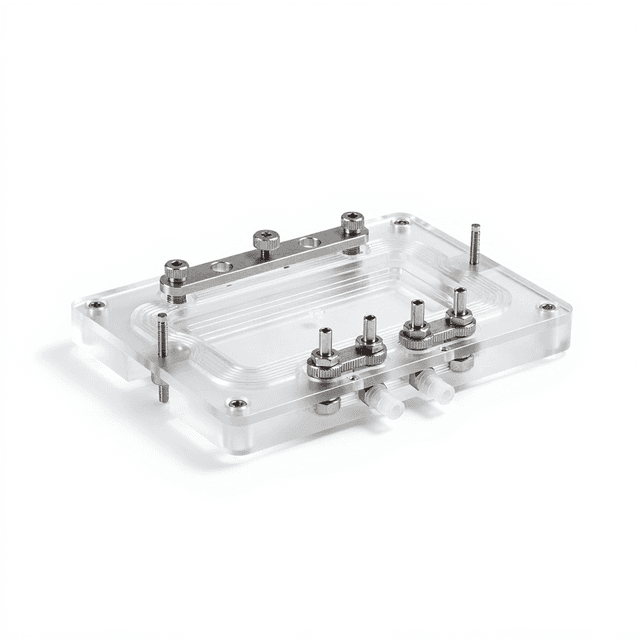
PDMS Reversible Sealing Chip Holder
4-layer microfluidic chip holder with reversible sealing mechanism and integrated observation window for controlled fluid handling experiments.

Louise Corscadden, PhD
Director of Science · ConductScience
Ask Louise about PDMS Reversible Sealing Chip Holder fit, setup, configuration, or quote prep.
Already working with us? Sign in to connect this with My Scientist.
Key Specifications
Full details →- Model fit
- Configured during quote
- SKU family
- WHM-0049
- Shipping box
- 80.0 x 50.0 x 25.0 cm
- Ordering
- Online checkout and quote request available
- Category
- Lab Equipment
- Build notes
- 4-layer: aluminum/glass/chip/PMMA
The PDMS Reversible Sealing Chip Holder provides a stable platform for microfluidic chip operations with integrated observation capabilities. The 4-layer construction combines aluminum base, glass observation window, chip interface, and PMMA top layer to create a sealed environment for controlled fluid handling experiments. PEEK connectors ensure chemical compatibility with diverse solvents and biological media.
The reversible sealing mechanism allows researchers to rapidly switch between different chip configurations without compromising seal integrity. The integrated observation window enables real-time monitoring of microfluidic processes through standard microscopy techniques, supporting both transmitted and fluorescence imaging protocols.
How It Works
The holder operates through mechanical compression sealing between the PMMA top layer and the microfluidic chip interface. The aluminum base provides thermal stability and structural rigidity, while the glass observation window maintains optical clarity for transmitted light and fluorescence microscopy. The 4-layer construction distributes clamping forces evenly across the chip surface, preventing deformation of microfluidic channels.
PEEK connectors interface with standard microfluidic tubing systems, providing leak-resistant connections for fluid delivery and waste removal. The reversible sealing mechanism allows chip replacement without disassembly of fluid connections, reducing dead volume and preventing cross-contamination between experiments. The observation window dimensions accommodate standard microscope objectives for real-time process monitoring.
Features & Benefits
Connectors
- PEEK
Features
- Observation window, reversible sealing
Automation Level
- manual
Brand
- ConductScience
Material
- 4-layer: aluminum/glass/chip/PMMA
Research Domain
- Analytical Chemistry
- Cell Biology
- Environmental Monitoring
- Materials Science
- Microbiology
- Pharmaceutical QC
Shipping weight
- 0.3 lb
Shipping box
- L: 80.0 cm
- W: 50.0 cm
- H: 25.0 cm
| Feature | This Product | Typical Alternative | Advantage |
|---|---|---|---|
| Sealing Mechanism | Reversible sealing with 4-layer construction | Permanent bonding or single-use adhesive seals | Enables chip reuse and rapid protocol changes without compromising seal integrity. |
| Observation Access | Integrated glass observation window | External viewing ports or separate optical access | Simplifies setup and reduces optical path interference for cleaner imaging. |
| Construction Materials | Aluminum/glass/PMMA with PEEK connectors | Plastic or metal-only construction | Combines thermal stability with chemical resistance and optical clarity. |
| Form Factor | Compact 80x50x25mm, 0.3kg design | Larger benchtop units or bulky clamping systems | Fits standard microscope stages while providing sufficient working area for complex chips. |
| Connector Type | PEEK chemical-resistant connectors | Standard plastic or metal fittings | Ensures compatibility with aggressive solvents and biological media without degradation. |
The holder combines reversible sealing capability with integrated optical access in a compact design optimized for microscope-based microfluidic experiments. The multi-material construction balances mechanical stability, chemical resistance, and optical performance for diverse research applications.
Practical Tips
Apply clamping pressure gradually while monitoring chip alignment through the observation window to prevent channel deformation.
Why: Uneven pressure distribution can collapse microfluidic channels and compromise experimental results.
Clean glass surfaces with appropriate solvents after each use to prevent contamination buildup that affects optical clarity.
Why: Residue accumulation degrades imaging quality and can introduce artifacts in fluorescence applications.
Verify seal integrity using test fluids at operating pressure before introducing experimental samples.
Why: Pressure testing identifies potential leak points that could compromise fluid handling accuracy.
Ensure proper ventilation when using volatile solvents with PEEK connectors in enclosed microscope chambers.
Why: Solvent vapors can accumulate in confined spaces and pose health risks or affect imaging stability.
Allow thermal equilibration after chip installation before beginning temperature-sensitive experiments.
Why: Thermal gradients from handling can affect fluid viscosity and reaction kinetics in microfluidic systems.
If bubble formation occurs, reduce flow rate and increase backpressure to improve channel wetting.
Why: Air bubbles disrupt fluid flow patterns and can block microfluidic channels completely.
Store chips in a clean environment between uses to prevent particulate contamination of sealing surfaces.
Why: Contaminated sealing surfaces reduce seal effectiveness and can introduce experimental artifacts.
Inspect PEEK connectors regularly for signs of wear or chemical attack, especially after exposure to aggressive solvents.
Why: Degraded connectors can develop leaks that compromise experimental reproducibility and waste samples.
Setup Guide
What’s in the Box
- PDMS Reversible Sealing Chip Holder (main unit)
- PEEK connectors (2 pieces, typical)
- User manual and operation guidelines
- Maintenance and cleaning protocols (typical)
Warranty
ConductScience provides a standard 1-year manufacturer warranty covering defects in materials and workmanship, with technical support for installation and operational guidance.
Compliance
What chip thicknesses are compatible with the sealing mechanism?
Consult product datasheet for specific thickness tolerances. The reversible sealing design accommodates standard microfluidic chip dimensions with appropriate clamping pressure adjustment.
Can the holder withstand backpressure from high flow rate applications?
The 4-layer construction and PEEK connectors support typical microfluidic operating pressures. Verify pressure ratings in technical specifications for your specific flow requirements.
What maintenance is required for the sealing surfaces?
Regular cleaning of the glass window and PMMA surfaces prevents contamination buildup. Inspect PEEK connectors periodically for wear and replace as needed to maintain leak-free operation.
Is the observation window compatible with oil immersion objectives?
The glass observation window supports standard microscopy techniques. Verify working distance and numerical aperture compatibility with your specific objective lens requirements.
Can multiple holders be used simultaneously on the same microscope stage?
The compact 80x50mm footprint allows multiple unit positioning depending on stage dimensions. Consider spacing requirements for tubing connections and objective access.
What solvents are compatible with the PEEK connectors and construction materials?
PEEK exhibits excellent chemical resistance to most organic solvents and biological media. Consult chemical compatibility charts for specific reagents used in your protocols.
How is chip alignment maintained during the sealing process?
The 4-layer design provides visual reference points for chip positioning. Apply clamping pressure gradually while monitoring alignment through the observation window.
What is the typical seal lifetime under continuous operation?
Seal durability depends on operating pressure, temperature, and chemical exposure. Inspect sealing surfaces regularly and replace chips when deformation or wear becomes apparent.
Have a question about this product?
Have a question? Just ask.
Send it over and we'll email you a personalized answer — no call, no scheduling.
Prefer to talk it through?
Accessories
Enhance your setup with compatible accessories
Frequently Bought Together