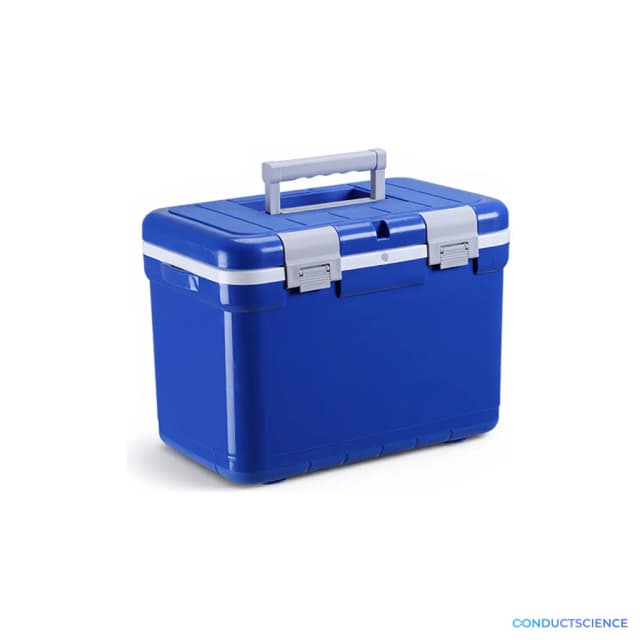
Biosafety Transport Box
Secure transport container for biological specimens and laboratory samples, providing containment during movement between laboratory areas and storage facilities.
| Automation Level | manual |

The Biosafety Transport Box provides secure containment and transport of biological specimens, laboratory samples, and potentially hazardous materials within research facilities. Constructed with dimensions of 38.0 cm × 23.0 cm × 24.5 cm and weighing 4.8 kg, this transport container enables safe movement of samples between laboratory areas, cold storage facilities, and transport vehicles while maintaining specimen integrity.
The transport box serves as a critical component in laboratory biosafety protocols, providing an additional containment barrier for specimens during handling and movement. Its compact design accommodates standard laboratory workflows while ensuring proper isolation of materials during transport between workstations, storage areas, and external facilities.
How It Works
The biosafety transport box functions as a secondary containment system, providing an additional barrier beyond primary sample containers. The rigid construction creates a sealed environment that isolates contents from external contamination while preventing potential specimen leakage during transport. The box dimensions accommodate standard laboratory containers including microcentrifuge tubes, culture flasks, and sample vials.
Transport containment relies on physical barriers and secure closure mechanisms to maintain specimen isolation. The box interior provides cushioning and stabilization for samples during movement, reducing mechanical stress that could compromise container integrity. The external dimensions allow for efficient handling while maintaining compatibility with standard laboratory equipment and storage systems.
Features & Benefits
Automation Level
- manual
Research Domain
- Analytical Chemistry
- Cell Biology
- Clinical Diagnostics
- Environmental Monitoring
- Immunology
- Microbiology
- Pharmaceutical QC
Weight
- 4.8 kg
Dimensions
- L: 23.0 mm
- W: 38.0 mm
- H: 24.5 mm
Comparison Guide
| Feature | This Product | Typical Alternative | Advantage |
|---|---|---|---|
| Container Dimensions | 38.0 × 23.0 × 24.5 cm interior space | Smaller containers often limit capacity to single sample types | Accommodates diverse container sizes and multiple samples in a single transport operation |
| Construction Type | Rigid container with secure closure | Flexible transport bags offer limited protection | Provides superior mechanical protection for fragile specimens during transport |
| Weight Profile | 4.8 kg total weight | Heavier units reduce portability | Balances structural integrity with manageable handling characteristics for laboratory personnel |
| Reusability | Designed for repeated use with decontamination | Disposable containers generate ongoing costs | Reduces long-term transport costs while maintaining containment performance |
The transport box offers versatile specimen containment with dimensions suitable for multiple container types and secure closure mechanisms. The 4.8 kg weight provides manageable portability while maintaining structural integrity for laboratory transport applications.
Practical Tips
Distribute specimen containers evenly within the transport box to prevent shifting during movement.
Why: Proper distribution reduces mechanical stress on primary containers and maintains transport stability.
Inspect closure mechanisms and sealing surfaces regularly for wear or damage.
Why: Compromised seals can reduce containment effectiveness and increase contamination risk.
Always use appropriate personal protective equipment when handling the transport box containing biological specimens.
Why: Secondary containment does not eliminate the need for standard laboratory safety precautions.
Label the exterior clearly with contents and hazard information before transport.
Why: Proper identification ensures appropriate handling and emergency response if needed.
Allow complete air drying after decontamination before storing the container.
Why: Moisture retention can promote microbial growth and compromise subsequent containment applications.
Document transport conditions and timing when specimen integrity is critical for analysis.
Why: Transport variables can affect specimen quality and should be recorded for quality control purposes.
Setup Guide
What’s in the Box
- Transport container with secure closure (typical)
- User manual with biosafety guidelines (typical)
- Hazard labeling kit (typical)
Warranty
ConductScience provides a standard one-year manufacturer warranty covering defects in materials and workmanship, with technical support for proper use and maintenance procedures.
Compliance
What types of laboratory containers fit within the transport box dimensions?
The 38.0 × 23.0 × 24.5 cm interior accommodates standard culture flasks, microcentrifuge tube racks, sample vials, and small reagent bottles commonly used in laboratory workflows.
How should the transport box be decontaminated between uses?
Clean all interior surfaces with appropriate disinfectant compatible with the container material, ensure complete drying, and follow institutional protocols for biological containment equipment.
What is the maximum specimen load the container can safely transport?
Consult product datasheet for specific load limits. The 4.8 kg total weight suggests capacity for multiple standard laboratory containers when properly distributed.
Can the transport box be used for temperature-sensitive specimens?
The container provides insulation properties typical of rigid transport boxes. For specific temperature maintenance requirements, consult product specifications or use with appropriate cold packs.
What biosafety level materials can be transported using this container?
Transport suitability depends on institutional biosafety protocols and specimen risk assessment. Verify compatibility with local guidelines for the specific biological materials being transported.
How does this compare to disposable transport containers?
This reusable container offers enhanced durability and cost-effectiveness for frequent transport applications, while disposable options may be preferred for single-use or high-risk specimens.
Have a question about this product?
Accessories
Enhance your setup with compatible accessories
Frequently Bought Together