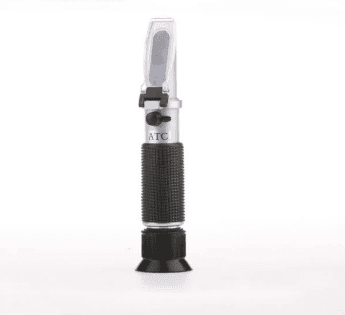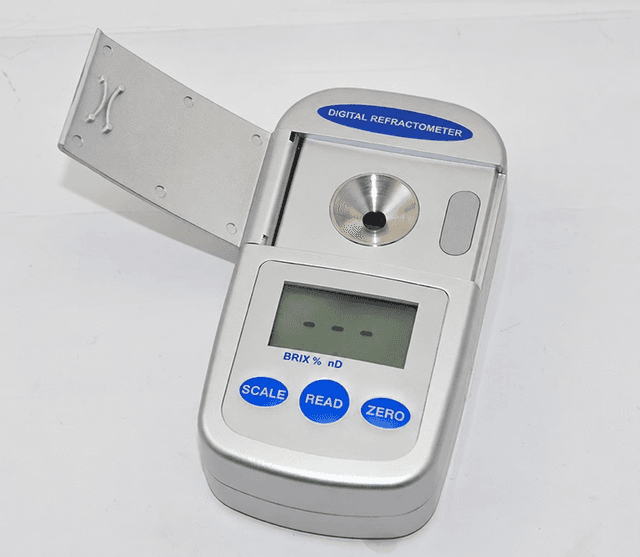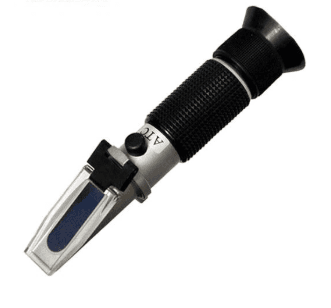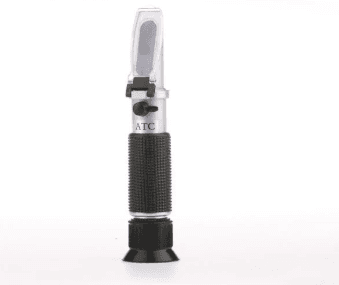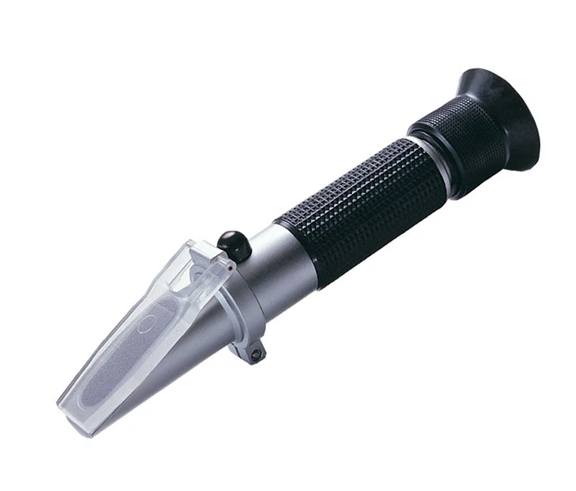
Digital Sugar Refractometer
Handheld digital refractometer measuring sugar content (Brix) from 0-55% with ±0.2% accuracy, featuring automatic temperature compensation and 5-second measurement time for food science and analytical applications.

Louise Corscadden, PhD
Director of Science · ConductScience
Ask Louise about Digital Sugar Refractometer fit, setup, configuration, or quote prep.
Already working with us? Sign in to connect this with My Scientist.
Key Specifications
Full details →- Model fit
- Configured during quote
- SKU family
- CS-LH-B55
- Shipping box
- 5.51 x 2.44 x 1.14 cm
- Ordering
- Online checkout and quote request available
- Category
- Refractometers
- Build notes
- Confirm accessories, station layout, and support needs before purchase
The Digital Sugar Refractometer (Model LH-B55) is a precision optical instrument designed for rapid determination of sugar content in food products, beverages, and biological samples. Based on refractive index measurement principles, this handheld device measures Brix values from 0-55% with ±0.2% accuracy and 0.1% resolution. The instrument incorporates automatic temperature compensation across a 10-40°C range, ensuring consistent measurements across varying laboratory conditions.
Featuring a digital display and 5-second measurement capability, the refractometer requires minimal sample volume (≤0.5ml) and operates on standard AAA batteries for approximately 2000 tests. The compact design (62×29×140mm, 140g) enables both laboratory bench work and field sampling applications. Temperature compensation algorithms maintain measurement accuracy across the specified operating range, critical for reliable concentration determinations in research protocols.
How It Works
Digital refractometry operates on the principle that light changes direction (refracts) when passing through materials of different densities. The LH-B55 uses an LED light source directed through a sample onto a prism interface. As light passes from the sample into the prism, the angle of refraction depends on the sample's refractive index, which correlates directly with dissolved solids concentration.
A linear image sensor detects the boundary between light and dark regions created by the refracted light, converting this optical signal into a digital refractive index measurement. The instrument's microprocessor applies calibration algorithms to convert refractive index values into Brix percentage readings. Built-in temperature compensation algorithms automatically adjust measurements based on the integrated temperature sensor, accounting for thermal effects on solution density that would otherwise introduce measurement errors.
The 5-second measurement cycle allows rapid data acquisition while maintaining ±0.2% accuracy across the 0-55% Brix range. Sample volume requirements of ≤0.5ml enable measurements on limited sample quantities typical in research applications.
Features & Benefits
Model
- LH-B55
Product name
- Sugar brix refractometer LH-B55
Range
- 0-55%
Temperature Compensation
- 10-40 â
Test environment
- 10-40 âï¼RHï¼95%
Sample Volume
- â¥0.5ml
Test time
- 5s
Battery
- 3*AAA(About 2000 times test)
Dimension and weight
- 62*29*140mm,140g
Automation Level
- manual
Brand
- ConductScience
Accuracy
- ±0.2%
Research Domain
- Analytical Chemistry
- Environmental Monitoring
- Food Science
- Materials Science
- Microbiology
- Pharmaceutical QC
Shipping weight
- 0.31 lb
Shipping box
- L: 5.51 cm
- W: 2.44 cm
- H: 1.14 cm
| Feature | This Product | Typical Alternative | Advantage |
|---|---|---|---|
| Measurement Range | 0-55% Brix | Entry-level models often limited to 0-32% Brix | Enables analysis of concentrated solutions including syrups and honey samples that exceed typical measurement ranges. |
| Resolution | 0.1% Brix | Standard digital units commonly offer 0.1-0.2% resolution | Provides sufficient precision for research applications requiring quantitative concentration determination. |
| Temperature Compensation | Automatic 10-40°C range | Manual compensation or limited automatic range | Eliminates calculation errors and maintains accuracy across typical laboratory temperature variations without user intervention. |
| Sample Volume | ≤0.5ml requirement | Varies by model, typically 1-3ml | Conserves limited research samples and enables analysis of small-volume specimens. |
| Measurement Time | 5 seconds | Varies from 3-30 seconds depending on model | Supports efficient sample throughput in high-volume analytical workflows. |
| Battery Life | 2000+ measurements on 3×AAA batteries | Battery life varies significantly by design | Provides extended field operation capability without frequent battery replacement interruptions. |
The LH-B55 combines extended measurement range up to 55% Brix with automatic temperature compensation and minimal sample volume requirements. The 5-second measurement cycle and 2000+ test battery life support efficient analytical workflows in both laboratory and field environments.
Practical Tips
Perform zero-point calibration with distilled water at the beginning of each analytical session and when changing sample types significantly.
Why: Maintains baseline accuracy and compensates for minor optical drift that can occur with temperature changes.
Clean the prism surface immediately after each sample using distilled water followed by lint-free cloth drying.
Why: Prevents sample carryover and maintains optical clarity essential for accurate refractive index measurements.
Allow both instrument and samples to equilibrate to room temperature before measurements, especially when working with refrigerated samples.
Why: Temperature gradients can create measurement artifacts even with automatic compensation systems.
Filter samples containing visible particulates or debris before analysis to prevent light scattering interference.
Why: Suspended particles can cause erratic readings by disrupting the light path needed for refractive index determination.
If readings appear unstable, check for air bubbles under the daylight plate and ensure complete sample coverage of the prism surface.
Why: Air-liquid interfaces create additional refractive boundaries that interfere with measurement accuracy.
Use appropriate personal protective equipment when handling samples and avoid dropping the instrument as optical alignment is sensitive to mechanical shock.
Why: Protects both operator and instrument integrity, as misaligned optics require factory calibration to restore accuracy.
Verify accuracy periodically using certified sucrose standards spanning the working range for your specific applications.
Why: Validates instrument performance across the measurement range and identifies potential calibration drift before it affects research results.
Setup Guide
What’s in the Box
- LH-B55 Digital Sugar Refractometer main unit
- Calibration reference solutions (typical)
- Cleaning cloth and maintenance kit (typical)
- Protective carrying case (typical)
- User manual and calibration certificate (typical)
- Pipettes for sample application (typical)
Warranty
ConductScience provides a standard one-year manufacturer warranty covering defects in materials and workmanship. Technical support includes calibration guidance and measurement protocol assistance for optimal instrument performance.
Compliance
What is the minimum sample volume required for accurate measurements?
The instrument requires ≤0.5ml sample volume, making it suitable for analysis of limited-volume research samples while maintaining ±0.2% measurement accuracy.
How does temperature compensation work and what range is covered?
Built-in temperature sensors and algorithms automatically compensate for thermal effects on refractive index across 10-40°C, eliminating need for manual temperature corrections during routine measurements.
What calibration standards are required for accurate measurements?
Primary calibration uses distilled water as 0% Brix reference. Additional sucrose standards across the measurement range can verify linearity and accuracy for specific applications.
Can the instrument measure non-sugar solutions or only sucrose-based samples?
The refractometer measures total dissolved solids via refractive index and displays results as Brix equivalent. Non-sugar solutions can be measured but require appropriate conversion factors for accurate concentration determination.
What maintenance is required to maintain measurement accuracy?
Regular cleaning of the prism surface with distilled water and lint-free cloths, periodic zero-point calibration with distilled water, and protection from mechanical shock to maintain optical alignment.
How does this compare to traditional benchtop refractometers?
The digital format eliminates subjective reading interpretation inherent in visual refractometers while providing automatic temperature compensation and faster measurement cycles compared to manual instruments.
What factors can interfere with measurement accuracy?
Particulates in samples, air bubbles on the prism surface, temperature gradients during measurement, and organic solvents can affect refractive index readings and should be controlled in measurement protocols.
Have a question about this product?
Have a question? Just ask.
Send it over and we'll email you a personalized answer — no call, no scheduling.
Prefer to talk it through?