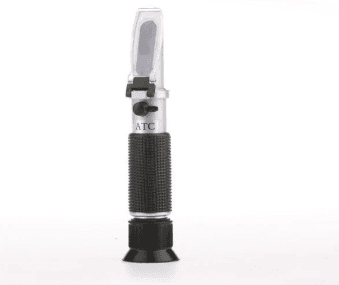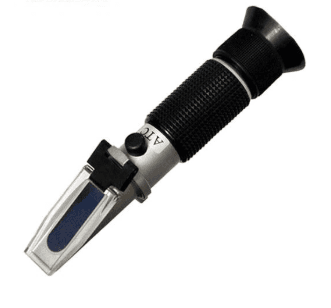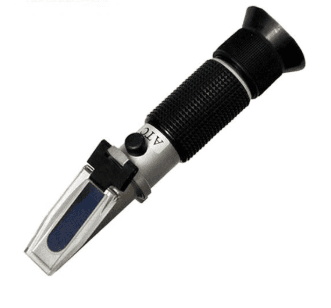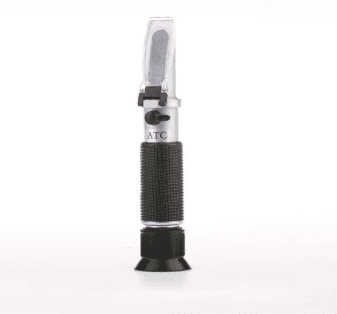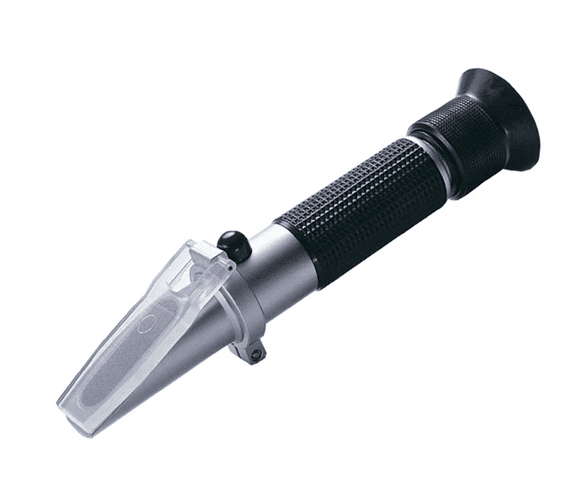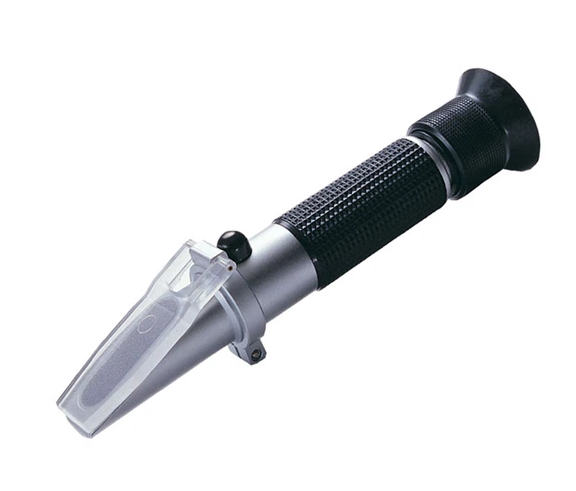
Brix Sugar Refractometer
Handheld optical refractometer measuring 0-90% Brix for sugar concentration analysis in food and beverage applications.

Louise Corscadden, PhD
Director of Science · ConductScience
Ask Louise about Brix Sugar Refractometer fit, setup, configuration, or quote prep.
Already working with us? Sign in to connect this with My Scientist.
Key Specifications
Full details →- Model fit
- Configured during quote
- SKU family
- CS-LH-T90
- Shipping box
- 20.0 x 10.0 x 5.0 cm
- Ordering
- Online checkout and quote request available
- Category
- Refractometers
- Build notes
- Confirm accessories, station layout, and support needs before purchase
The Brix Sugar Refractometer (CS-LH-T90) is a handheld optical instrument designed for measuring sugar concentrations in aqueous solutions using refractive index principles. This refractometer provides a measurement range of 0-90% Brix, making it suitable for analyzing sugar content across a wide spectrum of food and beverage samples including fruit juices, soft drinks, wine, honey, and other sugar-containing solutions.
The instrument operates through optical refractometry, where the refractive index of a sample correlates directly with its sugar concentration. The CS-LH-T90 enables rapid, non-destructive analysis requiring only a few drops of sample, making it valuable for quality control applications in food science laboratories, beverage production facilities, and agricultural research settings where sugar content monitoring is critical for product specification and process control.
How It Works
The refractometer operates on Snell's law of refraction, where light passing through a sample undergoes directional change proportional to the sample's refractive index. When a sugar solution is placed on the daylight plate, light enters the sample at a critical angle and creates a distinct boundary line visible through the eyepiece. The position of this boundary line corresponds directly to the refractive index of the solution.
Sugar molecules in aqueous solution increase the solution's optical density, causing greater light refraction compared to pure water. The instrument's prism system and scale are calibrated to convert refractive index measurements directly to Brix units, where 1° Brix equals 1 gram of sucrose per 100 grams of solution. Temperature compensation may be incorporated to account for thermal effects on refractive index measurements.
Sample analysis requires placement of 2-3 drops on the daylight plate, closure of the cover plate, and visual reading of the boundary line position against the graduated scale visible through the eyepiece. The measurement process is rapid, typically completed within 30 seconds of sample application.
Features & Benefits
Model
- LH-T90
Scope of use
- Model.No.
Brix
- LH-T10
LH-T20
- 0-20%
LH-T32
- 0-32%
LH-T50
- 0-50%
LH-T62
- 28-62%
LH-T80
- 0-80%
LH-T82
- 45-82%
LH-T90
- 0-90%
LH-T20S
- 0-20%
LH-T32S
- 0-32%
Automation Level
- manual
Brand
- ConductScience
Research Domain
- Analytical Chemistry
- Environmental Monitoring
- Food Science
- Industrial Hygiene
- Materials Science
- Pharmaceutical QC
Shipping weight
- 0.26 lb
Shipping box
- L: 20.0 cm
- W: 10.0 cm
- H: 5.0 cm
| Feature | This Product | Typical Alternative | Advantage |
|---|---|---|---|
| Brix Measurement Range | 0-90% Brix coverage | Entry-level models often limited to 0-32% or 0-50% ranges | Wide range accommodates diverse sample types from dilute beverages to concentrated honey without requiring multiple instruments |
| Reading Method | Direct visual scale reading | Digital displays common in higher-end models | Visual reading eliminates battery requirements and provides immediate results without electronic processing delays |
| Portability | Handheld optical design | Benchtop models require fixed laboratory setup | Enables field measurements and multi-location analysis without power requirements or complex installation |
| Sample Volume | 2-3 drops required | Some instruments require larger sample volumes | Minimal sample consumption preserves valuable materials and enables analysis of limited-quantity samples |
| Maintenance Requirements | Optical system with manual calibration | Digital models may require sensor replacement or electronic calibration | Simple optical design reduces long-term maintenance costs and eliminates electronic component failure risks |
The CS-LH-T90 provides comprehensive 0-90% Brix measurement capability in a portable, battery-free design suitable for both laboratory and field applications. The visual reading system offers immediate results with minimal sample requirements, making it valuable for routine quality control and research applications requiring reliable sugar concentration analysis.
Practical Tips
Perform zero calibration with distilled water at the beginning of each measurement session and verify with known sugar standards periodically.
Why: Consistent calibration ensures measurement accuracy and accounts for any optical component drift over time.
Store the refractometer in a protective case and avoid exposing optical surfaces to abrasive materials or harsh chemicals.
Why: Optical components are sensitive to scratches and chemical damage that can permanently affect measurement accuracy.
Allow samples to equilibrate to room temperature before measurement and ensure complete coverage of the daylight plate without air bubbles.
Why: Temperature variations and air bubbles can create refractive index inconsistencies that affect measurement precision.
If the boundary line appears fuzzy or indistinct, clean the optical surfaces and check sample clarity for suspended particles.
Why: Optical contamination or sample turbidity can obscure the critical angle boundary needed for accurate refractive index measurement.
Take multiple readings of the same sample and average the results to improve measurement reliability.
Why: Multiple measurements help identify and minimize reading variability caused by technique differences or sample non-uniformity.
Clean sample contact surfaces thoroughly when switching between different sample types, especially when analyzing potentially hazardous materials.
Why: Cross-contamination can create safety risks and affect measurement accuracy in subsequent analyses.
Document environmental conditions during measurements, particularly temperature and humidity, for quality assurance records.
Why: Environmental factors can influence refractive index measurements and documentation supports data traceability requirements.
Use certified reference standards in addition to distilled water calibration to verify measurement accuracy across the working range.
Why: Reference standards provide verification that the instrument maintains accuracy throughout its measurement span, not just at the zero point.
Setup Guide
What’s in the Box
- CS-LH-T90 Brix refractometer main unit (typical)
- Calibration adjustment tool (typical)
- Cleaning cloth (typical)
- User manual and operation guide (typical)
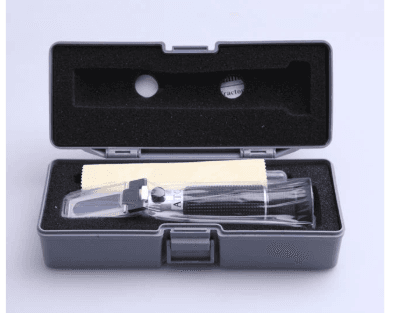
- Protective carrying case (typical)
Warranty
ConductScience provides standard manufacturer warranty coverage including technical support for calibration and operational guidance. Warranty terms typically include repair or replacement for manufacturing defects under normal laboratory use conditions.
Compliance
What is the measurement precision of the CS-LH-T90 across its 0-90% Brix range?
Consult product datasheet for specific precision specifications. Measurement accuracy depends on proper calibration, sample temperature stability, and consistent reading technique.
Does the refractometer include automatic temperature compensation?
Consult product specifications to determine if ATC is incorporated. Manual temperature correction may be required for samples measured at temperatures significantly different from calibration conditions.
What sample types can interfere with Brix measurements?
Samples containing suspended particles, alcohol, or non-sugar dissolved solids may affect refractive index readings. Filtration and understanding of sample composition are important for accurate sugar content determination.
How frequently should the instrument be calibrated?
Daily calibration with distilled water is recommended for consistent results. Additional calibration checks should be performed when switching between significantly different sample types or after extended use periods.
Can the refractometer measure other dissolved solids besides sugar?
The Brix scale is calibrated specifically for sucrose solutions. While other dissolved solids affect refractive index, the readings would not accurately represent their concentrations using the Brix scale.
What is the minimum sample volume required for measurement?
Measurements require 2-3 drops of sample to completely cover the daylight plate. This small volume requirement makes the instrument suitable for analyzing precious or limited samples.
How does ambient light affect measurement accuracy?
Adequate lighting is essential for clear boundary line visualization. Consistent light conditions improve reading reproducibility, and some models may include built-in illumination for standardized viewing conditions.
What cleaning procedures are required between different samples?
Rinse daylight plate and cover plate with distilled water and dry with lint-free cloth between samples to prevent cross-contamination and ensure accurate readings.
Have a question about this product?
Have a question? Just ask.
Send it over and we'll email you a personalized answer — no call, no scheduling.
Prefer to talk it through?