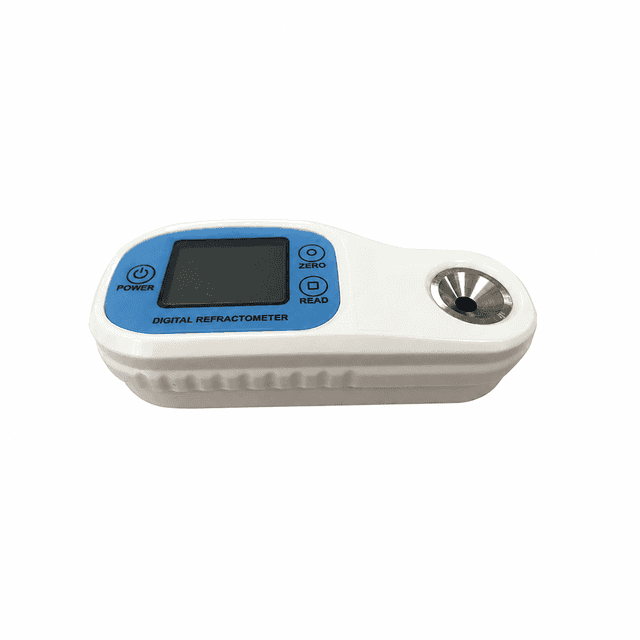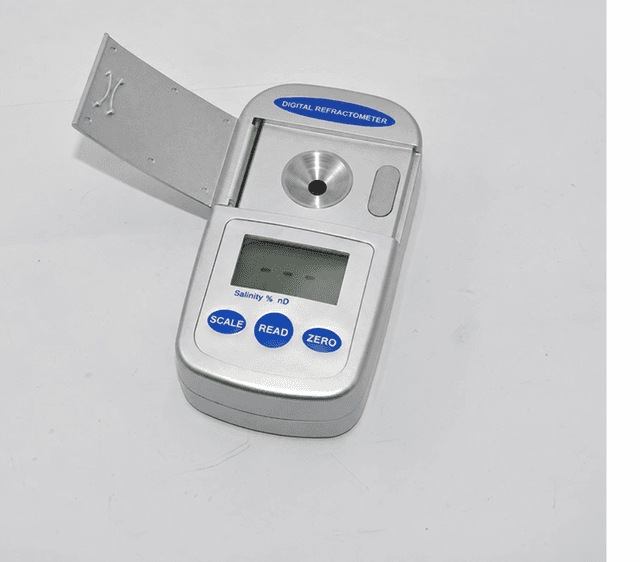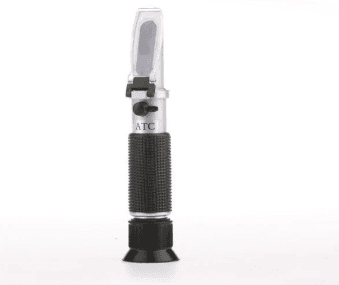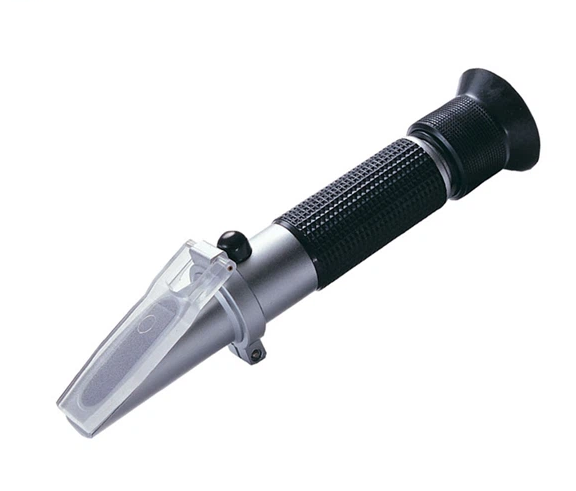
Portable Refractometer BK-PR series
Portable optical refractometer series for Brix measurement with multiple concentration ranges from 0-5% to 58-92%, featuring 0.1% resolution and compact handheld design.

Louise Corscadden, PhD
Director of Science · ConductScience
Ask Louise about Portable Refractometer BK-PR series fit, setup, configuration, or quote prep.
Already working with us? Sign in to connect this with My Scientist.
Key Specifications
Full details →- Model fit
- Configured during quote
- SKU family
- BIO-0471
- Shipping box
- 7.87 x 3.74 x 3.15 cm
- Ordering
- Online checkout and quote request available
- Category
- Refractometers
- Build notes
- Confirm accessories, station layout, and support needs before purchase
The Portable Refractometer BK-PR series provides accurate Brix measurements for solution concentration analysis across research and industrial applications. This handheld optical instrument utilizes refractive index principles to determine dissolved solids content in aqueous solutions, with multiple model variants covering measurement ranges from 0-5% to 58-92% Brix depending on specific analytical requirements.
The compact design (200×95×80mm, 0.35kg) enables field measurements and laboratory use where space constraints or portability are considerations. Each model in the BK-PR series targets specific concentration ranges with 0.1% minimum scale resolution, supporting applications requiring rapid, non-destructive concentration assessment of sugar solutions, industrial process fluids, and research samples.
How It Works
Refractometry measures the refractive index of a solution, which correlates directly with dissolved solids concentration. When light passes through the sample at the prism interface, the critical angle of total internal reflection shifts proportionally to the solution's refractive index. This optical phenomenon follows Snell's law, where the refractive index varies with solute concentration in a predictable relationship.
The instrument contains a daylight plate that provides uniform illumination and an optical system that creates a sharp boundary line on the scale. The user observes this boundary through the eyepiece and reads the corresponding Brix value directly from the calibrated scale. Temperature compensation may be required for accurate measurements, as refractive index changes with temperature variations.
Each BK-PR model variant is optimized for specific concentration ranges, allowing researchers to select the appropriate measurement window for their applications. The 0.1% minimum scale resolution provides sufficient precision for most analytical protocols requiring rapid concentration assessment.
Features & Benefits
Automation Level
- manual
Minimum Scale
- Package Size(W*D*H)
Brix
- BK-PR5
0~5%
- 0.1%
200*95*80mm
- 0.35kg
BK-PR10
- 0~10%
BK-PR18
- 0~18%
BK-PR20
- 0~20%
BK-PR32
- 0~32%
BK-PR50
- 0~50%
BK-PR60
- 0~60%
BK-PR62
- 28~62%
BK-PR82
- 45~82%
BK-PR92
- 58~92%
BK-PR80
- 0~80%(1 ranges)
Brand
- ConductScience
Research Domain
- Analytical Chemistry
- Environmental Monitoring
- Food Science
- Industrial Hygiene
- Materials Science
- Pharmaceutical QC
Shipping weight
- 0.77 lb
Shipping box
- L: 7.87 cm
- W: 3.74 cm
- H: 3.15 cm
| Feature | This Product | Typical Alternative | Advantage |
|---|---|---|---|
| Measurement Range Options | Eleven model variants from 0-5% to 58-92% Brix | Entry-level models often offer single fixed ranges or fewer range options | Allows researchers to select optimal measurement window for their specific application requirements |
| Scale Resolution | 0.1% minimum scale across all models | Basic refractometers may offer 0.2-0.5% resolution | Provides consistent precision for quality control protocols requiring accurate concentration differentiation |
| Instrument Weight | 0.35kg lightweight construction | Varies by model, with some laboratory units being heavier | Supports extended field use and reduces operator fatigue during multiple measurements |
| Power Requirements | No electrical power needed | Digital models require batteries or AC power | Enables continuous operation in field conditions without power infrastructure concerns |
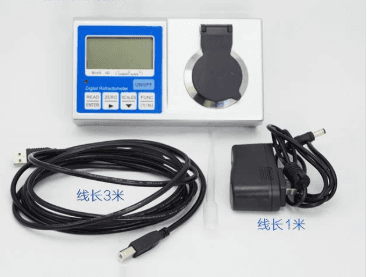
| Measurement Principle | Optical boundary line reading | Digital models provide numeric displays | Offers simple, reliable operation without electronic components that may require maintenance or calibration |
The BK-PR series offers comprehensive range coverage through eleven model variants with consistent 0.1% resolution across all measurement ranges. The lightweight, power-independent design supports both laboratory and field applications where electrical power may not be available.
Practical Tips
Calibrate using distilled water at the same temperature as your samples to minimize temperature-related measurement errors.
Why: Temperature differences between calibration and measurement conditions introduce systematic errors in refractive index readings.
Clean the prism surface immediately after each measurement session to prevent sample residue buildup that could affect optical clarity.
Why: Dried sample residues scatter light and create false boundary lines that compromise measurement accuracy.
Allow samples to equilibrate to room temperature before measurement, or apply appropriate temperature correction factors.
Why: Refractive index varies significantly with temperature, and thermal equilibration ensures consistent measurement conditions.
Take multiple readings of each sample and average the results to improve measurement precision.
Why: Optical boundary line interpretation introduces small operator variations that averaging can minimize.
If the boundary line appears fuzzy or indistinct, ensure complete prism coverage with sample and check for air bubbles.
Why: Incomplete sample coverage or trapped air creates optical discontinuities that interfere with accurate boundary line positioning.
Wear appropriate personal protective equipment when handling unknown samples or potentially hazardous solutions.
Why: Direct sample contact with the prism surface requires safe handling procedures to prevent exposure to harmful substances.
Record the measurement temperature alongside Brix readings for comprehensive data documentation.
Why: Temperature documentation enables post-measurement corrections and supports data quality assurance protocols.
Setup Guide
What’s in the Box
- Portable refractometer (model-specific)
- Calibration screwdriver (typical)
- Protective carrying case (typical)
- Cleaning cloth (typical)
- User manual with operation instructions (typical)
- Calibration solution samples (typical)
Warranty
ConductScience provides standard one-year manufacturer warranty covering defects in materials and workmanship. Technical support includes calibration guidance and troubleshooting assistance for optimal measurement performance.
Compliance
What is the accuracy and repeatability of Brix measurements across the different model ranges?
All BK-PR models provide 0.1% minimum scale resolution. Consult product datasheet for specific accuracy specifications and temperature coefficients for each measurement range variant.
How do I select the appropriate model for my concentration analysis requirements?
Choose the model whose measurement range encompasses your expected sample concentrations. For example, use BK-PR10 for 0-10% solutions or BK-PR62 for higher concentration samples in the 28-62% range.
What temperature compensation is required for accurate measurements?
Temperature affects refractive index measurements. Calibrate at your working temperature or apply correction factors based on the temperature difference from calibration conditions. Consult product datasheet for temperature coefficients.
What sample volume is required for each measurement?
Typically 2-3 drops of sample solution are sufficient to cover the prism surface completely. The small sample requirement conserves valuable research materials.
How frequently should the instrument be calibrated?
Calibrate daily or before each measurement session using distilled water at 0% Brix. Recalibrate if the instrument experiences temperature changes or mechanical impacts.
What maintenance is required to maintain measurement accuracy?
Clean the prism surface with distilled water and lint-free tissue between samples. Avoid abrasive cleaning materials that could scratch the optical surfaces. Store in protective case when not in use.
Can the instrument measure non-aqueous solutions or other refractive index scales?
The BK-PR series is calibrated specifically for Brix measurements in aqueous solutions. For other scales or solvent systems, consult product datasheet or consider alternative refractometer models.
What are the limitations compared to digital refractometers?
Manual optical reading requires user interpretation of the boundary line position, while digital models provide numerical displays. However, optical refractometers offer simplicity, no power requirements, and lower cost.
Have a question about this product?
Have a question? Just ask.
Send it over and we'll email you a personalized answer — no call, no scheduling.
Prefer to talk it through?
Accessories
Enhance your setup with compatible accessories