Salinity Refractometer
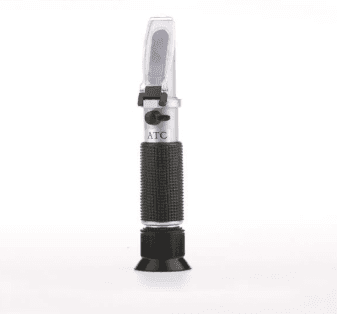
Handheld salinity refractometer with dual specific gravity and parts per thousand scales, featuring automatic temperature compensation for aquatic research applications.

Louise Corscadden, PhD
Director of Science · ConductScience
Ask Louise about Salinity Refractometer fit, setup, configuration, or quote prep.
Already working with us? Sign in to connect this with My Scientist.
Key Specifications
Full details →- Model fit
- Configured during quote
- SKU family
- CS-LH-Y28
- Shipping box
- 20.0 x 10.0 x 5.0 cm
- Ordering
- Online checkout and quote request available
- Category
- Refractometers
- Build notes
- Confirm accessories, station layout, and support needs before purchase
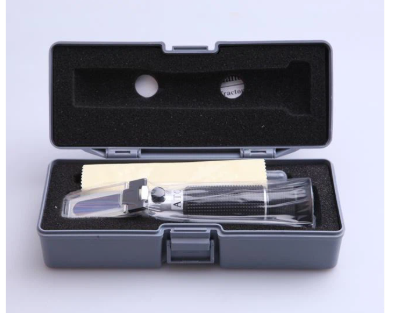
The Salinity Refractometer (Model LH-Y28) is a handheld optical instrument designed for precise measurement of solution salinity through refractive index determination. This dual-scale refractometer provides readings in both specific gravity and parts per thousand (‰), making it suitable for aquatic research and environmental monitoring applications.
The instrument features automatic temperature compensation (ATC) across 10°C to 30°C, eliminating the need for manual temperature correction charts. The high-contrast white-on-blue display enhances readability in laboratory and field conditions, while the included protective carrying case supports portable use in diverse research environments.
How It Works
Refractometric salinity measurement relies on the principle that dissolved salts alter the refractive index of water in a predictable manner. When light passes from one medium to another with different optical densities, it bends according to Snell's law. The degree of bending (refraction) is proportional to the concentration of dissolved solutes.
The instrument directs light through a small sample volume on a daylight plate prism. The refracted light creates a distinct boundary line visible through the eyepiece, which moves along calibrated scales corresponding to salinity values. The dual-scale design provides simultaneous readings in specific gravity (density relative to pure water) and parts per thousand (mass concentration), allowing direct comparison with different measurement conventions.
Automatic temperature compensation adjusts readings based on ambient temperature, accounting for thermal effects on both sample density and optical properties. This eliminates systematic errors that would otherwise require manual correction using temperature-salinity lookup tables.
Features & Benefits
Model
- LH-Y28
Scope of use
- Model.No.
LH-Y28S
- 0-28%
Automation Level
- manual
Brand
- ConductScience
Research Domain
- Analytical Chemistry
- Environmental Monitoring
- Materials Science
Shipping weight
- 0.26 lb
Shipping box
- L: 20.0 cm
- W: 10.0 cm
- H: 5.0 cm
| Feature | This Product | Typical Alternative | Advantage |
|---|---|---|---|
| Temperature Compensation | Automatic temperature compensation from 10-30°C | Manual compensation or limited ATC range in entry-level models | Reduces measurement errors and eliminates need for temperature correction calculations in standard laboratory conditions. |
| Scale Display | Dual-scale display with specific gravity and parts per thousand | Single-scale readouts requiring unit conversions | Eliminates conversion errors and accommodates different reporting requirements in research protocols. |
| Optical Design | High-contrast white-on-blue display | Standard contrast displays with varying visibility | Improves measurement accuracy by enhancing boundary line visibility and reducing operator eye strain. |
| Portability | Handheld design with protective carrying case | Benchtop models with limited mobility | Enables field measurements and point-of-use testing without laboratory infrastructure requirements. |
| Measurement Range | 0-28% salinity range | Varies by model and application focus | Covers typical seawater and aquarium salinity ranges for marine research applications. |
This refractometer combines automatic temperature compensation with dual-scale display in a portable design, providing measurement flexibility and accuracy for aquatic research applications. The high-contrast optical system and protective case design support both laboratory and field use environments.
Practical Tips
Perform zero calibration with distilled water at the same temperature as your samples to minimize thermal effects on accuracy.
Why: Temperature differences between calibration and measurement can introduce systematic errors even with ATC function.
Clean the prism surface immediately after each use with distilled water followed by gentle drying with a lint-free cloth.
Why: Salt crystal formation or residue buildup can affect optical clarity and measurement accuracy.
Allow samples to equilibrate to ambient temperature for 2-3 minutes before measurement to ensure ATC effectiveness.
Why: Temperature gradients within the sample can cause measurement instability and reduce precision.
Take multiple readings from the same sample and average the results to improve measurement precision.
Why: Operator variability in boundary line reading can be reduced through statistical averaging of replicate measurements.
If the boundary line appears fuzzy or indistinct, adjust the eyepiece focus and ensure the prism surface is completely covered with sample.
Why: Poor optical contrast reduces measurement accuracy and can lead to reading errors.
Handle the instrument carefully to avoid dropping or impacts that could misalign the optical system.
Why: Optical misalignment can cause permanent calibration drift that cannot be corrected through zero adjustment alone.
Store the refractometer in its protective case when not in use, avoiding extreme temperatures or humid conditions.
Why: Thermal cycling and moisture can affect optical component alignment and internal calibration stability.
Verify calibration periodically using certified reference standards in addition to distilled water zero checks.
Why: Zero calibration alone does not detect span errors or nonlinearity that can develop in the measurement range.
Setup Guide
What’s in the Box
- Salinity refractometer (main unit)
- Soft-sided carrying case
- Calibration adjustment tool (typical)
- Cleaning cloth (typical)
- User manual with operating instructions (typical)
Warranty
ConductScience provides a standard one-year manufacturer warranty covering defects in materials and workmanship, with technical support available for calibration and operational questions.
Compliance
References
Background reading relevant to this product:
What is the measurement accuracy and resolution of this refractometer?
Specific accuracy and resolution specifications should be consulted in the product datasheet. Typical handheld refractometers provide resolution of 0.1-0.2% salinity with accuracy dependent on calibration and temperature stability.
How often does the instrument require calibration?
Zero calibration with distilled water should be performed daily or before each measurement session. More comprehensive calibration with certified reference standards is recommended monthly or as specified in laboratory QC protocols.
Can this refractometer measure samples other than seawater?
Yes, the instrument can measure any aqueous solution within its salinity range. However, the scale calibration assumes NaCl-equivalent salinity, so solutions with different ionic compositions may require conversion factors.
What sample volume is required for measurement?
Approximately 2-3 drops of sample solution are sufficient to cover the prism surface. This minimal volume requirement makes it suitable for precious or limited samples.
How does temperature affect measurements outside the ATC range?
For measurements outside 10-30°C, manual temperature corrections are required using supplier-provided temperature coefficient tables. Sample and instrument should be equilibrated to the same temperature.
Is this instrument suitable for continuous monitoring applications?
No, this is a handheld instrument designed for discrete measurements. Continuous monitoring would require automated flow-through refractometer systems with electronic data logging capabilities.
What maintenance is required for optimal performance?
Regular cleaning of optical surfaces with distilled water and soft cloth, periodic calibration verification, and proper storage in the protective case to prevent optical damage or contamination.
Have a question about this product?
Have a question? Just ask.
Send it over and we'll email you a personalized answer — no call, no scheduling.
Prefer to talk it through?
Accessories
Enhance your setup with compatible accessories