Droplet Encapsulation PDMS Chip
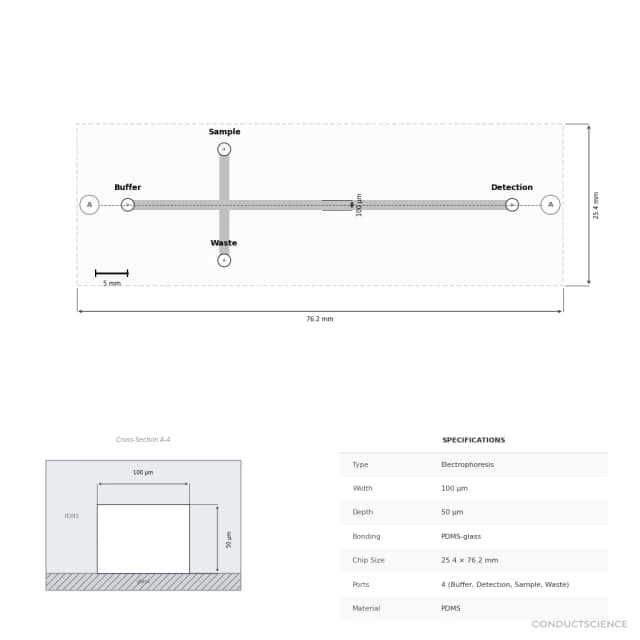
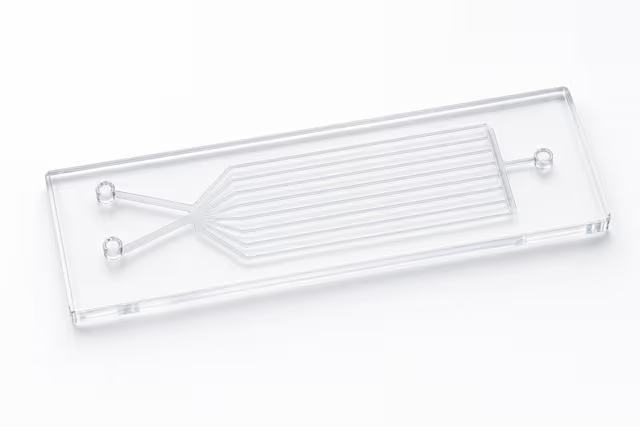
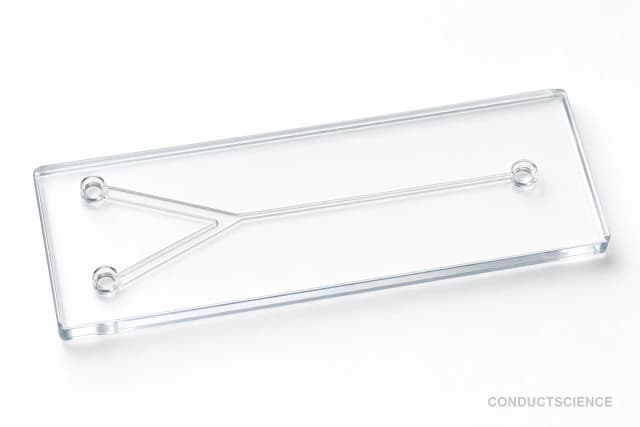
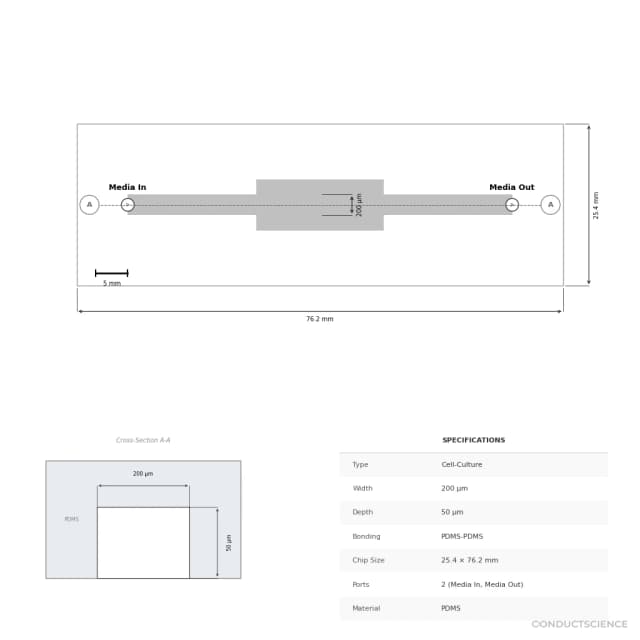
PDMS microfluidic chip with 100 x 100 μm channels for controlled droplet formation and encapsulation of cells, beads, and reagents in single-cell analysis workflows.
Reusable chip — designed for multiple experimental runs. Compatible with standard microfluidic tubing: steel pins (0.7 mm ID / 1.0 mm OD) and silicone tubing (0.8 mm ID / 1.9 mm OD). Available in bulk packs (5‑, 10‑, and 25‑unit) for lab-scale and consumable workflows.

Louise Corscadden, PhD
Director of Science · ConductScience
Ask Louise about Droplet Encapsulation PDMS Chip fit, setup, configuration, or quote prep.
Already working with us? Sign in to connect this with My Scientist.
Key Specifications
Full details →- Model fit
- 3 selectable configurations
- SKU family
- WHM-0090
- Shipping box
- 181.8 x 136.3 x 90.9 cm
- Ordering
- Online checkout and quote request available
- Category
- Droplet Generator Chips
- Build notes
- Confirm accessories, station layout, and support needs before purchase
The Droplet Encapsulation PDMS Chip enables precise formation and encapsulation of aqueous droplets in oil-continuous phases through microfluidic flow focusing. Fabricated from polydimethylsiloxane (PDMS) with 100 x 100 μm channel dimensions, this chip provides controlled droplet generation for single-cell analysis, bead loading, and reagent compartmentalization applications.
The device combines droplet formation and encapsulation capabilities in a single microfluidic platform, allowing researchers to create monodisperse droplets containing cells, beads, or reagents. The PDMS construction ensures optical clarity for real-time monitoring while maintaining biocompatibility for cell-based experiments. Channel geometry facilitates consistent droplet size and encapsulation efficiency across experimental runs.
How It Works
The chip operates on flow-focusing principles where aqueous sample streams intersect with immiscible carrier oil at a junction geometry. Shear forces at the interface between phases create droplet breakoff, with droplet size controlled by flow rate ratios and channel dimensions. The 100 x 100 μm channels provide sufficient space for cell passage while maintaining droplet uniformity.
PDMS fabrication enables precise channel molding and surface treatment for controlled wetting properties. The material's flexibility allows reversible bonding to glass substrates while maintaining fluidic integrity under typical operating pressures. Droplet formation occurs when the dispersed phase flow rate is overcome by interfacial tension forces, creating discrete compartments containing encapsulated material.
Encapsulation efficiency depends on sample concentration, flow dynamics, and channel geometry. The device design accommodates various aqueous samples including cell suspensions, bead solutions, and reagent mixtures, with droplet volumes typically in the picoliter to nanoliter range based on operating conditions.
Features & Benefits
Shipping weight
- 3.3 lb
Shipping box
- L: 181.8 cm
- W: 136.3 cm
- H: 90.9 cm
| Feature | This Product | Typical Alternative | Advantage |
|---|---|---|---|
| Channel Dimensions | 100 x 100 μm channels | Entry-level chips often feature larger channels (150-300 μm) with lower precision | Smaller channels enable better size control and reduce reagent consumption per droplet. |
| Material Construction | PDMS fabrication | Glass or thermoplastic alternatives require specialized bonding | PDMS provides easier handling and reversible bonding for prototyping applications. |
| Application Range | Cell encapsulation and bead loading | Single-purpose devices focus on either cells or beads exclusively | Dual functionality reduces need for multiple chip designs in mixed workflows. |
| Formation Mechanism | Droplet formation plus encapsulation | Basic flow-focusing devices lack integrated encapsulation features | Integrated design eliminates post-formation processing steps and reduces sample loss. |
This chip combines precise 100 x 100 μm channel geometry with dual-function droplet formation and encapsulation capabilities in biocompatible PDMS construction. The integrated design supports both cell and bead applications in a single platform, providing experimental flexibility compared to single-purpose alternatives.
| Model | SKU | Listed price | Status | Shipping box |
|---|---|---|---|---|
| 25-Pack | WHM-0090-25PK | Quote | Available | 181.8 x 136.3 x 90.9 cm |
| 10-Pack | WHM-0090-10PK | $1,490.00 | Available | 181.8 x 136.3 x 90.9 cm |
| 5-Pack | WHM-0090-5PK | Quote | Available | 181.8 x 136.3 x 90.9 cm |
Practical Tips
Pre-condition channels with surfactant solution before sample introduction to improve wetting and droplet uniformity.
Why: Surface treatment reduces channel fouling and ensures consistent droplet formation throughout experiments.
Establish flow rate calibration curves for your pump system using droplet size measurements at various settings.
Why: Pump accuracy varies between models, and calibration ensures reproducible droplet dimensions across experiments.
Flush channels immediately after use with appropriate cleaning solutions to prevent protein or cell adhesion.
Why: Rapid cleaning prevents channel blockage and maintains chip reusability for multiple experimental runs.
If droplet formation becomes irregular, check for air bubbles in inlet lines and re-prime the system.
Why: Air bubbles disrupt flow stability and cause inconsistent droplet sizes or formation failure.
Record ambient temperature and humidity as these affect oil viscosity and can influence droplet formation dynamics.
Why: Environmental conditions impact fluid properties and droplet size reproducibility between experimental sessions.
Use appropriate chemical-resistant gloves when handling fluorinated oils, as they can penetrate standard nitrile gloves.
Why: Fluorinated carrier fluids require specialized PPE to prevent skin exposure during chip operation and cleaning.
Filter cell suspensions through 40 μm strainers before loading to prevent channel clogging with cell aggregates.
Why: Pre-filtration removes debris and clumps that could block the 100 μm channels during operation.
Setup Guide
What’s in the Box
- Droplet Encapsulation PDMS Chip
- Product documentation
- Quality control certificate (typical)
Warranty
ConductScience provides standard warranty coverage for manufacturing defects with technical support for microfluidic applications. Extended support available for protocol optimization and troubleshooting.
Compliance
References
Background reading relevant to this product:
What droplet sizes can be achieved with this chip?
Droplet diameter typically ranges from 20-200 μm depending on flow rate ratios and fluid properties. Oil-to-sample ratios of 5:1 to 20:1 provide good size control within channel constraints.
How many cells can be encapsulated per droplet?
Single-cell encapsulation requires sample dilution to achieve Poisson distribution with <0.1 cells per droplet average. Higher concentrations enable multi-cell encapsulation when desired.
What oils are compatible with this PDMS chip?
Fluorinated oils, mineral oils, and silicone oils work well. Avoid organic solvents that swell PDMS such as toluene, chloroform, or strong alcohols which can damage channels.
Can the chip be reused for multiple experiments?
Yes, with proper cleaning protocols. Flush channels with surfactant solutions followed by appropriate solvents to remove residual oil and biological material between uses.
What microscopy setup is needed for droplet monitoring?
Standard inverted microscope with 10-40x objectives sufficient for droplet observation. High-speed cameras useful for formation dynamics studies at kilohertz rates.
How stable are the generated droplets?
Droplet stability depends on surfactant choice and storage conditions. Properly formulated systems maintain integrity for hours to days at 4°C storage.
What flow rates are recommended for cell encapsulation?
Start with oil flows of 50-200 μL/hr and sample flows of 5-20 μL/hr. Adjust ratios to optimize droplet size while maintaining cell viability through shear minimization.
Have a question about this product?
Have a question? Just ask.
Send it over and we'll email you a personalized answer — no call, no scheduling.
Prefer to talk it through?