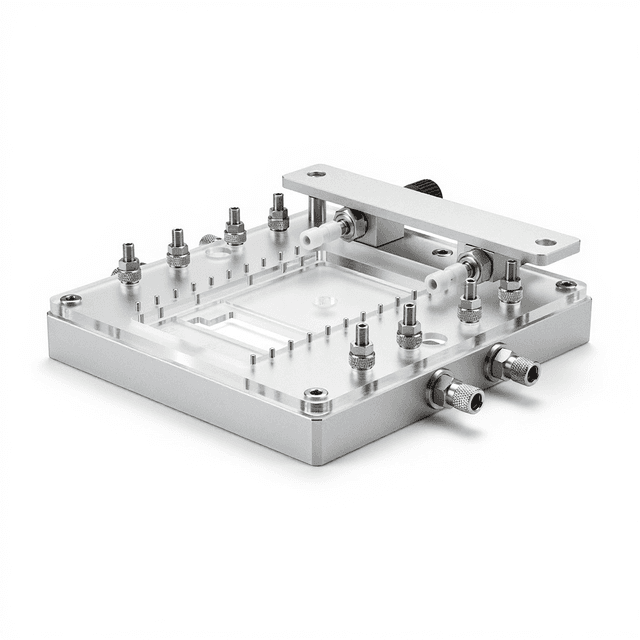
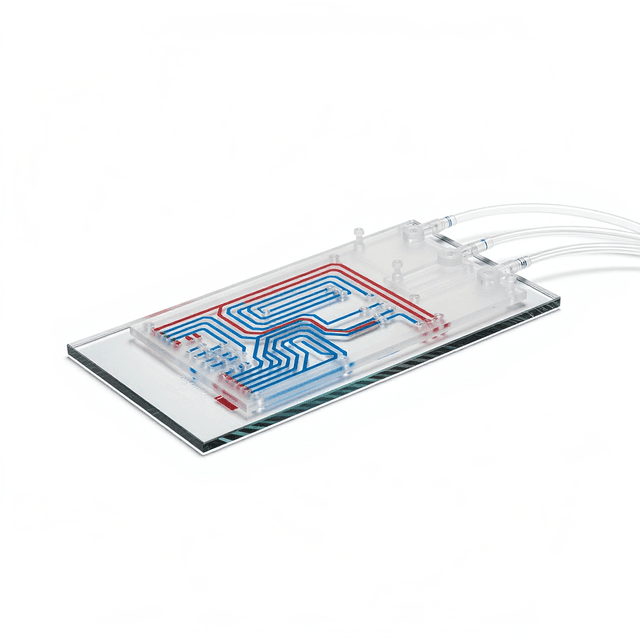
Microfluidic Nanoparticle Synthesis Chip
Microfluidic chip with 100 μm channel depth for controlled nanoparticle synthesis with precise flow control and reproducible particle formation.
Reusable chip — designed for multiple experimental runs. Compatible with standard microfluidic tubing: steel pins (0.7 mm ID / 1.0 mm OD) and silicone tubing (0.8 mm ID / 1.9 mm OD). Available in bulk packs (5‑, 10‑, and 25‑unit) for lab-scale and consumable workflows.

Louise Corscadden, PhD
Director of Science · ConductScience
Ask Louise about Microfluidic Nanoparticle Synthesis Chip fit, setup, configuration, or quote prep.
Already working with us? Sign in to connect this with My Scientist.
Key Specifications
Full details →- Model fit
- 3 selectable configurations
- SKU family
- WHM-0023
- Shipping box
- 25.0 x 15.0 x 3.0 cm
- Ordering
- Online checkout and quote request available
- Category
- Lab Equipment
- Build notes
- Confirm accessories, station layout, and support needs before purchase
The Microfluidic Nanoparticle Synthesis Chip provides researchers with a controlled platform for continuous-flow synthesis of nanoparticles. This chip features 100 μm channel depth optimized for laminar flow conditions and precise mixing control. The compact 25 × 15 × 3 mm form factor integrates into standard microfluidic setups for reproducible nanoparticle production.
The chip enables researchers to control particle size distribution and morphology through manipulation of flow rates, residence times, and mixing ratios. The microfluidic environment provides rapid heat and mass transfer, allowing for precise control over nucleation and growth processes that are difficult to achieve in bulk synthesis methods.
How It Works
The microfluidic chip operates on the principle of controlled mixing in laminar flow conditions. Reactant solutions are introduced through separate inlets and meet at designated mixing zones within the 100 μm deep channels. The high surface-to-volume ratio and short diffusion distances enable rapid mixing and heat transfer, providing precise control over reaction conditions.
Nanoparticle formation occurs through controlled nucleation and growth processes as reactants mix in the flowing stream. The residence time, controlled by flow rates and channel geometry, determines the extent of particle growth. Temperature gradients and concentration profiles can be precisely controlled to influence particle size distribution and morphology.
The continuous-flow design allows for steady-state operation and consistent particle production. Multiple outlet channels can enable size separation or collection of particles at different stages of growth, providing researchers with fine control over the final nanoparticle characteristics.
Features & Benefits
Shipping weight
- 0.03 lb
Shipping box
- L: 25.0 cm
- W: 15.0 cm
- H: 3.0 cm
| Feature | This Product | Typical Alternative | Advantage |
|---|---|---|---|
| Channel Depth Control | 100 μm depth for controlled mixing | Fixed geometries with limited depth options | Optimized depth provides efficient mixing while maintaining manageable pressure requirements for most synthesis protocols. |
| Form Factor | Compact 25 × 15 × 3 mm design | Larger chips requiring specialized holders | Small footprint integrates into standard microfluidic setups without extensive modification of existing systems. |
| Application Focus | Optimized for nanoparticle synthesis | General-purpose mixing chips | Purpose-built design addresses specific requirements of nucleation and growth control in nanoparticle formation. |
| Weight and Handling | Lightweight 0.03 kg design | Heavier integrated systems | Easy positioning and integration into temperature-controlled environments for thermal synthesis studies. |
The chip provides specialized geometry for nanoparticle synthesis applications with precise channel depth control and compact integration. The design balances mixing efficiency with practical pressure requirements for laboratory-scale synthesis protocols.
| Model | SKU | Listed price | Status | Shipping box |
|---|---|---|---|---|
| 25-Pack | WHM-0023-25PK | Quote | Available | 25.0 x 15.0 x 3.0 cm |
| 10-Pack | WHM-0023-10PK | $1,490.00 | Available | 25.0 x 15.0 x 3.0 cm |
| 5-Pack | WHM-0023-5PK | Quote | Available | 25.0 x 15.0 x 3.0 cm |
Practical Tips
Verify flow rates with dye injection before introducing reactants to ensure uniform mixing patterns.
Why: Flow visualization confirms proper channel priming and identifies any blockages or flow irregularities.
Store chips in protective cases and avoid exposure to strong acids or bases that may damage channel surfaces.
Why: Proper storage prevents contamination and maintains channel integrity for reproducible synthesis results.
Start with low concentration reactants to optimize synthesis conditions before scaling to higher concentrations.
Why: Lower concentrations reduce the risk of channel clogging while allowing parameter optimization.
If particles aggregate in channels, reduce reactant concentrations or increase flow rates to minimize residence time.
Why: Shorter residence times prevent excessive growth and aggregation that can lead to channel blockage.
Collect product after achieving steady-state conditions, typically 3-5 residence times after starting synthesis.
Why: Steady-state operation ensures consistent particle characteristics and eliminates transient effects.
Use appropriate chemical-resistant tubing and fittings compatible with your specific reactant chemistry.
Why: Chemical compatibility prevents contamination and ensures safe operation with various synthetic precursors.
Document flow rates, concentrations, and temperature for each synthesis to enable protocol reproduction.
Why: Detailed records are essential for optimizing synthesis conditions and troubleshooting batch variations.
Setup Guide
What’s in the Box
- Microfluidic nanoparticle synthesis chip
- User manual with protocols (typical)
- Protective storage case (typical)
Warranty
ConductScience provides a one-year manufacturer warranty covering defects in materials and workmanship. Technical support is available for setup guidance and troubleshooting applications.
Compliance
References
Background reading relevant to this product:
What flow rate ranges are optimal for this channel depth?
The 100 μm channel depth typically supports flow rates from 1-100 μL/min per inlet, with optimal mixing occurring at Reynolds numbers below 1 for laminar flow conditions.
What types of nanoparticles can be synthesized?
The chip is suitable for aqueous and organic synthesis of metal, semiconductor, polymer, and lipid nanoparticles where controlled mixing and residence time are critical.
How do I prevent channel clogging during synthesis?
Use filtered reactants, avoid supersaturation conditions, and maintain appropriate flow velocities to prevent particle aggregation and deposition on channel walls.
What temperature range is compatible with the chip?
Operating temperature depends on chip material; consult product datasheet for specific temperature limits and thermal expansion considerations.
How do I achieve different particle sizes?
Control particle size by adjusting flow rates (residence time), reactant concentrations, temperature, and mixing ratios between nucleation and growth phases.
What pumping system is recommended?
Syringe pumps provide precise flow control for reproducible synthesis, while pressure-driven systems offer simpler operation for routine production.
How do I clean the chip between syntheses?
Flush channels with appropriate solvents (water, ethanol, or organic solvents) and air dry; sonication may help remove stubborn deposits.
Have a question about this product?
Have a question? Just ask.
Send it over and we'll email you a personalized answer — no call, no scheduling.
Prefer to talk it through?
Replacement Parts & Consumables
Upgrade Options