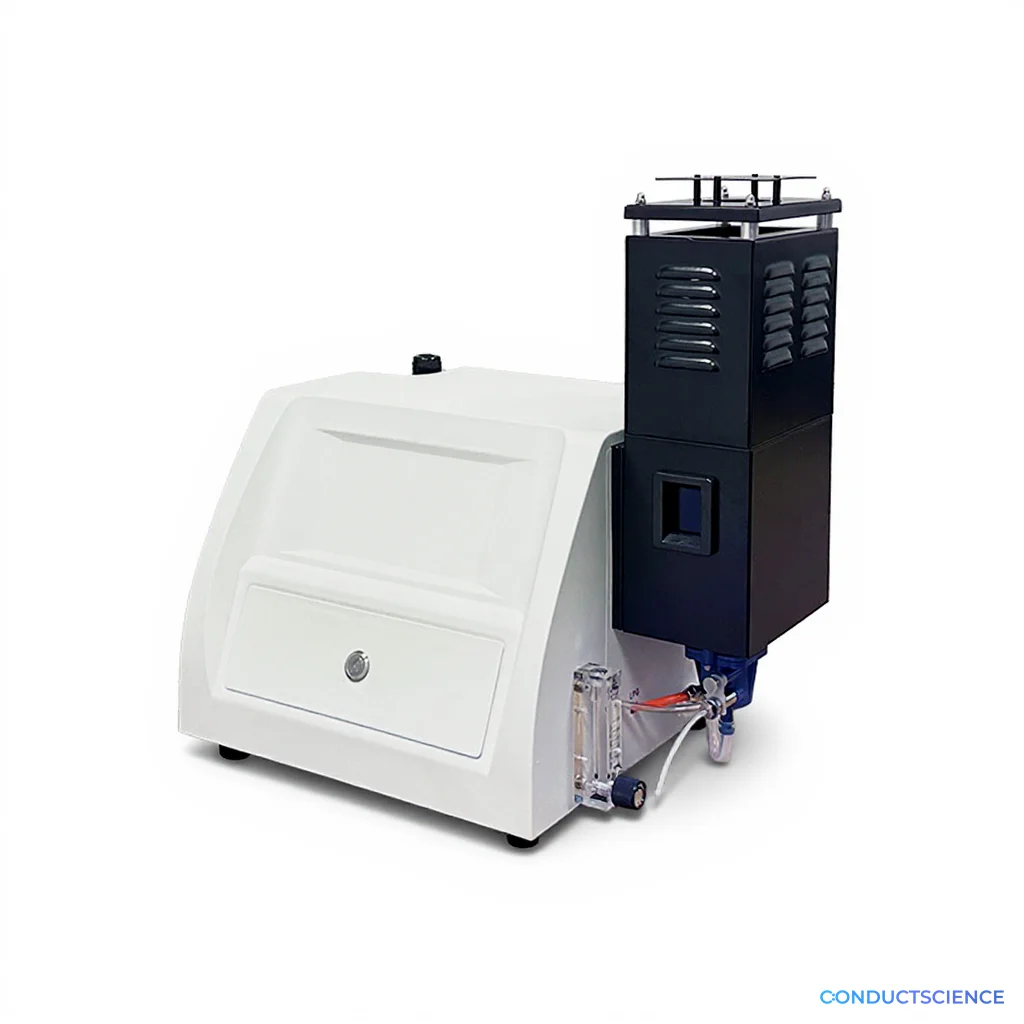
BK-FP Series Flame Photometer / Spectrophotometer
The BK-FP series offers flame-based elemental analysis in two precision tiers.
The Flame Photometer (B-suffix models) measures K, Na, Li, Ca, or Ba in 2–4 channel configurations from $4,790. The Flame Spectrophotometer provides tighter reproducibility (≤2%) and lower sample uptake (<3 mL/min) across 1–5 channel models from $5,390. Both share LPG fuel, 7-inch touchscreen, one-touch ignition, and gas-leak safety shutoff.

Louise Corscadden, PhD
Director of Science · ConductScience
Ask Louise about BK-FP Series Flame Photometer / Spectrophotometer fit, setup, configuration, or quote prep.
Already working with us? Sign in to connect this with My Scientist.
Key Specifications
Full details →- Model fit
- 11 selectable configurations
- SKU family
- BIO-0396
- Sizing
- 42.5 x 31.0 x 43.7 cm
- Ordering
- Online checkout and quote request available
- Category
- Imaging & Analysis
- Build notes
- Confirm accessories, station layout, and support needs before purchase
The BK-FP series uses flame emission spectroscopy — thermal energy from an LPG flame excites alkali and alkaline-earth elements to emit characteristic wavelengths, which are detected by dedicated optical filters and photodetectors. Two instrument tiers share the same platform and safety architecture: the Flame Photometer (B-suffix models) for cost-effective multi-element screening, and the Flame Spectrophotometer for higher-precision analytical work. Both feature a 7-inch colour touchscreen, one-touch ignition, gas-leakage alarm with automatic gas cutoff, flame-out detection, and storage for up to 20 calibration curves.
Which Instrument to Choose
| Flame Photometer (B-suffix) | Flame Spectrophotometer | |
|---|---|---|
| Sample Uptake | <4 mL/min | <3 mL/min |
| Reproducibility | ≤3% | ≤2% |
| Stability (15 s) | ≤3% | ≤3% |
| Price Range | $4,790 – $5,790 | $5,390 – $6,490 |
| Best For | Routine screening, high throughput | Regulatory, clinical, research-grade |
Flame Photometer — Models
| Model | Elements | Channels | Price |
|---|---|---|---|
| BK-FP6410B | K / Na | 2 | $4,790 |
| BK-FP6430B | K / Na / Li | 3 | $5,290 |
| BK-FP6431B | K / Na / Ca | 3 | $5,290 |
| BK-FP6432B | K / Na / Ba | 3 | $5,290 |
| BK-FP6440B | K / Na / Li / Ca | 4 | $5,790 |
Flame Photometer — Detection Limits, Linear Error & Test Range
| Element | LOD (ppm) | Linear Error (ppm) | Test Range (ppm) |
|---|---|---|---|
| K | ≤0.156 | ≤0.195 | 0.15–100 |
| Na | ≤0.184 | ≤0.69 | 0.18–100 |
| Li | ≤0.104 | ≤0.146 | 0.1–30 |
| Ca | ≤2.004 | ≤3.006 | 0.1–1,000 |
| Ba | ≤6.043 | ≤9.064 | 0.1–300 |
Flame Photometer — Full Technical Specifications
| Parameter | Specification |
|---|---|
| Response Time | <8 s |
| Sample Uptake | <4 mL/min |
| Stability | ≤3% (15 s); ≤15% (6 min) |
| Reproducibility | ≤3% |
| Display | 7.0-inch colour touchscreen |
| Calibration Curves | Up to 20 stored |
| Communication | USB |
| Fuel | LPG |
| Air Supply | External air compressor |
| Power | 30 W, AC 110/220 V, 50/60 Hz |
| Operating Conditions | 10–35 °C; ≤85% RH |
| External Dimensions (W×D×H) | 425 × 310 × 437 mm |
| Net Weight | 10 kg (unit); 12 kg (packaged); 5.3 kg (air compressor) |
Flame Spectrophotometer — Models
| Model | Elements | Channels | Price |
|---|---|---|---|
| BK-FP640 | K / Na | 1 | $5,390 |
| BK-FP6410 | K / Na | 2 | $5,590 |
| BK-FP6430 | K / Na / Li | 2 | $5,590 |
| BK-FP6431 | K / Na / Ca | 3 | $5,590 |
| BK-FP6440 | K / Na / Li / Ca | 4 | $5,990 |
| BK-FP6450 | K / Na / Li / Ca / Ba | 5 | $6,490 |
Flame Spectrophotometer — Detection Limits per Model
| Model | K (ppm) | Na (ppm) | Li (ppm) | Ca (ppm) | Ba (ppm) |
|---|---|---|---|---|---|
| BK-FP640 | ≤0.195 | ≤0.69 | — | — | — |
| BK-FP6410 | ≤0.195 | ≤0.69 | — | — | — |
| BK-FP6430 | ≤0.195 | ≤0.69 | ≤0.1449 | — | — |
| BK-FP6431 | ≤0.195 | ≤0.69 | — | ≤3 | — |
| BK-FP6440 | ≤0.156 | ≤0.184 | ≤0.1035 | ≤2 | — |
| BK-FP6450 | ≤0.156 | ≤0.184 | ≤0.1035 | ≤2 | ≤6.028 |
Flame Spectrophotometer — Full Technical Specifications
| Parameter | Specification |
|---|---|
| Response Time | 8 s |
| Sample Uptake | <3 mL/min |
| Stability | ≤3% (15 s); ≤15% (6 min) |
| Reproducibility | ≤2% |
| Display | 7-inch colour touch LCD |
| Fuel | LPG |
| Power Supply | AC 110/220 V, 50/60 Hz |
| Package Dimensions | 570 × 530 × 400 mm |
Standard Accessories (both tiers)
- LPG reducing valve
- Stainless steel bellows for LPG
- Silica gel tubing for waste liquid
- PU tubing for air
- Air compressor
Optional Accessories
- FP atomizer
- Built-in thermal printer
- Professional data processing software
Applications
- Agricultural soil and fertiliser analysis
- Cement, ceramics, and silicate industry QC
- Clinical and medical pathological research
- Environmental monitoring and water analysis
- Food and beverage testing
- Battery-grade brine and lithium monitoring
- Geological and geochemical surveys
How It Works
Flame photometry operates on the principle of flame emission spectroscopy, where sample solutions are atomized in a controlled flame environment. The thermal energy of the flame excites metal electrons to higher energy states, and as these electrons return to ground state, they emit characteristic wavelengths of light specific to each element.
The instrument aspirates liquid samples into an air-fuel flame where atomization and excitation occur simultaneously. Emitted light passes through optical filters or monochromators that isolate specific wavelengths corresponding to target elements. Photodetectors measure emission intensity, which correlates directly with elemental concentration following Beer-Lambert principles.
Multi-channel configurations enable simultaneous detection of multiple elements by employing separate optical pathways and detectors for each target wavelength. This parallel analysis approach increases throughput while maintaining measurement precision across the analytical range.
Features & Benefits
Instrument Type
- Flame Photometer
- Flame Spectrophotometer
Model
- BK-FP640
- BK-FP6410
- BK-FP6410B
- BK-FP6430
- BK-FP6430B
- BK-FP6431
- BK-FP6431B
- BK-FP6432B
- BK-FP6440
- BK-FP6440B
- BK-FP6450
Weight
- 10 kg
Dimensions
- L: 42.5 mm
- W: 31.0 mm
- H: 43.7 mm
| Feature | This Product | Typical Alternative | Advantage |
|---|---|---|---|
| Detection Limit for Potassium | ≤0.156 ppm | Entry-level flame photometers often provide detection limits of 0.5-1.0 ppm | Lower detection limits enable analysis of more dilute samples without concentration steps, improving analytical efficiency. |
| Detection Limit for Sodium | ≤0.184 ppm | Basic models typically offer detection limits above 0.3 ppm | Enhanced sensitivity allows quantification in low-concentration biological and environmental matrices. |
| Channel Configuration Options | 2-channel and 3-channel systems with multiple element combinations | Many instruments offer fixed configurations with limited flexibility | Configurable options allow laboratories to optimize analytical capability for specific application requirements. |
| Element Coverage | K, Na, Li, Ca, Ba analysis capability | Basic models often limited to K/Na analysis only | Broader elemental coverage supports diverse analytical requirements without requiring additional instrumentation. |
| Compact Design | 43.7 × 42.5 × 31.0 cm footprint | Larger systems may require more bench space | Space-efficient design maximizes laboratory bench utilization while maintaining analytical performance. |
This flame photometer combines sensitive detection limits with flexible channel configurations for multi-element analysis. The compact design and configurable element combinations provide laboratories with scalable analytical capability for routine metal ion quantification in diverse sample matrices.
| Model | SKU | Listed price | Status | Dimensions |
|---|---|---|---|---|
| BK-FP6450 | BIO-0396-BK-FP6450 | $6,490.00 | Available | 42.5 x 31.0 x 43.7 cm |
| BK-FP6440 | BIO-0396-BK-FP6440 | $5,990.00 | Available | 42.5 x 31.0 x 43.7 cm |
| BK-FP6431 | BIO-0396-BK-FP6431 | $5,590.00 | Available | 42.5 x 31.0 x 43.7 cm |
| BK-FP6430 | BIO-0396-BK-FP6430 | $5,590.00 | Available | 42.5 x 31.0 x 43.7 cm |
| BK-FP6410 | BIO-0396-BK-FP6410 | $5,590.00 | Available | 42.5 x 31.0 x 43.7 cm |
| BK-FP640 | BIO-0396-BK-FP640 | $5,390.00 | Available | 42.5 x 31.0 x 43.7 cm |
| BK-FP6440B | BIO-0396-BK-FP6440B | $5,790.00 | Available | 42.5 x 31.0 x 43.7 cm |
| BK-FP6432B | BIO-0396-BK-FP6432B | $5,290.00 | Available | 42.5 x 31.0 x 43.7 cm |
| BK-FP6431B | BIO-0396-BK-FP6431B | $5,290.00 | Available | 42.5 x 31.0 x 43.7 cm |
| BK-FP6430B | BIO-0396-BK-FP6430B | $5,290.00 | Available | 42.5 x 31.0 x 43.7 cm |
| BK-FP6410B | BIO-0396-BK-FP6410B | $4,790.00 | Available | 42.5 x 31.0 x 43.7 cm |
Practical Tips
Prepare calibration standards using the same acid matrix as your samples to minimize matrix effects and ensure accurate quantification.
Why: Matrix matching eliminates systematic bias that can occur when standards and samples have different chemical environments.
Clean the aspiration system with dilute acid after analyzing high-concentration samples to prevent carryover contamination.
Why: Residual sample matrix can cause positive bias in subsequent analyses and affect detection limit performance.
Allow adequate warm-up time for flame stabilization and verify baseline stability before beginning analytical sequences.
Why: Thermal equilibration ensures consistent atomization efficiency and reduces measurement variability across sample batches.
Check gas pressures and flow rates if flame characteristics appear unstable or emission intensity decreases unexpectedly.
Why: Proper gas flow ratios are critical for maintaining optimal flame temperature and atomization conditions.
Run duplicate analyses and control standards throughout analytical batches to monitor precision and detect systematic drift.
Why: Quality control samples provide real-time assessment of instrument performance and data reliability.
Install appropriate flame safety interlocks and ensure adequate ventilation in the analysis area before operating.
Why: Open flame operation requires proper safety measures to prevent accidents and maintain safe laboratory conditions.
Verify calibration linearity across the full analytical range and investigate non-linear responses that may indicate interference or instrumental issues.
Why: Linear calibration relationships ensure accurate quantification and indicate proper instrument performance.
Optimize aspiration rate to balance sensitivity and sample consumption based on your sample volume constraints.
Why: Proper aspiration rate maximizes analytical signal while conserving precious samples in volume-limited applications.
Setup Guide
What’s in the Box
- Main flame photometer unit
- LPG reducing valve
- Stainless steel bellows for LPG
- Silica gel tubing for waste liquid
- PU tubing for air
- External air compressor, quote-confirmed for current configuration
Warranty
ConductScience provides a standard one-year manufacturer warranty covering instrument defects and technical support. Extended service contracts and calibration services are available for laboratories requiring ongoing maintenance and validation support.
Compliance
How do I choose a BK-FP model?
Choose by required element set: K/Na for routine sodium and potassium work, K/Na/Li for lithium workflows, K/Na/Ca or K/Na/Ba for specialized mineral analysis, or BK-FP6450B for full K/Na/Li/Ca/Ba coverage.
Can this instrument analyze solid samples directly?
No. Samples must be prepared as liquids through dilution, extraction, or digestion methods appropriate for the sample matrix and target elements.
What utilities should be planned before installation?
Plan AC power, LPG fuel handling, compressed air, waste-liquid routing, ventilation, calibration standards, and bench space for the main unit and external air compressor.
Is every accessory guaranteed in every quote?
Final configuration, plug type, gas fittings, printer, software, calibration materials, and air-compressor inclusion should be confirmed at quote stage.
How do you adjust the valve pressure? Is there a dial behind the meter?
Connect the gas pipeline, air pipeline, and power cord. Turn on the power switch and start the air compressor. Open the gas cylinder valve, press the safety valve, and open the gas pipeline valve. Adjust the valve pressure regulator to 0.04–0.05 MPa. The pressure is adjusted using the regulator valve on the gas supply line rather than a control behind the meter.
Have a question about this product?
Have a question? Just ask.
Send it over and we'll email you a personalized answer — no call, no scheduling.
Prefer to talk it through?