Glass Laminar Flow Microfluidic Chip
Precision borosilicate glass microfluidic chip with dual inlets and adjustable 10-150 μm channel depth for laminar flow applications and microscale fluid manipulation. Reusable chip — designed for multiple experimental runs. Compatible with standa...

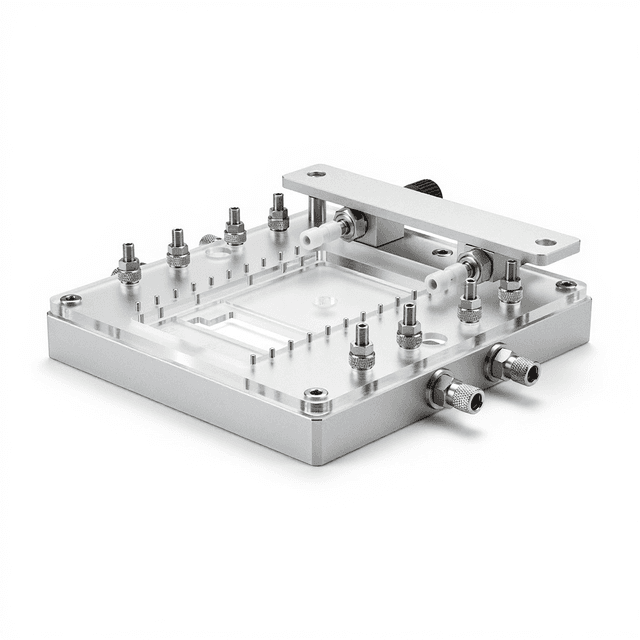
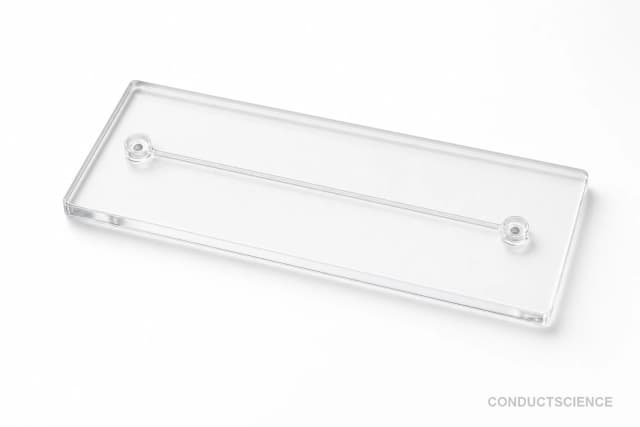
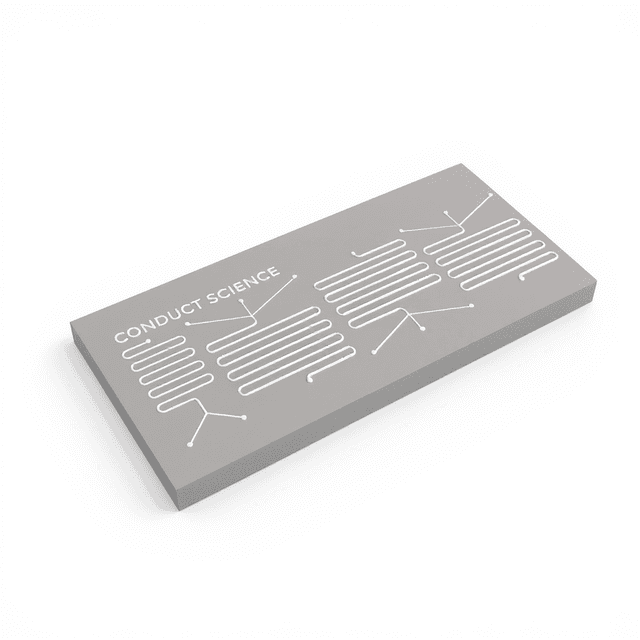
The Glass Laminar Flow Microfluidic Chip is a precision-engineered borosilicate glass device designed for controlled fluid manipulation at the microscale. Featuring dual inlet ports and a single outlet port, this chip enables precise laminar flow control across a 15 mm channel length with adjustable channel depths from 10-150 micrometers.
Manufactured using HF etching and hot press bonding techniques, the chip provides superior optical clarity and chemical resistance compared to polymer alternatives. The compact 22.5 x 15 x 4 mm form factor accommodates standard microscope stages while maintaining pressure resistance up to 10 bar and temperature stability from -15 to 150°C for diverse experimental conditions.
How It Works
The chip operates on the principle of laminar flow, where fluid streams flow in parallel layers without turbulent mixing. At the microscale, low Reynolds numbers (typically <1) ensure predictable flow patterns governed by viscous forces rather than inertial effects. The dual inlet design allows two distinct fluid streams to enter the channel and flow side-by-side, with mixing occurring only through molecular diffusion across the interface.
The borosilicate glass construction provides excellent optical properties for real-time visualization and fluorescence microscopy. Channel depths from 10-150 micrometers can be selected based on application requirements, with shallower channels providing faster diffusion times and deeper channels accommodating larger particles or cells. Flow rates are controlled through applied pressure differentials, with the chip rated for pressures up to 10 bar.
The HF etching fabrication process creates smooth channel walls with minimal surface roughness, reducing particle adhesion and enabling predictable flow profiles. Hot press bonding ensures hermetic sealing between glass layers while maintaining optical clarity throughout the device.
Features & Benefits
Pack Size
- 5-Pack
- 10-Pack
- 25-Pack
Weight
- 0.05 kg
Dimensions
- L: 22.5 mm
- W: 15.0 mm
- H: 4.0 mm
Comparison Guide
| Feature | This Product | Typical Alternative | Advantage |
|---|---|---|---|
| Material Construction | Borosilicate glass with HF etching fabrication | Polymer devices often use PDMS or thermoplastics with molding processes | Provides superior chemical resistance and optical clarity for demanding applications requiring harsh solvents or high-resolution imaging |
| Channel Depth Options | Adjustable from 10-150 μm | Fixed-depth devices typically offer single geometry options | Enables optimization of mixing characteristics and particle accommodation without requiring multiple device purchases |
| Pressure Rating | 10 bar maximum pressure | Polymer devices commonly limited to lower pressures | Supports high-throughput applications and integration with pressurized fluid handling systems |
| Temperature Range | -15 to 150°C operational range | Polymer alternatives often limited to narrower temperature windows | Accommodates thermal cycling experiments and extreme temperature protocols without device degradation |
| Optical Properties | Borosilicate glass with minimal autofluorescence | Some materials exhibit background fluorescence or optical distortion | Enables sensitive fluorescence measurements and high-resolution microscopy without interference |
| Channel Surface Quality | HF etching creates smooth channel walls | Molded devices may have surface roughness or demolding artifacts | Reduces particle adhesion and ensures predictable flow profiles for consistent experimental results |
This glass microfluidic chip offers exceptional chemical resistance, optical clarity, and pressure tolerance through borosilicate glass construction. The adjustable channel depth and dual inlet design provide versatility for various laminar flow applications, while the precision fabrication ensures reproducible performance across temperature and pressure ranges.
Practical Tips
Pre-condition channels with experimental buffer for 5-10 minutes before introducing samples to ensure stable surface chemistry.
Why: Surface equilibration prevents adsorption artifacts and maintains consistent flow characteristics throughout the experiment.
Clean channels immediately after use with appropriate solvent followed by deionized water rinse and air drying.
Why: Prompt cleaning prevents protein or particle fouling that could alter channel dimensions or surface properties.
Verify flow rates using fluorescent tracers or particle tracking before each experimental session.
Why: Flow rate verification ensures laminar flow profiles match experimental requirements and detects any blockages or leaks.
If laminar streams mix prematurely, check for air bubbles, pressure fluctuations, or channel contamination.
Why: Premature mixing typically indicates flow instabilities that compromise experimental control and reproducibility.
Allow sufficient equilibration time after flow changes before data collection to ensure steady-state conditions.
Why: Flow transients can create artifacts in measurements, particularly in gradient-sensitive applications or kinetic studies.
Handle glass chips carefully and inspect for cracks before pressurization, especially after temperature cycling.
Why: Glass fracture under pressure can cause injury and sample contamination, particularly when using organic solvents or heated solutions.
Use consistent inlet tubing lengths and diameters to maintain symmetric flow resistance between channels.
Why: Asymmetric flow resistance creates uneven flow rates that shift the laminar interface position and affect mixing profiles.
Store chips in protective cases and avoid contact between channel surfaces and hard materials.
Why: Surface scratches can disrupt laminar flow patterns and create nucleation sites for bubble formation or particle adhesion.
Setup Guide
What’s in the Box
- Glass laminar flow microfluidic chip
- Protective storage case (typical)
- User manual and specifications sheet (typical)
- Quality control certificate (typical)
Warranty
ConductScience provides a standard 1-year manufacturer warranty covering defects in materials and workmanship. Technical support includes application guidance and troubleshooting assistance for optimal experimental results.
Compliance
References
Background reading relevant to this product:
What flow rates can this chip accommodate?
Flow rates depend on channel depth selection and applied pressure. With the 10 bar pressure rating, typical flow rates range from nL/min to μL/min scales. Consult product datasheet for specific flow rate curves at different channel geometries.
How do I select the appropriate channel depth for my application?
Shallow channels (10-50 μm) provide faster mixing through shorter diffusion distances, while deeper channels (100-150 μm) accommodate larger particles or cells. Consider your particle size, desired mixing time, and visualization requirements.
Is this chip compatible with organic solvents?
The borosilicate glass construction provides excellent chemical resistance to most organic solvents, acids, and bases. However, avoid hydrofluoric acid and strong alkaline solutions at elevated temperatures.
Can I reuse the chip between experiments?
Yes, the glass construction allows for cleaning and reuse. Flush thoroughly with appropriate solvents followed by deionized water. Inspect channels for residue or damage before reuse.
What microscopy techniques are compatible?
The optical clarity supports brightfield, phase contrast, fluorescence, and confocal microscopy. The thin glass construction minimizes optical distortion for high-resolution imaging.
How stable is the laminar flow interface?
Interface stability depends on flow rate ratio, fluid viscosity, and channel geometry. Maintain consistent pressures and avoid perturbations in the fluidic system for stable interfaces.
What tubing connections are recommended?
Use PEEK or PTFE tubing with appropriate fittings for the inlet/outlet ports. Ensure connections are leak-free as any pressure loss will affect flow profiles.
Can this chip handle cell suspensions?
Yes, with appropriate channel depth selection (typically >50 μm for mammalian cells). Ensure cell viability by minimizing shear stress through controlled flow rates and considering cell settling.
Have a question about this product?
Upgrade Options