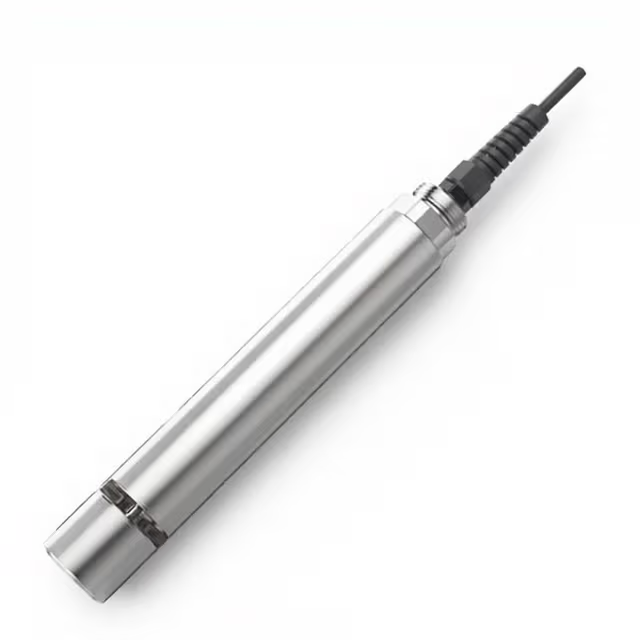
Industrial Fluorescence Dissolved Oxygen Sensor
Membrane-free fluorescence dissolved oxygen sensor providing 0-20.00 mg/L measurement range with ±1% accuracy and RS485/MODBUS digital interface for industrial water quality monitoring applications.

Louise Corscadden, PhD
Director of Science · ConductScience
Ask Louise about Industrial Fluorescence Dissolved Oxygen Sensor fit, setup, configuration, or quote prep.
Already working with us? Sign in to connect this with My Scientist.
Key Specifications
Full details →- Model fit
- Configured during quote
- SKU family
- LH-WQ-0011
- Shipping box
- 19.0 x 22.0 x 17.0 cm
- Ordering
- Online checkout and quote request available
- Category
- Industrial Sensors
- Build notes
- Confirm accessories, station layout, and support needs before purchase
The Industrial Fluorescence Dissolved Oxygen Sensor utilizes fluorescence quenching technology to provide accurate, real-time measurement of dissolved oxygen concentrations in aqueous solutions. This membrane-free sensor operates on the principle that oxygen molecules quench the fluorescence emission of a ruthenium-based probe, with the degree of quenching directly proportional to oxygen concentration. The sensor measures dissolved oxygen across a range of 0-20.00 mg/L with ±1% full-scale accuracy and 0.01 mg/L resolution.
The sensor incorporates a DS18B20 digital temperature sensor for automatic temperature compensation, ensuring measurement accuracy across varying thermal conditions. Digital communication is facilitated through RS485/MODBUS interface, enabling integration with industrial monitoring systems and data acquisition platforms. The fluorescence-based measurement principle eliminates the need for consumable electrolytes or replaceable membranes, reducing maintenance requirements compared to traditional Clark-type electrodes.
How It Works
The sensor operates on the principle of fluorescence quenching, where oxygen molecules interact with a ruthenium-based fluorophore immobilized within the sensor head. When excited by blue light, the fluorophore emits red light with an intensity inversely proportional to the dissolved oxygen concentration. Oxygen molecules act as dynamic quenchers, colliding with excited fluorophore molecules and dissipating their energy non-radiatively, thereby reducing the fluorescence signal.
The relationship between oxygen concentration and fluorescence intensity follows the Stern-Volmer equation, allowing for precise quantification across the 0-20.00 mg/L measurement range. Temperature compensation is achieved through the integrated DS18B20 digital sensor, which automatically corrects for temperature-dependent changes in oxygen solubility and fluorophore quantum yield. The membrane-free design eliminates diffusion barriers and drift associated with traditional electrochemical sensors, while the absence of consumable electrolytes ensures long-term stability.
Digital signal processing converts the optical measurements to standardized dissolved oxygen units, with data transmitted via RS485/MODBUS protocol for integration with monitoring systems. The sensor provides both concentration (mg/L) and saturation percentage outputs, referenced to air-saturated water at the measured temperature.
Features & Benefits
Measuring Range (DO)
- 0-20.00 mg/L
Measuring Range (Saturation)
- 0-200% air saturation
Measurement Principle
- Fluorescence quenching (no membrane, no electrolyte)
Temperature Compensation
- DS18B20 digital sensor
Digital Interface
- RS485 / MODBUS
Automation Level
- semi-automated
Brand
- ConductScience
Accuracy
- 0.01 mg/L
Temperature Range
- 0-40 C
Research Domain
- Analytical Chemistry
- Environmental Monitoring
- Food Science
- Industrial Hygiene
- Microbiology
- Pharmaceutical QC
Shipping weight
- 1.0 lb
Shipping box
- L: 19.0 cm
- W: 22.0 cm
- H: 17.0 cm
| Feature | This Product | Typical Alternative | Advantage |
|---|---|---|---|
| Measurement Principle | Fluorescence quenching (no membrane, no electrolyte) | Many alternatives use Clark electrode technology requiring replaceable membranes and electrolyte solutions | Eliminates consumable components and reduces maintenance requirements while improving long-term measurement stability. |
| Measurement Range | 0-20.00 mg/L with 0.01 mg/L resolution | Entry-level models often provide lower resolution or narrower measurement ranges | Comprehensive range covers anoxic to supersaturated conditions with high-precision resolution for process control applications. |
| Temperature Compensation | DS18B20 digital sensor with automatic compensation | Basic models may rely on manual temperature correction or analog temperature sensing | Digital temperature sensing provides accurate automatic compensation across the full 0-40°C operating range. |
| Digital Interface | RS485/MODBUS protocol | Lower-cost alternatives often provide only analog 4-20mA outputs | Standardized digital communication enables advanced system integration and remote monitoring capabilities. |
| Accuracy Specification | ±1% full-scale accuracy | Standard sensors typically offer ±2-5% accuracy specifications | High precision measurement supports demanding analytical applications and regulatory monitoring requirements. |
| Dual Output Format | Both mg/L concentration and % saturation outputs | Many sensors provide single output format only | Flexibility to display concentration or temperature-normalized saturation values depending on application requirements. |
This sensor combines advanced fluorescence measurement technology with industrial-grade digital communication and precision temperature compensation. The membrane-free design and ±1% accuracy specification position it as a high-performance solution for critical dissolved oxygen monitoring applications.
Practical Tips
Perform two-point calibration using air-saturated distilled water at measurement temperature and sodium sulfite solution for zero oxygen standard.
Why: Two-point calibration accounts for both sensor sensitivity and zero offset, ensuring accuracy across the full measurement range.
Clean sensor head monthly with soft brush and distilled water to remove biofilm or mineral deposits that could affect optical measurements.
Why: Optical interference from surface deposits can cause measurement drift and reduced accuracy over time.
Ensure adequate water flow around the sensor head (minimum 0.3 m/s) to prevent stratification and achieve representative measurements.
Why: Stagnant conditions can create localized oxygen depletion or accumulation that doesn't reflect bulk water conditions.
If readings appear unstable, check for air bubbles on sensor head and verify temperature compensation is functioning properly.
Why: Air bubbles create optical interference while temperature compensation errors cause systematic measurement bias.
Log both dissolved oxygen and temperature data simultaneously to identify temperature-related measurement artifacts or calibration drift.
Why: Temperature trending helps distinguish between actual oxygen changes and sensor-related measurement issues.
Ensure proper electrical grounding and use appropriate ingress protection when installing in wet or outdoor environments.
Why: Electrical safety is critical for sensors operating in conductive water environments to prevent shock hazards and equipment damage.
Verify calibration more frequently in high-fouling environments or when measuring in chemically challenging matrices.
Why: Harsh conditions can accelerate sensor drift and require more frequent calibration to maintain measurement accuracy.
Allow 15-minute stabilization period after power-up or significant temperature changes before recording critical measurements.
Why: Thermal equilibration ensures the temperature compensation system provides accurate corrections for stable measurements.
Setup Guide
What’s in the Box
- Industrial fluorescence dissolved oxygen sensor (typical)
- Mounting hardware and brackets (typical)
- RS485 communication cable (typical)
- Power supply adapter (typical)
- User manual and calibration certificate (typical)
- Configuration software or documentation (typical)
Warranty
ConductScience provides a standard one-year manufacturer warranty covering defects in materials and workmanship, with technical support available for installation and operational guidance.
Compliance
References
Background reading relevant to this product:
How does the fluorescence quenching method compare to traditional Clark electrode sensors?
Fluorescence quenching eliminates consumable membranes and electrolytes, reducing maintenance requirements and drift. The method is less susceptible to fouling and provides more stable long-term performance, though initial cost may be higher than electrochemical sensors.
What calibration procedures are required for accurate measurements?
Calibration typically involves two-point calibration using air-saturated water (100% saturation) and oxygen-free water (0% saturation). Frequency depends on application requirements but monthly verification is recommended for critical measurements.
Can the sensor operate in high-turbidity or chemically challenging water matrices?
The membrane-free design reduces fouling compared to covered sensors, but optical measurements can be affected by high turbidity or interfering fluorescent compounds. Consult product datasheet for specific interference information.
What is the typical response time for dissolved oxygen measurements?
Response time depends on temperature, flow conditions, and concentration change magnitude. Consult product datasheet for specific response time specifications under various operating conditions.
How accurate is the temperature compensation across the 0-40°C range?
The DS18B20 digital sensor provides ±0.5°C temperature accuracy. Combined with algorithmic compensation for oxygen solubility and fluorophore temperature effects, overall accuracy remains within ±1% full-scale across the operating range.
Can multiple sensors be networked on the same RS485 bus?
Yes, RS485 supports multi-drop configurations with up to 32 devices per bus. Each sensor requires a unique MODBUS address for network communication and data acquisition.
What power requirements does the sensor have?
Power specifications should be confirmed from the product datasheet. Most industrial dissolved oxygen sensors operate on 12-24V DC supply with current consumption varying based on measurement frequency and communication activity.
How does the sensor perform in continuous versus intermittent monitoring applications?
The fluorescence method is well-suited for continuous monitoring with minimal drift. For intermittent measurements, allow adequate warm-up time and verify calibration more frequently to maintain measurement accuracy.
Have a question about this product?
Have a question? Just ask.
Send it over and we'll email you a personalized answer — no call, no scheduling.
Prefer to talk it through?
Accessories
Enhance your setup with compatible accessories
Frequently Bought Together